


Inhibition. - Definition. - Dynamogenesis. Part 3
Description
This section is from the book "Treatment By Hypnotism And Suggestion Or Psycho-Therapeutics", by Charles Lloyd Tuckey. Also available from Amazon: Treatment By Hypnotism And Suggestion, Or Psycho-Therapeutics.
Inhibition. - Definition. - Dynamogenesis. Part 3
Brown-Sequard quotes the experiments of Fleming and Augustus Waller, showing how simultaneous pressure on the cervical sympathetic, the pneumogastric, and the carotid determines sleep. He supposes that these procedures act as peripheral irritations which are carried to a certain point - situated, probably, at the base of the brain - and that from this point proceed inhibitory impulses which affect the functioning of the different centres (Archives de Physiologie, January, 1889).
† This effect is taken advantage of by some of the Indian tribes. If a man is suspected of a crime he is given rice to chew, and told to spit it out. The guilty person is so affected by terror that the rice is reduced to a fine dry powder, in consequence of the absence of saliva, Tarchanoff gives some interesting examples of inhibitory action, and the following are selected from his book:
If the posterior limbs of a frog be plunged into a weak acid solution, the animal will withdraw them at once; but if at the same time the middle region of its brain be stimulated by an electric current or by a solution of salt, the movement does not take place, because the reflex movements have been inhibited by the action induced in the brain.
If a section of the upper part of the spinal cord of a frog be removed, and the remaining portion be connected with the brain by a circuit in which a galvanometer is placed, the needle will be observed to oscillate periodically from the passage through the circuit of nerve impulses proceeding from the bulbar centres, and this movement will continue for some time; but if a nerve in connection with the cord be irritated, it will be found that the needle will become motionless as long as the irritation is kept up. We here see that nervous action can be inhibited in the brain centres by peripheral stimulation, just as in the previous example reflex action was arrested by acting on the cerebral centres.
Tarchanoff argues that external sensory impressions act as inhibitory or moderating influences on the nervous centres of the brain, and that in hypnosis, as there is an absence of these impressions, the phenomena of excitation of the centres are no longer counterpoised, and are, therefore, in the ascendant. To support this view he instances an experiment he has made on a young dog. He exposed the motor area of the cerebrum, and stimulated it to action by applying an electric current. This procedure was found to excite localized movement, according to the zone experimented on; but when he held a piece of meat to the animal's nose, he found the movements ceased; i.e., the excitation of the centres of smell and sight produced an inhibitory action on the motor centres. To enforce the same theory, he quotes an experiment performed on dogs by Heidenhain and Boubnoff. They find that when dogs are poisoned by morphia, so that ordinary external impressions cease to act upon the brain, irritation of the motor zones produces strong tonic contractions, which continue after the excitation has ceased; but if other parts of the grey matter be gently stimulated, the contractions at once cease; and the same effect is observed if the senses of sight, hearing, smell, or touch be peripherally excited.
He draws an analogy between the morphinized dog and the hypnotized subject, and seeks to show how in the latter case hyperexcitability of the muscular system and senses exists, in consequence of the absence of many-sided impressions from the closure of all the avenues of sense, except those specially excited.
whilst if innocent it is ejected as pulp. But the function of the salivary glands can be influenced mechanically, in the same way as that of the heart. Take the submaxillary gland. It is supplied with vaso-motor nerves, which keep its vessels moderately contracted when food is not being taken. A branch of the chorda tympani nerve seems to act as inhibitory nerve of the vaso-constrictor fibres of the vessels supplying the gland, and irritation of it has the effect of causing dilatation of the vessels, with consequent increased afflux of blood and increased functional activity - i.e., increased flow of saliva.
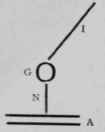
The accompanying diagram shows how inhibitory action affects the calibre of an artery, and consequently the blood-supply of a part. G is a nerve ganglion connected with the artery A, through a nerve N, and I is a centrifugal nerve derived from an inhibitory centre. Under ordinary circumstances G is constantly acting on A as a vaso-con-strictor, and keeps its walls moderately contracted. When, however, an inhibitory impulse arrives at G through I, the action of G is arrested and restrained, and the vessel A is free to dilate.
Lauder Brunton thinks inhibition of secretion may result either from interference with the supply of blood to an organ, with consequent cramp of the arterioles and local anaemia, or from direct action of inhibitor)' nerves on motor cells without any changes occurring in the vessels.
Brown-Sequard supposes that where on the one hand there is an inhibitory influence at work, there is also present on the other hand its antithesis - dynamogenesis. Nervous force cannot, any more than other forms of energy, be created; it can only be transformed and made to act in altered combinations and different directions.
Thus Beaunis says that every nervous excitation determines in the excited nervous substance two contrary modifications, an impulsion towards activity and a tendency to inhibition. Similarly Lauder Brunton considers that inhibition is the opposite phase to stimulation, that both depend on excitation, and that the resulting condition depends upon the force with which and the direction from which their mutual interference acts.
It has been generally held that inhibition is the property of special nerve centres situated in the brain and spinal cord, from which proceed nervous discharges of an inhibitory nature, in the same way as from motor centres proceed motor impulses. It is proved that the higher centres of the brain exercise an inhibitory action on those below them, and that these, again, control the next below them, and so on. Reflex action increases in proportion to the removal of the control of the higher centres, not only in the brain but also in the cord, for when the cord is removed in segments we find the excitability of the segment below increases with the removal of the one above. So the activity of the lower cerebral centres will become more apparent in proportion to the removal of the control of the higher.
Continue to:


My Books

