


Acacia Catechu, Linn. Sans
Description
This section is from the book "The Materia Medica Of The Hindus", by Udoy Chand Dutt. Also available from Amazon: The Materia Medica Of The Hindus.
Acacia Catechu, Linn. Sans

Khadira. Vern. Kat, Hind. Khaer, Beng.
Khadira or catechu is obtained by boiling the wood of Acacia catechu in water and inspissating the decoction. The Bhavaprakasa mentions two varieties of catechu, namely, khadira or the ordinary dark brown catechu, and kadara or pale catechu. This last is known as pάpri khaer, or catechu having a laminated structure. Fluckiger and Hanbury thus describe the preparation of pale catechu in Northern India. "Instead of evaporating the decoction to the con-dition of an extract, the inspissation is stopped at a certain point and the liquor allowed to cool, "coagulate," and crystallize over twigs and leaves thrown into the pots for the purpose."3 Pale catechu is a porous, opaque, earthy looking substance with a laminated texture, light and easily broken.
The chief use of catechu in India, is as an ingredient of the packet of betle leaf chewed by the natives. For this purpose it is sometimes aromatized in various ways. The packets of betle

3 Pharmacographia, page 250, leaf sold in all the Indian bazars under the name of golάbi khili, are prepared with catechu dissolved in rose water. Again, catechu is softened with the addition of water, and mixed with powdered spices, such as cardamoms, nutmeg, cloves, etc., the mixture is enclosed within the fragrant floral leaves of Pandanus odoratissimus (ketaki), and dried. The leaves adhere to the catechu, which is cut into small pieces suitable for use with the betle leaf.
Catechu is described as astringent, cooling, digestive, and useful in hoarseness, diseases of the mouth and gums, cough and skin diseases. In diarrhoea it is sometimes used in combination with other medicines of its class, as for example in a prescription in the Bhaisajya Ratnavali, called Grahani kapάta rasa, which contains catechu along with a large number of other drugs, but it is not regarded as an important medicine for this disease.
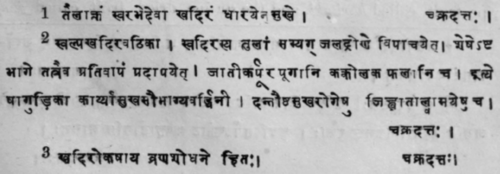
In hoarseness, catechu rubbed with oil, is recommended to be kept in the mouth.1 In diseases of the mouth and gums the following called Svalpakhadira vatikά is a favourite medicine. To prepare it, take of catechu twelve seers and a half, water sixty-four seers, boil down to eight seers, then add nutmeg, camphor, betle-nuts and kakkola, each half a 3eer in fine powder, and prepare a mass fit for being made into balls or boluses. They are directed to be kept in the mouth, in affections of the teeth, gums, palate and tongue.2
In skin diseases, catechu is much used in a variety of forms both externally and internally. A decoction of catechu is used as a wash for inflamed parts and ulcers.3 Water in which catechu is dissolved is recommended to be used as a drink, wash and bath. The following decoction called khadirάshtaka is prescribed by several writers for internal use in boils, prurigo, measles and other skin diseases.1 Take of catechu, the three myrobalans, nim bark, leaves of Trichosanthes dioiea (patala), gulancha and Justicia Adhatoda (vάsaka), equal parts, and prepare a decoction in the usual way Sarangadhara describes a fermented liquor called khadirάrishta for use in skin diseases. It is prepared with catechu and the wood of pinns Deodara, and some other ingredients in smaller proportions.2
Continue to:


My Books

