


Products Of Fermenation And Distillation
Description
This section is from the book "The Materia Medica Of The Hindus", by Udoy Chand Dutt. Also available from Amazon: The Materia Medica Of The Hindus.
Products Of Fermenation And Distillation
Wines And Spirits. All fermented and distilled liquors causing intoxication, are called Madya or Madird in Sanskrit. The following varieties are mentioned by the later writers.

Mάddhika, or spirit distilled from grapes.

Khάrjura, do.
do.
dates.

Gaudi, do.
do.
treacle.

Sidhu, do.
do.
sugar-cane juice.

Surά, do.
do.
rice.

Kohala, do.
do.
barley.

Madhulikά, do.
do.
wheat.

Paishti, do.
do.
from different sorts of grain
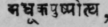
Madhuka pushpottha, do. do. the flowers of Bassia latifolia and treacle.

Jάmbava, do.
do.
ripe fruits of Eugenia Jambolana.

Kάdambari, do.
do.
Flowers of Anthocephalus Cadamba.

Valkali, do.
do.
belleric myrobalan and treacle.

Vάruni is the fermented juice of the palm and date trees.

Some of these spirituous liquors have several varieties. Thus two varieties of sidhu are mentioned, namely, that produced from boiled sugar-cane juice and that from the unboiled juice. The liquor distilled from rice receives different names according to its consistence. The clear transparent fluid which floats on the top is called prasannά; that below it, is called kάdambari; jagala is a thicker fluid than kάdambari; medaka in the thickest and weakest of all. The forms of medicated spirituous liquors have been already described in the introduction, (see page 31).
Spirituous liquors are described as stimulant, sedative, agreeable, heating, intoxicating, digestive and nourishing. They are easily assimilated but injurious to health in hot climates. New wine is disagreeable to the taste and smell, unpleasant in its effects, not easily assimilated, laxative, heating and injurious to health. Old wine is agreeable, light and appetizing. It promotes the circulation of the fluids in the vessels and renders the senses acute. In amiable and virtuous men, wine promotes mirth and a desire for musical entertainments. In passionate men it gives rise to rashness and evil actions. Used at the proper season, in proper doses and with suitable food, wine acts like nectar. If taken to excess it induces a host of diseases. Medicinally, spirituous liquors are said to be useful in emaciation, debility, anaemia, urinary diseases, dyspepsia, chronic bowel complaints, chronic fever, deficient secretion of milk, etc.
A mixture of ginger, cumin seeds, treacle, wine and warm water is given in ague with prolonged cold stage.1 In chronio intermittent fever with debility, spirit distilled from rice, together with the flesh of fowls is recommended to be given as diet by most writers, but their advice is not followed in the present day. Several preparations of spirit distilled from treacle with the addition of various medicinal and aromatic substances are used in different diseases. The following is an example.
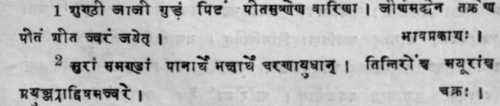
Mritasanjivani sura.I Take of new treacle eight hundred tolas and steep it in thirty times its weight of water. Add to the mixture the following substances in the form of a paste, namely, ginger sixteen tolas, bark of Acacia Arabica two seers, of Ziziphus Jujuba (kola) two seers, of Symplocos racemosa (lodkra) half a seer, betle-nuts as many as desired; stir in a large earthen vessel, and keep the mixture for twenty days in a covered jar. After this period remove the fermented fluid to a distilling apparatus, and add to it, the following aromatic substances, namely, betle-nuts, cloves, sandal wood, cumin seeds, ajowan, black pepper, ginger, nutmegs, cardamoms, cinnamon, tejapatra leaves, fennel seeds, nigella seeds, the fragrant substances called elavaluka, padma-kash-tha and granthiparni, devadaru wood, khas khas root, zedoary root, jatamansi root and the tubers of Cyperus rotundus (mustaka), each eight tolas, in coarse powder, and distil. This distilled liquor is used as a tonic, astringent and invigorating drink.

The
Continue to:


My Books

