


The Analgesic Antipyretics. Part 3
Description
This section is from the book "Materia Medica: Pharmacology: Therapeutics Prescription Writing For Students and Practitioners", by Walter A. Bastedo. Also available from Amazon: Materia Medica: Pharmacology: Therapeutics: Prescription Writing for Students and Practitioners.
The Analgesic Antipyretics. Part 3
That they act through the centers is shown by their failure to affect the temperature in health, by their failure to reduce temperature if the spinal cord is severed, and by the fact that there is no attempt on the part of the body, as the temperature falls, to manufacture more heat by shivering, etc., as occurs when the temperature is reduced by external cold (cold baths, etc.). The lowering of temperature by these drugs may be accompanied by profuse sweating, but this is a result of the action upon the centers,
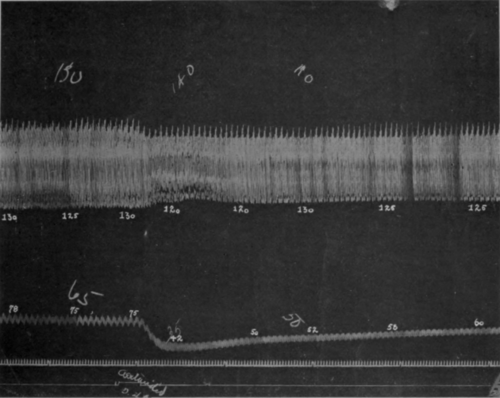
Fig. 58. - Acetanilid, 0.4 mg. per kilo. Ventricle (upper tracing) shows increased tonicity and diminished contractility (down-stroke, systole). Arterial pressure, lower tracing, falls from 75 to 42 mm. The pulse-rate drops from 130 to 120. (Tracing made by Dr. C. C. Lieb.)
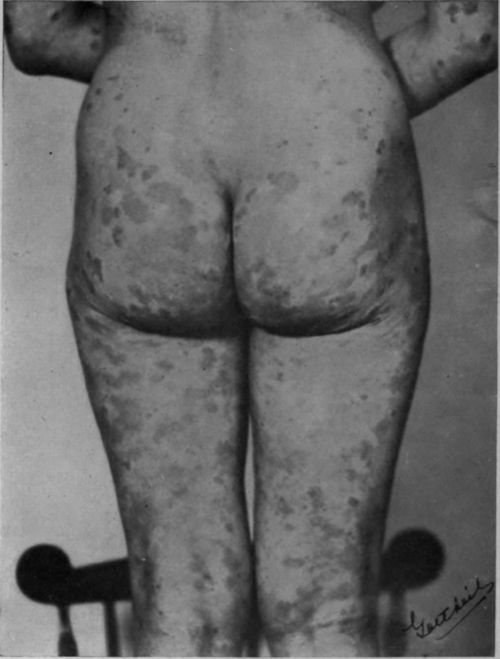
Fig. 59. - Urticarial eruption following antipyrine (W. S. Gottheil in Archives of and they are still antipyretic if the sweating is prevented by atropine. Occasionally, as the result of their action, the centers reassert themselves too strongly, overshoot the mark, and carry the temperature away below the normal. In some cases this results in collapse.
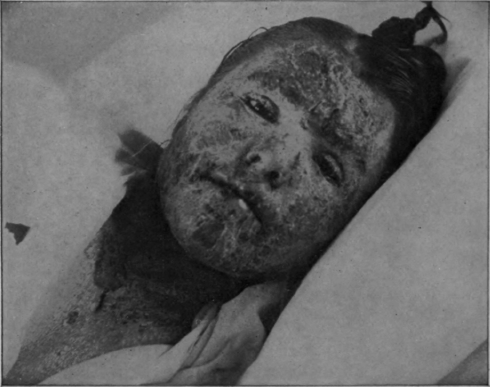
Fig. 60. - Exfoliative dermatitis following the administration of large doses of antipyrine. Hair and nails shed (Schamberg).
Schutze has shown that antipyrine does not prevent the formation of antitoxins in the body, so it does not interfere with the natural forces of protection against disease, except as fever is beneficial.
The other parts of the nervous system are also affected practically alike by these three drugs.
Cerebrum
This is somewhat depressed, all three remedies being useful in overcoming nervous irritability and restlessness. They have also a notable power in lessening pain, especially that from neuralgia or neuritis, or a lesion of the central nervous system. They are especially useful in headache. Head suggests the hypothesis that the analgesia is the result of an action on synapses in the pain-conveying tract in the thalamus adjacent to the heat center. Stekel believes that the action in headache is due to the regulation of the balance between heat production and heat loss. In migrainal headache, for example, he noted that there was diminished surface 'temperature, as noted in the axilla, though normal rectal temperature, and that after small doses of antipyrine the axillary temperature rose as much as one degree with the disappearance of the headache. Martin, Grace, and McGuire found a marked lowering of general electrocutaneous sensitiveness within one hour of mouth doses of acet-phenetidin, 5 to 15 grains (0.3-1 gm.).
These remedies are not strongly hypnotic, and do not produce somnolence if the patient is up and about; yet if taken at bedtime, they favor the onset and maintenance of normal sleep. The cerebral cortex, then, is partly depressed; yet even large doses seem to have very little depressing effect on the intellectual functions. This distinguishes them markedly from morphine, the bromides, and other central depressants. Phenacetin, being an ethyl compound, is more hypnotic than the others; antipyrine is the least hypnotic. But antipyrine is said to be more depressing to the motor areas, so that it has been used in epilepsy, chorea, and whooping-cough with more or less benefit.
The centers of the medulla are scarcely, if at all, affected. In poisoning, convulsions may occur, due probably to stimulation of the spinal cord centers, or perhaps to asphyxia.
Circulation
A number of cases of collapse following the use of antipyrine, acet-phenetidin, and acetanilid have been reported, so that these drugs have acquired a bad reputation as circulatory depressants. In experimental work the heart muscle is directly stimulated by ordinary doses, the beat being stronger and more rapid. But from large doses the muscle is weakened, and the beat may be slow and irregular, causing collapse. The skin vessels are dilated in fever, apparently as a result of the action of the heat-regulating centers.
The collapse action is most pronounced with acetanilid, and when it occurs from moderate doses, would seem to be due to idiosyncrasy. Nearly all the fatalities or cases of serious collapse from these drugs have come from very large doses taken in the form of proprietary headache and anti-pain remedies. Many of these cases have occurred from preparations containing caffeine, which is often added as a heart stimulant, and it has been shown by Worth Hale that they are more dangerous with caffeine than without, and less dangerous with sodium bicarbonate. Employed in proper dosage, these drugs are practically as safe as any other powerful depressants, but must be used with equal caution.

Acetanilid, NaHco3...

Acetanilid..

Acetanilid, caffeine, NaHco2..

Acetanilid, caffeine ...
Fig. 61. - Toxicity of acetanilid increased strikingly by caffeine, decreased by sodium bicarbonate. Experiments on mice by Worth Hale. The degree of toxicity is represented by the length of the bars.
Metabolism
Antipyrine and acet-phenetidin have probably no appreciable effect on the metabolism in health, as shown by the elimination of N, the absorption of O2, and the elimination of Co2. Acetanilid increases metabolism, as shown by an increase in the urea and total nitrogen of the urine.
In fever, in association with the reduction of the temperature, the metabolism is lessened.
Excretion is by the kidneys. Antipyrine appears n the urine either unchanged or as oxyantipyrine in combination with glycu-ronic and sulphuric acids. Acetanilid appears as para-amidophe-nol. Acet-phenetidin appears as phenetidin compounds.
Continue to:


My Books

