


Menthol - Mentholis - Menthol. U. S. P
Description
This section is from the book "A Text-Book Of Materia Medica, Pharmacology And Therapeutics", by George F. Butler. Also available from Amazon: A text-book of materia medica, pharmacology and therapeutics.
Menthol - Mentholis - Menthol. U. S. P
Definition. - A secondary alcohol, C6H9(CH3)(OH)(C3H7) 1:3 14, obtained from the oil of Mentha piperita L. or other peppermint oils.
Description and Properties. - Colorless, acicular, or prismatic crystals, having a strong and pure odor of peppermint and a warm, aromatic taste, followed by a sensation of cold when air is inhaled. Menthol is but slightly soluble in water, but imparts to the latter its odor and taste. It is freely soluble in alcohol, ether, chloroform, carbon disulphide, and glacial acetic acid. It is a saturated secondary alcohol, with the following formula:
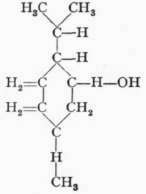
Dose. - 1/2-2 grains (0.03-0.12 Gm.) [I grain (0.065 Gm.1, U. S. P.].
Physiological Action and Therapeutics. - Externally and Locally. - Menthol is an antiseptic, antipruritic, analgesic, and anesthetic, as well as a germicide. It is used for the same purposes as oil of cloves. It is used extensively in headache, being rubbed on the forehead. Owing to its analgesic properties, it is used in the form of an ointment in various strengths for painful hemorrhoids, burns, boils, and superficial inflammations.
The oil of peppermint, or menthol, is an ingredient of many sprays and lotions for the treatment of diseases of the ear, nose, and throat.
As an antipruritic menthol is a valuable remedy to relieve the itching of eczema, pruritus, urticaria, etc. It should be dissolved in oil for this purpose - in severe cases 50 grains to 1 ounce (3.2 Gm. to 30.0 Cc).
Internally. - The uses of oil of peppermint are similar to those of other aromatic oils, it being a valuable carminative, stimulant, antifermentative, and antispasmodic. In small doses menthol has been given to allay nausea and vomiting and to relieve the pain of gastralgia.
Continue to:


My Books

