


Autograph Prescriptions
Description
This section is from the book "The Art Of Dispensing", by Peter MacEwan. See also: Calculation of Drug Dosages.
Autograph Prescriptions
The capability of pharmacists to decipher illegible caligraphy is so generally known as to be almost proverbial. It is a kind of expertness which they have acquired through long practice in reading the prescriptions of physicians. Their business requires this art; it has received official recognition by being made a part of the requirements of the qualifying examination, at which badly-written medical prescriptions have to be read by candidates, and teachers find it necessary to collect specimens of bad medical penmanship on behalf of their pupils.
The duty of the dispenser who has an illegible prescription presented to him has never been clearly defined; he has certainly a perfect right, legally, to refuse to compound a prescription which he cannot read; but it is believed that in the case of prescriptions which have previously been dispensed he is justified in doing his best. The best, however, may be a serious matter to the patient if it happens to be contrary to the intentions of the prescriber. It is far better for the dispenser that he should not risk his own reputation or the comfort of his customer by undertaking a task respecting which he is uncertain.
We print here examples of such prescriptions which have actually been dispensed. The study of these may afford assistance to any who have had little practice in deciphering bad writing. It is important to remember that in deciphering handwriting the peculiarities of the specimen should be picked out. These frequently give a clue to the whole thing, and once a writer's style has been grasped, difficulties in the future appear to vanish. This is the case with the following:

The above is a prescription of Dr. Cecil W. Hastings, 'a well-known bad writer,'remarked a correspondent of The Chemist and Druggist at the time the facsimile was first published. The most difficult point about it is the quantity of the second ingredient of the 'drops'; opinions are divided as to whether it should be mv. or 3ss. The former is, however, on the whole more in accordance with the writer's style, for, in the case of the other drachm signs, they are distinctly separated from the names of the ingredients, whereas the opposite is the case with the 'ol. menth. pip.' The translation is:
| 3ij. |
O1. menth. pip. ... . | m.v. |
Ol. olivae....................... | 3x |
 Benzol. .........
F. mist. Cap. gutt. xxx. t. die.
| g. iv. |
Pulv. Doveri ..... | Эij. |
Bism. Subnit | Эij. |
Ol. carui ........ | q.s. |
 Calomel
Misce. Ft. pil. xxiv. Cap. j. 2 horis.
The next specimen is much less obscure:

The quantity of liquor strychniae looks like 'mxiv., but this is not intended. Dr. Ward Cousins is the writer of this, and the rendering is:
| . miv. |
Quin. s. . | gr. j. |
Ac. phosph. dil. ..... | mx.. |
AEther. chlor....... | m XV. |
Syr. aurantii ...... | . 3ss. |
Aq........ | ad |
 Liq. strychnise .....
The subjoined prescription is an extremely carelessly written one, of the 'scrap of paper'class which cause numerous mistakes:
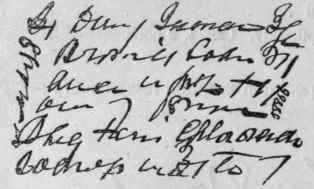
The peculiarity of this prescription lies in the contraction 'y'for 'every.' The proper rendering is:
| 3ss. |
Bromid. sodii . ............................. . | 3ij. |
Divid. in pulv. xij.................................... | |
One y 8hrs.................................. | |
|
|
20 drops in water y [8 hours]. |
 Disulph. quinae.......
 Liq. ferri chlorozidi...........................
The words in brackets are written along the left-hand side. A most misleading prescription is the following:
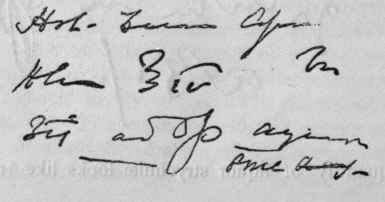
No fewer than eight different renderings of this have been given by experienced dispensers. It was rendered as follows by the pharmacist who sent it to The Chemist and Druggist:Haust. ferri aper. bis.
Alum.........
3ij. ad Oss. aquam (sic) once day.
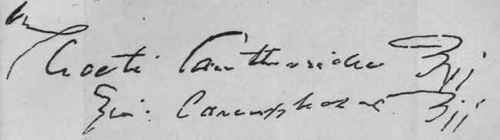
This last is a carelessly written prescription, the second ingredient being particularly obscure ; but after careful examination the dispenser will render it:
| 3vj. |
Spir. camphoræ ....................................... | 3ij. |
 Aceti cantharidis .....................................
This is correct. There is little in the writing to guide the dispenser, but it is highly unlikely that the writer would mean 'Lin. camphorae' (an oleaceous preparation) to be mixed with a vinegar.
This hitherto brief chapter has been so much valued by students that the opportunity of a new edition is taken to augment it considerably, and in order that the autographs may be used" as exercises the correct renderings are placed at the end of the chapter. There are also included copies of prescriptions by the late Daniel Hanbury, F.R.S., when he was a comparatively young man engaged in dispensing prescriptions. These are given as an object-lesson to apprentices and assistants, who too frequently are as careless in their caligraphy as are some medical practitioners. Medicine and pharmacy are sufficiently onerous occupations to merit the most careful attention to the writing of anything which has to do with the health or lives of our fellow-men.
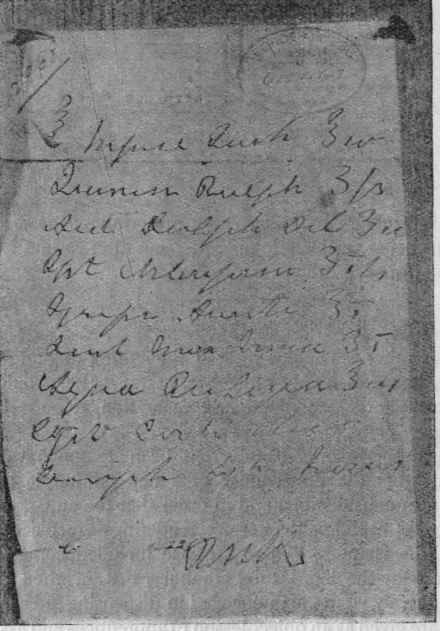
Prescription A.
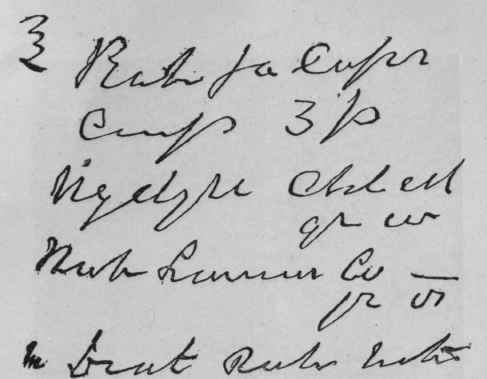
Prescription B.
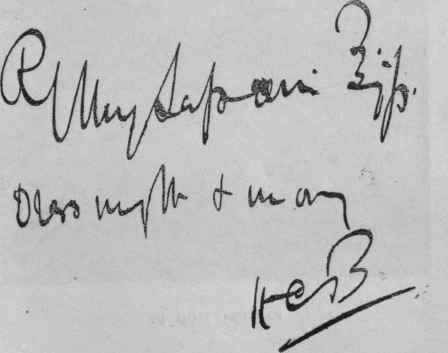
Prescription C.
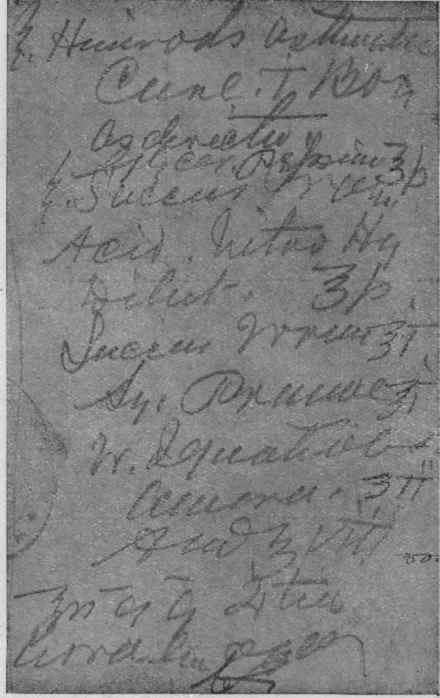
Prescription D.
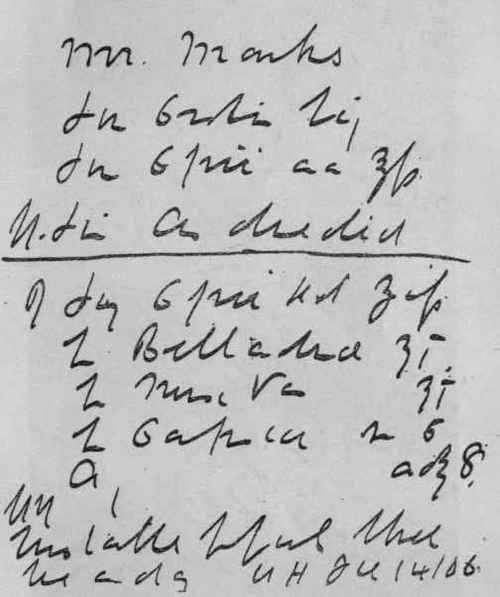
Prescription E.
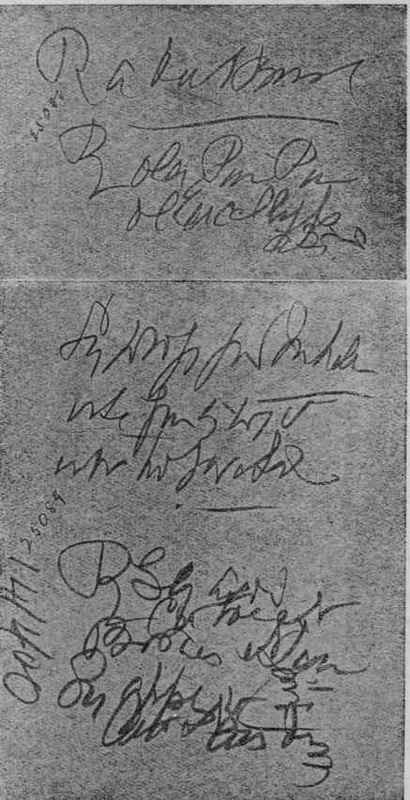
Prescription F.
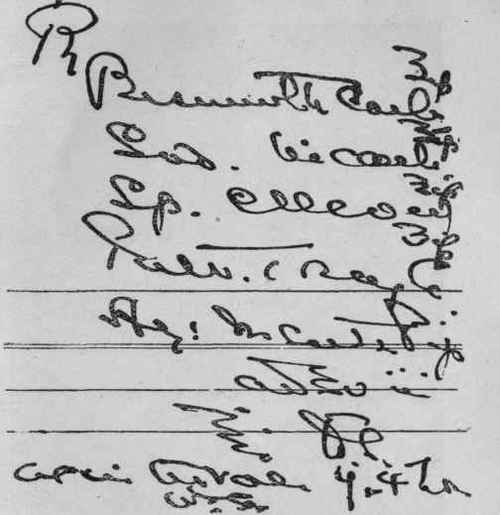
Prescription G.
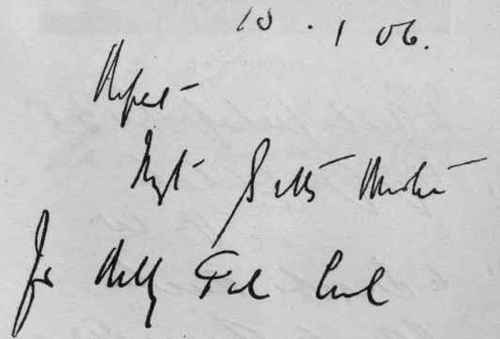
Prescription H.
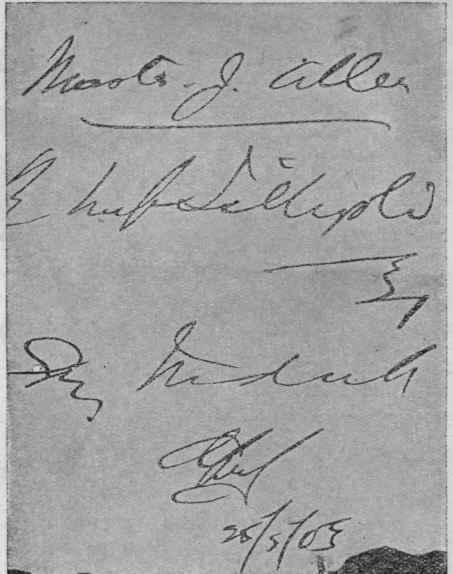
Prescription I.
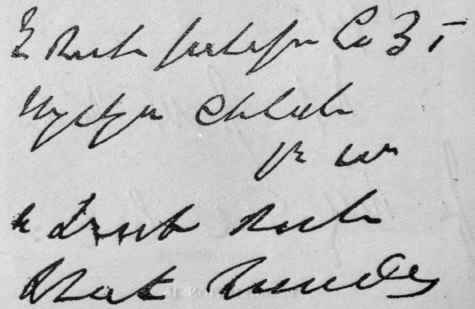
Prescription J.
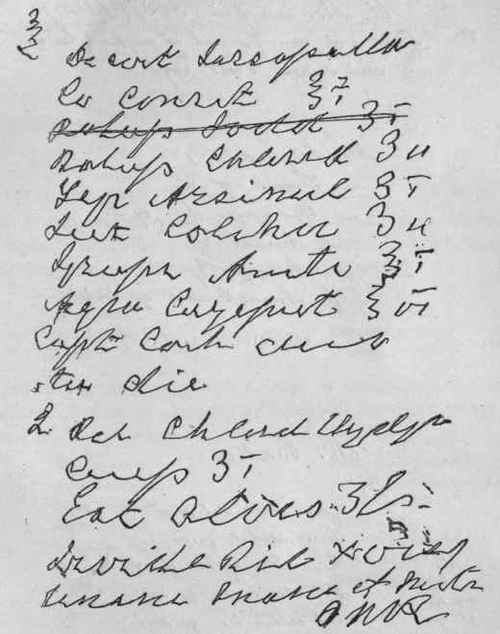
Prescription K.
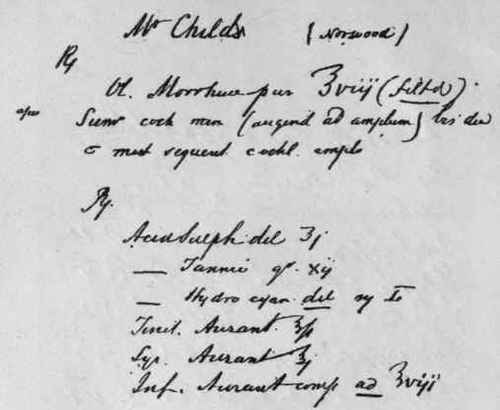
Prescription L.
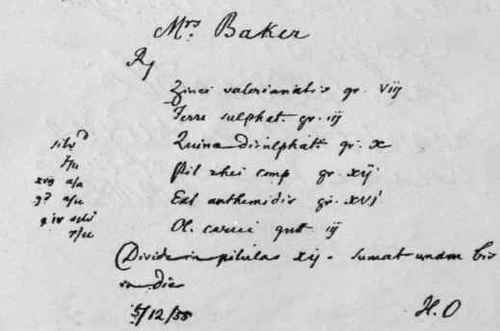
Prescription M.
Continue to:


My Books

