


Faradism, or Electro-Magnetism and Magneto-Electricity
Description
This section is from the "A Practical Treatise On Materia Medica And Therapeutics" book, by Roberts Bartholow. Also available from Amazon: A Practical Treatise On Materia Medica And Therapeutics
Faradism, or Electro-Magnetism and Magneto-Electricity
Faradism, so named in honor of Faraday, is induced electricity. When the galvanic current passes through the conjunctive wire of the elements of a cup, especially of a battery, it acquires new properties— acts on a magnetic needle, and exhibits the other properties of a magnet. When the conjunctive wire is extended into a coil, coated with insulating material, it will act on another coil in its neighborhood, as it does on a magnet. The former is called the primary or inducing coil, and the latter the secondary or induction coil. If the latter is connected with a galvanometer, it will be found that when a current traverses the primary coil, the needle of the galvanometer is at once deflected; but if the current continue to pass without any variations in the tension, the needle presently comes to rest. When the current is broken or interrupted, the needle is again deflected, but this time in the opposite direction. It follows, therefore, that the induced current only occurs at the opening and closing of the primary circuit: at the making or closing the circuit, in the opposite direction; and at the opening or breaking of the circuit, in the same direction. The induced or faradic current is therefore a to-and-fro current, instantaneous in duration. It is obvious from these considerations that in the construction of a faradic battery there must be a mechanical arrangement for interrupting the current in the primary circuit. The usual automatic interrupter is Neef's hammer, a vibratile steel spring worked by the magnetism of the soft-iron core. The best instruments are now provided with a simple mechanism to give slow interruptions, an important matter when muscles are to be exercised. In the purchase of a faradic instrument for medical purposes the device to effect the slow interruptions should not be overlooked.
The galvanic couplet for the primary coil is now almost always the zinc-carbon combination excited by bichromate solution.* The primary or inducing coil is made of thick wire and is much shorter than the secondary coil. In the interior of the primary coil is placed a bundle of wires, each one insulated and becoming a magnet when the current passes. This temporary magnet attracts the hammer of the vibrator, and on the instant the current is closed and opened again. The so-called primary current of the faradic battery is therefore something more than that coming from the galvanic couplet; it is re-enforced by the induction between the turns of the coil and by the magnetism of the soft-iron core.
* The bichromate solution is prepared as follows: Dissolve one ounce of bichromate of potassium in eighteen ounces of hot water in an earthenware vessel. Let it cool, and when cold add two fluid ounces of sulphuric acid, and two drachms of nitric acid. It should not be used until cold, and it is, therefore, preferable to keep it on hand.

Fig. 11. Ruhmkorff Coil.
The coil of induction, or the secondary coil, is made of long and fine wire; the longer and finer, the more intense the current. The Ruhmkorff coil, which is composed of miles of very fine wire, furnishes a brilliant spark sometimes several inches in length (Fig. 11).
Electro-magnetism is the title of that mode of the force induced by the action of a galvanic current on a bundle of wires within an insulated coil; in other words, it is the ordinary faradic battery, excited by a galvanic couplet (Fig. 12). Magneto-electricity, on the other hand, is that mode of the force induced by the action of a permanent magnet. If we substitute for the cell a strong permanent magnet, we learn that, on the approach or withdrawal of the magnet from a coil of insulated wire, a current of electricity is induced in the coil: on the approach of the magnet, in one direction; on its withdrawal, in the opposite direction (Fig. 13). Thus an instantaneous to-and-fro current may be caused by the action of a magnet, just as by the action of a galvanic current. Out of this principle has developed the magneto-electric machine, which consists of the permanent magnets, insulated coils made to revolve about the poles, and a mechanical arrangement for obtaining regular revolutions, and making and breaking the circuit. Thus, by mechanical power, the same results are produced as by chemical action (Fig. 14).
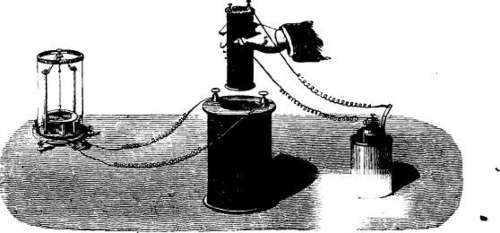
Fig. 12.
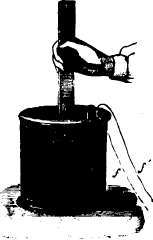
Fig. 13.
The discovery of a simple commutator, by which the currents can be collected and sent in one direction, has quite revolutionized the utility of this form of battery. It is now applicable to electric decomposition (electrolysis), to electric heating (galvano-causty), and electric lighting. Indeed, with the general use of electricity furnished by the "dynamo-machines" as a motive power, it is probable that the force in this form will be successfully applied to medical purposes.
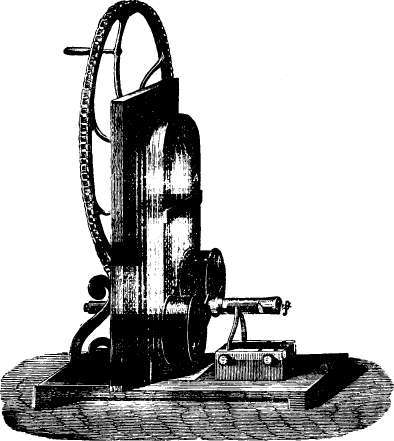
Fig. 14. Magneto-Electric Machine.
Continue to:
Books by Roberts Bartholow:


My Books

