


Saline Mineral Waters
Description
This section is from the "A Practical Treatise On Materia Medica And Therapeutics" book, by Roberts Bartholow. Also available from Amazon: A Practical Treatise On Materia Medica And Therapeutics
Saline Mineral Waters
1. North American.
St. Catharine's Wells, St. Catharine's, Ontario, Canada.
These contain chloride of sodium (217 to 375 grains to the pint), chlorides of potassium, magnesium, calcium (108 to 127 grains to the pint), sulphate of lime, and iodide and bromide of magnesium. A concentrated water prepared by evaporation is used, properly diluted by patients at a distance for internal diseases, and at the wells, externally.
These waters are diluted with ordinary water to three fourths or seven eighths, before they are drunk. They are chiefly used as warm baths. The diseases in which they have been found most beneficial are chronic gout, rheumatic gout, chronic rheumatism, and gouty and rheumatic diseases, strumous diseases, engorgement of the pelvic viscera, chronic metritis, uterine fibroids, haemorrhoids, etc.
Spring Lake Well, Ottawa County, Michigan.
The water of this spring contains chloride of sodium (50'691 grains to the pint), chloride of calcium (14·177 grains to the pint), chloride of magnesium, carbonates of soda, manganese, and iron, in small quantity, sulphate of soda (5·837 grains to the pint), bromide of magnesium, and a trace of
These waters are applicable to the treatment of gout, rheumatism, strumous diseases, etc. The waters are drunk and used as warm baths.
Saratoga Springs, Saratoga, New York.
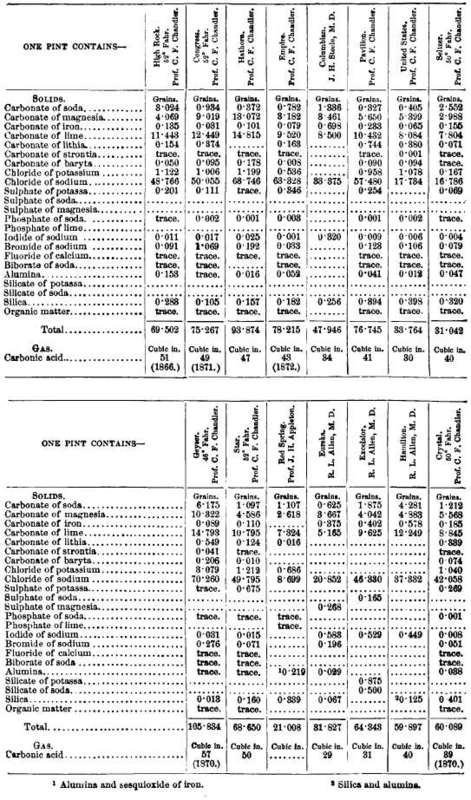
In general terms, these waters contain chloride of sodium, the alkaline carbonates, and are highly charged with carbonic-acid gas. The springs are numerous, and differ somewhat in composition. I subjoin a tabular statement of the analyses of the different waters, which show their adaptation to various morbid states.
These waters are useful in plethora of the abdominal viscera, in obesity, in habitual constipation due to deficient secretion, in plethora of the pelvic viscera, haemorrhoids, etc. The waters of the Pavilion and Geyser Springs, owing to the quantity of lithia which they contain, are especially serviceable in chronic gout, chronic rheumatism, rheumatic gout, and affections dependent on these diatheses. The Columbian, Pavilion, Eureka, and Excelsior, containing a considerable proportion of iron, are more especially adapted to cases of the above-mentioned disorders, in which anaemia exists, but they must be drunk with caution by the plethoric.
Ballston Spa, Ballston, Saratoga County, New York.
These waters are similar in composition to the waters of the Saratoga Springs, but they are richer in mineral constituents.
Bedford, Bedford County, Pennsylvania. These waters are purgative saline in character and composition, somewhat like those of Saratoga, but contain more iron.
There are probably in no part of the world more admirable mineral springs than those of Saratoga, and of Bath County, Virginia. Physicians of this country have not given them the attention they deserve, nor have their owners been sufficiently awake to their remarkable utility.
2. European.
Cheltenham, Gloucestershire, England.
These spas are saline aperient, indurated saline, iodureted-magnesian saline, and the waters contain a good deal of carbonic acid. The season is from July to October. These waters are chiefly serviceable in dyspepsia, hepatic affections, and constipation. Some of the springs at Cheltenham contain iron, and the water of these is employed in chlorosis and anaemia.
Leamington, Warwickshire, England.
These waters contain chlorides of calcium and sodium, and sulphate of soda, with carbonic acid. They are much prescribed in dyspepsia, acidity, and hepatic troubles, constipation, etc.
Adelheidsquelle, Heilbrun, Bavaria. Altitude, 2,000'. Temperature of spring, 50° Fahr. Season, May to September.
This valuable water contains chloride of sodium, carbonate of sodium, iodide and bromide of sodium, etc.; carbonic acid, 13·18 cubic inches. It is highly prized in strumous diseases, rheumatism, gout, affections of the skin, and pelvic troubles of females (chronic metritis, fibroids, etc.).
Baden-Baden. Altitude, 616'. Mean annual temperature, 48° Fahr. Season, May to October.
According to Bunsen's analysis, these waters contain chloride of sodium, bicarbonate of lime, magnesia, and iron, sulphates of lime and potash, arseniate of iron (a trace), chloride of potassium, bromide of sodium (traces), etc.; carbonic-acid gas. The Meurquelle contains 2·3694 grains of chloride of lithium in 20 ounces.
Carlsbad, Bohemia. Altitude, 1,200'. Season, June to September.
These waters contain sulphate of soda, carbonate of soda, chloride of sodium, sulphate of potash, carbonate of lime, etc. Marktbrunnen contains, besides these ingredients, a small quantity of carbonates of lithia, strontia, and manganese, and iodide and bromide of sodium; the gas is carbonic acid.
The Carlsbad water is highly prized in affections of the liver and portal system, uterine diseases, gout, rheumatism, and diabetes.
Friedrichshall, Saxe-Meiningen, Germany. Bitter water.
According to Liebig, this water contains sulphate of soda, 46·51 grains; sulphate of magnesia, 39·55; chloride of sodium, 61·10; chloride of magnesium, 30·25; sulphates of potash, 1·52, and of lime, 10·34 grains. Carbonic-acid gas, 5·32 cubic inches.
This is aperient, and is used in diseases of the stomach, liver, intestines, and kidneys. It is imported in quart-bottles, and is much prescribed as a laxative in habitual constipation, in hepatic troubles, plethora of pelvic organs, etc.
Homburg, Central Germany. Altitude, 600'. Open all the year, but the season is from May to September. Temperature, 50° to 53° Fahr.
According to the analysis of Liebig and Hofmann, these waters contain chlorides of sodium (79 to 104 grains), potassium, magnesium, and calcium, carbonates of lime, magnesia and iron, and sulphates of soda and lime. Free carbonic acid, 48 cubic inches.
In therapeutical action they are laxative, and are prescribed in habitual constipation, dyspepsia, abdominal and pelvic plethora, obesity, hypochondriasis, hysteria, etc.
Kissingen, Bavaria. Altitude, 800'. Temperature of springs, 50° Fahr. The season is from May to September.
Liebig's analysis has shown that these waters contain chlorides of sodium (17·52 to 44·71 grains), potassium, lithium, and magnesium, sulphates of lime and magnesia, carbonates of lime and iron, bromide and iodide of sodium, etc. They are highly charged with carbonic acid.
Kissingen waters are laxative, and are used in dyspepsia, hepatic obstructions, albuminuria, diabetes, etc.
Kreutznach, Rhenish Prussia. Altitude, 285'. Season is from June to September.
This powerfully alterative water contains chloride of sodium (72 to 108 grains to the pint), chloride of calcium (13 to 22 grains to the pint), chlorides of magnesium, potassium and lithium, carbonate of lime and iron, bromide and iodide of magnesium.
The mother-liquor of Kreutznach contains 2,484 grains of solid matter in sixteen ounces.
These waters are extremely serviceable in constitutional syphilis, strumous diseases, affections of the skin, rheumatism, gout, engorgement of the abdominal and pelvic organs, hepatic diseases, etc.
Marienbad, Bohemia. Altitude, 1,900'. Season is from May to September.
The principal constituents of this water are sulphate of soda, bicarbonate of soda, chloride of sodium, bicarbonate of lime, bicarbonate of magnesia, and salts of lithia, strontia, iron, and manganese, in small quantity; carbonic-acid gas
Laxative, and used in hepatic disorders, dyspepsia, habitual constipation, gravel, gout, etc.
Reichenhall, Upper Bavaria. Altitude, 1,407'. Mean temperature of spring, 56° Fahr.; of summer, 64° Fahr.; of autumn, 54° Fahr. Season, July and August.
Used only for baths. Inhalations are practiced here on a large scale." The compressed-air cure" is also a prominent feature of the curative methods. Scrofula, phthisis, and affections of the throat, are chiefly treated.
The waters are rich in chlorides of sodium and magnesia, and sulphates of soda and lime.
Seidlitz, Bohemia.
The chief constituents are sulphate of magnesia, sulphate of soda, carbonate of lime, sulphate of lime, sulphate of potash, and chloride of magnesium.
Saline purgative.
Selters, Nassau.
Kastner's analysis has shown that this water contains bicarbonate of soda, chloride of sodium, bicarbonates of lime and magnesia, iron and manganese, phosphates of lime, alumina and soda, bromide of sodium, etc. Highly charged with carbonic acid.
Laxative and alterative.
Authorities referred to:
Braun, Dr. Julius. Systematisches Lehrbuch der Balneotherapie, Berlin, 1873.
Macpherson, Dr. John. The Baths and Wells of Europe, second edition, London, Macmillan & Co., 1873.
Moorman, Dr. J. J. Mineral Springs of North America, Philadelphia, J. B. Lippin-cott & Co., 1873.
Valentiner, Dr. Th. Handbuch der allgemeinen und speciellen Balneotherapie, Berlin, 1873.
Walton, Dr. George E. Mineral Springs of the United Stales and Canada,
Continue to:
Books by Roberts Bartholow:


My Books

