


Phthiriasis Capitis
Description
This section is from the book "A Treatise On The Materia Medica And Therapeutics Of The Skin", by Henry G. Piffard. Also available from Amazon: A Treatise On The Materia Medica And Therapeutics Of The Skin.
Phthiriasis Capitis
Definition And Description
This affection is due to the lodgment and increase of the Phthirius capitis or head-louse, on the scalp, which part it alone invades, other portions of the body being exempt from its attacks. The presence of the insect gives rise to irritation and itching, and this to scratching. In some persons the insect is tolerated without much inconvenience, but in others - especially in children with an ecze-matous tendency - considerable reaction may result and manifest itself by vascular and pustular eruptions, accompanied with more or leas exudation and the formation of crusts. In addition glandular enlargements in the post-cervical regions, and small abscesses may appear on this region and on the scalp. The hair is frequently matted together by the exudation, and in severe cases we meet with a mass of mingled hair-crusts and Hoe, constituting a fetid and disgusting collection of vitalized filth.
Etiology
The principal etiological factor in this disease is shown in n Fig. 23.
The appearance of this insect is familiar, I presume, to all, and need not be specially described.
Diagnosis
The only questions that can arise are between a phthiri-asis alone, a phthiriasis combined with eczema, and an eczema alone. The pathognomonic sign is, of course, the insect itself, which can generally be found without difficulty. If, however, the head has received a thorough combing, all, or most, of the insects may have been removed. The comb, however, will not remove the eggs, commonly called "nits," which remain attached to the hairs, being very firmly glued to the hair-shaft in the manner shown in Fig. 24.
The relationship between phthiriasis capitis and eczema seems to be this: In a person subject to eczema, phthiriasic invasion is likely to develop an eczema. In a person already suffering from eczema of the scalp,the phthirius capitis appears to increase and multiply more readily than in the scalp of one who is free from eruption. Eczema capitis without phthiriasis capitis is, of course, determined by the entire absence of the insect and of its ova.
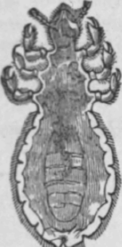
Fig. 23. - Phtbirius capitis, or
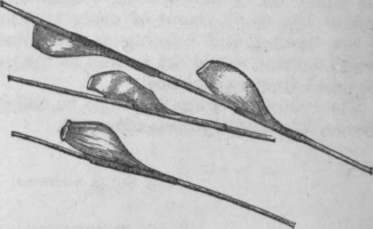
Fig. 24. - Eggs of the phthirius capitis. (Anderson.)
Prognosis
Always good.
Treatment
A very effectual method of curing the affection is to shave off all the hair. This it is often undesirable to do. Under these circumstances an antiparasitic ointment or lotion may be employed. Mercurial or sulphur ointments are effective, but perhaps the most popular application is the Tincture of Delphinium Staphisagria. Tobacco has been employed, but is dangerous. Crude petroleum, or its refined product, Kerosene, is a very eligible preparation, and the one most frequently employed by the author. It should be applied daily until the affection is at an end. Kerosene destroys the pediculus but does not appear to retard the hatching of the ova. The young, however, are destroyed as soon as hatched, and the affection is thus, in a short time, controlled. The empty egg-shells may remain attached to the hairs for a considerable time, thus deceiving one into the belief that the parasitic affection still exists. A coexisting eczema should be treated in accordance with the principles that underlie the treatment of that disease.
Continue to:


My Books

