


Absorption, Assimilation, And The Processes Of Metabolism. Part 8
Description
This section is from the book "The Nutrition Of Man", by Russell H. Chittenden. Also available from Amazon: The Nutrition of Man.
Absorption, Assimilation, And The Processes Of Metabolism. Part 8
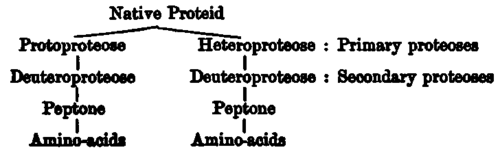
Our understanding of the chemical structure of any organic substance is based primarily upon a study of the decomposition products which result from its breaking down, under the influence of various chemical agencies. Simple proteid substances when acted upon by pancreatic juice reinforced by the enzyme erepsin, or when boiled with dilute acids, undergo hydrolytic cleavage with ultimate formation of a large number of relatively simple bodies, mostly amino-acids, the chemical structure of which throws some light upon the nature of the proteid. Thus, in the pancreatic digestion of proteid in the intestine we may adopt the following scheme as showing in a general way the progressive transformation that occurs, understanding at the same time that like transformations may be accomplished by corresponding intracellular enzymes in the tissues and organs of the body; and further, that by the long-continued action of hydrolytic agents there is a complete breaking down into amino-acids and other simple products.
Among these end-products, or amino-acids, are leucin, tyrosin, aspartio acid, glutaminic acid, glycocoll, arginin, lysin, histddin, and likewise the peculiar aromatic body tryptophan. The chemical make-up of these substances may be indicated by the following structural formulae, which, if even only partially understood, will suggest to the non-chemical mind some idea of close chemical relationship:

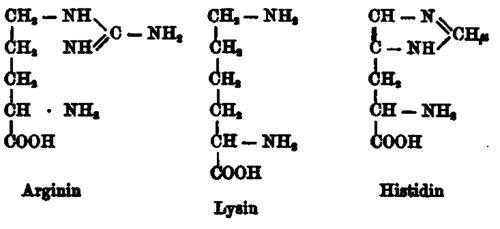
In these various decomposition products there is apparent certain definite lines of resemblance, on which is based one or more suggestions regarding possible ways in which these chemical groups are linked, or bound together, in the proteid molecule. Thus, there is apparently present a complex or nucleus which may be indicated as

The proteid molecule is presumably built up of amino-acids variously joined together, this synthesis being accomplished, doubtless, by the condensation of different types of amino-acids, in which the first of the above groups represents the more common method of union. We may indeed conjecture that such methods of condensation take place in the human body, in the epithelial cells of the intestine, and in the tissues in general; and that by such methods, construction of proteid is accomplished out of the various fragments split off by digestion, etc. In a tentative way, the principle may be illustrated by the fusion of leucin and glutaminic acid, - following Hofmeister's suggestion, - in which a still larger complex is formed:
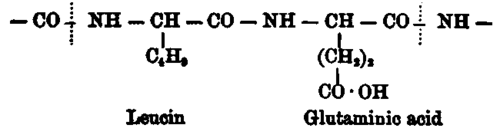
In this way, step by step, the proteid molecule is built up, and naturally in katabolism the proteid breaks down along certain definite lines of cleavage, with formation of katabolic products containing those groups, or chemical nuclei, which characterize the different proteid molecules. For it is to be clearly understood that there are many different forms of proteid, perhaps superficially alike, but possessed of physiological individuality. This is well illustrated by the two primary proteoses formed in digestion. As will be recalled, there are at first two proteoses produced, protoproteose and heteroproteoee. These are, superficially at least, not radically unlike; they possess essentially the same percentage composition, but when broken down by vigorous chemical methods they show a totally different make-up. In other words, at the very beginning of digestion there is a splitting up of the proteid into two parts, which have quite a different chemical structure, as is clearly indicated by the difference in the character and amount of the decomposition products yielded by hydrolytic cleavage. Thus, heteroalbumose as derived from blood-fibrin contains 39 per cent of its total nitrogen in basic form, i.e., in a form which goes over into the basic bodies, arginin, lysin, and histidin, etc. On the other hand, protoalbumose from the same source yields hardly 25 per cent of basic nitrogen. Further, heteroalbumose yields only a very small amount of tyrosin, while protoalbumose gives on decomposition a large amount of this substance. Again, heteroalbumose furnishes a large yield of leucin and glycocoll, while protoalbumose gives no glycocoll and only a little leucin. Obviously, these two proteoses have an inner structure quite divergent one from the other, and owing to this fact they must play a quite different role in metabolism.
Even greater differences in inner chemical structure are found among native proteids. By way of illustration, we may take egg-albumin, the casein of cow's milk, gliadin of wheat, and the edestin of hemp seed. These are all typical proteids; they are all useful as food, but they are radically different in their inner chemical structure, as is clearly indicated by the following data,1 which show the percentage yield of the different amino-acids and ammonia:
Leucin. | Tyrosm. | Glutaminio Add. | Arginin. | Lysin. | Histidin. | Ammonia. | |
Egg-albumin. | 6.1 | 1.1 | 9.0 | • • • | • • • | • • • | 1.6 |
Casein . . . | 10.5 | 4.6 | 10.7 | 4.8 | 6.8 | 2.6 | 1.9 |
Gliadin. . . | 6.7 | 1.2 | 87.3 | 3.2 | 0 | 0.6 | 5.1 |
Edestin. . . | 19.0 | 2.7 | 14.0 | 14.2 | 1.6 | 2.2 | 2.3 |
These are not mere technical differences, but they represent divergences of structure which cannot help counting as material factors in nutritional processes. Especially noticeable is the large yield of glutaminic acid from wheat proteid, as contrasted with the proteid (casein) of animal origin. As a rule, glutaminic acid forms a larger proportion of the decomposition products of vegetable than of animal proteids. Similarly, arginin is present in much larger proportion in most vegetable proteids than in most animal proteids. While many other data more or less trustworthy might be added, these figures will suffice to emphasize the main point under discussion, viz., that individual proteids show marked variation in the amount of the several amino-acids which serve as corner-stones or nuclei in the building up of the molecule, and consequently they must yield correspondingly different katabolic products when serving the body as food.
1 These data were furnished the writer by Dr. Thomas B. Osborne, and represent in large measure the results of his own chemical work.
Continue to:


My Books

