


Source Of The Energy Of Muscle Work. Part 2
Description
This section is from the book "The Nutrition Of Man", by Russell H. Chittenden. Also available from Amazon: The Nutrition of Man.
Source Of The Energy Of Muscle Work. Part 2
While experiments of this nature, on man and animals, all tended to show little or no increase in the excretion of nitrogen, as a result of muscle work; and likewise no increase in the output of sulphur and phosphorus, thus strengthening the view that muscular energy is not the result of proteid disintegration, there was observed marked increase in the consumption of oxygen, and in the excretion of carbom dioxide. Non-nitrogenous matter was thus at once suggested as the material with which muscle chiefly does its work. There is to-day no question of the general truth of this statement, yet there are other aspects of the problem to be considered before we can lay it aside. Pflüger working dogs, and Argu-tinsky, experimenting on himself by arduous-mountain climb-ing, reached conclusions seemingly quite opposed to what has just been said. Their results, however, admit of quite a different interpretation from what they were disposed to attach to them. Thus, Pfüger would go hack to the old view that all muscle work is at the expense of proteid material, because lean dogs fed mainly, or entirely, on meat and made to do an excessive amount of work were found by him to excrete nitrogen somewhat in proportion to the amount of work done. Argutinsky,2 likewise, in his mountain climbing carried to the point of fatigue, and with a high proteid intake likewise, saw in the increased output of nitrogen a suggestion of the same idea. In reality, however, their results merely prove that under some circumstances, proteid rnay berve as the, chief source of muscular energy as when the body is poor in fat and carbohydrate, or when the intake consists solely of pro-teid matter. In other words, muscular work may result in an increased excretion of nitrogen when the work is very severe, and there is not a corresponding increase in the fats or carbohydrates (fuel ingredients) of the food. In the words of Bunge,1 "we might assume a priori, on teleological grounds, that in the performance of its most important functions the organism is to a certain extent independent of the quality of its food. As long as non-nitrogenous food is supplied in adequate quantity or is stored up in the tissues, muscular work is chiefly maintained from this store. When it is gone the proteids are attacked."
1 Pfüger; Die Quelle der Miukelkraft pfüger Archiv für die geummte Pliyiiologie. Band 50, p. 98
1 Argutinsky:.Muskelarbeir and Sucksoffumsstz. Ibid., Band 46, p. 552
There is no question that the energy of muscular contraction can come from all three classes of organic foodstuffs. Voluntary muscular movement is under the control of the nervous system, and when the stimulus is applied the muscle is hound to contract, provided of course there is sufficient energy-containing material present to furnish the means. Muscle tissue, like other tissues and organs, has a certain power of adaptability, by which it is able to do its work, even though it is not adequately supplied with its preferred nutrient. While proteid is plainly not the material from which the energy of muscular contraction is ordinarily derived, it is equally evident that in emergency, as when the usual store of carbohydrate and fat is wanting, proteid can be drawn upon, and in such cases vigorous work may be attended with increased nitrogen output. In harmony with this statement, we find on record in recent years many experiments, both with man and animals, where severe muscular labor is accompanied by an excretion of nitrogen beyond what occurs on days of rest; but by simply adding to the intake of non-nitrogenous food this increased outgo of nitrogen is at once checked. With moderate work, the nitrogen outgo is rarely influenced; it is only when the work becomes excessive, or the store of non-nitrogenous reserve is small and the intake of the latter food is limited, that proteid matter is drawn upon to supply the required energy.
1 Bunge: Textbook of Physiological and Pathological Chemistry. Second English Edition, 1002, p. 363.
Recalling what has been said regardiug the significance of the respiratory quotient, it is obvious that we have here a means of acquiring information as to the character of the material that is burned up in the body during muscular work. Increased metabolism of carbohydrate will necessarily result in raising the respiratory quotient, and if the latter food material alone is involved the respiratory quotient must naturally approach 1.0. Zuntz, however, has clearly shown that vigorous muscular activity does not materially change the respiratory quotient; except in cases of very severe work, where the oxygen-supply of the muscles is interfered with. Indeed, the muscles may be made to do work sufficient to increase the consumption of oxygen threefold or more, without any change in the respiratory quotient being observed. And as there is frequently no change whatever in the output of nitrogen under these conditions, it follows that the energy of the muscle work must have come from the decomposition of non-nitrogenous material. If carbohydrates alone were involved, the respiratory quotient would obviously undergo change. Since, however, this remains practically stationary, we are led to the conclusion Mint, fat must be involved in large degree, in addition tocarbohydrates
In this connection, it is a significant fact that with fasting animals, where the store of carbohydrate material is more or less used up, severe muscle work may be accomplished without any appreciable increase in nitrogen output, thus showing that proteid material is not involved and clearly pointing to fat as the source of the muscular energy. Thus, in an experi-ment referred to by Leathes, a dog on the sixth and seventh day of starvation was made to do work in a treadmill equivalent to climbing to a height of 1400 meters, yet the output of nitrogen was increased from six to only six and a half grams. Obviously, not much of the energy of this muscle work could have come from the breaking down of proteid, but it must have been derived mainly from the oxidation of fat. There is abundant evidence that fat can be used as a source of energy by muscles, as well as carbohydrates and proteids, and there is every reason for believing that the yield of work for a given amount of chemical energy in the form of fat is as good as in the case of either of the other two substances. In fact, the observations of Zuntz show that fat can be used just as economically by the body for muscle work as either carbohydrates or proteid. Thus, in one experiment,1 he determined the oxygen-consumption and respiratory quotient in a man resting and working on three different diets - one principally fat, one principally carbohydrate, and the other principally proteid - and found that slightly less oxygen and energy were required to do work on the fat diet than on the others. This is clearly shown in the following table:
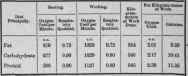
From these data, we see that per kilogram-meter of work less energy was required and less oxygen consumed with fat than with either of the other two foodstuffs; but practically, fat and carbohydrate as sources of muscle energy have about the same value.
1 Quoted from Leathers: Problems in Animal Metabolism, p. 100.
Continue to:


My Books

