


The Balance Of Nutrition. Part 7
Description
This section is from the book "The Nutrition Of Man", by Russell H. Chittenden. Also available from Amazon: The Nutrition of Man.
The Balance Of Nutrition. Part 7
In illustration of the efficiency of an apparatus of this description, and of the close agreement obtainable by direct calori-metric measurement with the estimated energy, as figured from the materials oxidized in the body, we may quote the following data from Dr. Benedict's report, referred to in the footnote. The subject was a young man who had been fasting for five days. The experiment deals with the metabolism on the first day after the fast, when a diet composed mainly of milk was
1 For an account of the respiration calorimeter and the great diversity of apparatus accessory thereto, together with a description of the methods of measurement, analysis, etc, see Publication No. 42, Carnegie Institution of Washington, "A Respiration Calorimeter with Appliances for the Direct Determination of Oxygen." By W. O. Atwater and F. G. Benedict made use of, containing 53.31 grama of proteid, 211.87 grams of fat, and 75.41 grams of carbohydrate. The following table shows the results of the experiment:
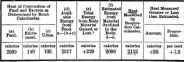
As is seen from the above figures, the total fuel value of the food was 2569 calories. The fuel value of the unoxidized portion of the food contained in the excreta was 149 + 103 calories, leaving as the available energy of the food 2317 calories. This must be further corrected by the fact, mentioned in the footnote, that a portion of the food was stored as fat and glycogen, while the body lost at the same time a small amount of proteid. Making the necessary correction for these causes, we find 2088 calories as the energy from material oxidized in the body. The actual output of energy as measured by the calorimeter was 2113 calories, only 1.2 per cent greater than the estimated amount.
By aid of the respiration calorimeter, many important questions in nutrition can be more or less accurately answered, especially such as relate to the total energy requirements of the body. The law of the conservation of energy obtains in the human body as elsewhere, and if we can measure with accuracy the total heat output, with any energy liberated in the form of work, and at the same time determine the total excretion of carbon dioxide, water, nitrogen, etc., together with the intake of oxygen, it becomes not only possible to ascertain the energy requirements of the body under different conditions, but, aided by data obtainable through study of the exchange of mutter, we can draw important conclusions concerning the sources of the energy, t. e., whether from proteid, fat, or carbohydrate.
1 In the experiment, the body lost 29.10 grams of proteid = 166 calories, but gained f«t and glycogen = 893 calorie*. Hence, there were 229 calories gained from body material.
It is obvious that a man asleep, or lying quietly at rest, in the calorimeter, especially when he has been without food for some hours, furnishes suitable conditions for ascertaining the minimal energy requirements of the body. Under such conditions, bodily activity and heat output are at their lowest, and we are thus afforded the means of determining what is frequently called the basal energy exchange of the body. The following table taken from Magnus-Levy, and embodying results from many sources, shows the heat production during sleep calucated for 24 hours, of various individuals of different body-weight and of different body surface.
I venture to present these individual results, rather than make a general statement simply, because it is important to recognize the fact that the basal energy exchange differs according to body-weight, extent of body surface, and the condition of the body. In the table, the results are arranged in the order of body-weight, and it is plain to see that the absolute energy exchange is greater with heavy persons than with light, yet the energy exchange does not increase in proportion to increase of body-weight. With a man of 83 kilos body-weight, the basal exchange is only 30 - 40 per cent higher than in a man of 43 kilos body-weight. In other words, the man of small body-weight has, per kilo, a much higher basal exchange than the heavier man. The energy exchange is more closely proportional to the extent of body surface than to weight.
As Richet has expressed it, the basal energy exchange is inversely proportional to the body-weight and directly propor-
Body-weight of the Individual | Total Calories for 24 Hours. | Calories per Kilo of Body-weight. |
kilos | ||
43.2 | 1833 | 80.9 |
48.0 | 1214 | 26.3 |
60.0 | 1316 | 26.9 |
63.0 | 1627 | 28.8 |
66.0 | 1600 | 28.9 |
66.6 | 1619 | 268 |
67.2 | 1660 | 27.3 |
68.0 | 1610 | 26.0 |
02.6 | 1431 | 22.9 |
63.0 | 1418 | 22.6 |
63.0 | 1492 | 28.7 |
64.0 | 1666? | 26.8 |
64.0 | 1476 | 22.7 |
66.0 | 1498 | 28.0 |
66.0 | 1446 | 22.2 |
Body-weight of the Individual. | Total Calories for 24 Hours. | Calories per Kilo of Body-weight |
kilos | ||
67.6 | 1608 | 23.8 |
67.6 | 1621 | 24.0 |
70.0 | 1661 | 23.7 |
70.0 | 1620 | 23.1 |
71.2 | 1787 | 26.1 |
72.6 | 1660 | 21.8 |
72.7 | 1667 | 22.8 |
73.0 | 1684 | 21.7 |
73.0 | 1630 | 22.4 |
76.6 | 1670 | 22.1 |
82.0 | 1666 | 19.0 |
82.7 | 2030? | 24.6 |
83.6 | 1670 | 20.0 |
88.3 | 2019? | 22.9 |
90.4 | 1778 | 19.6 |
tional to the body surface. This is in harmony with the view advanced by v. Hosslin, "that all the important physiological activities of the body, including of course its internal work and the consequent heat production, are substantially proportional to the two-thirds power of its volume, and that since the external surface bears the same ratio to the volume, a proportionality necessarily exists between heat production and surface."1
There are, however, many circumstances that modify, or influence, energy exchange. Thus, the taking of food, with all the attendant processes of digestion, assimilation, etc.. involves an expenditure of energy not inconsiderable. This has been experimentally demonstrated on man by several investigators. With fatty food, Magnus-Levy found that his subject lying upon a couch, as completely at rest as possible, produced in the 24 hours 1547 calories when 94 grams of fat were eaten, and 1582 calories when 195 grams of fat were consumed. The increase of heat production over the basal energy exchange was 10 and 58 calories respectively. With a mixed diet, where proteid food is a conspicuous element, the increase in heat production is much more marked Thus, in some experiments reported from Sweden the following data were obtained:1
1 See Armsby: Principles of Animal Nutrition, p. 368.
Day. | Energy of the Food. | Heat Production. |
calories | calories | |
First | 4141 | • • • • |
Second | 4277 | 2706 |
Third | 0 | 2220 |
Fourth | 0 | 2102 |
Fifth | 0 | 2024 |
Sixth | 0 | 1902 |
Seventh | 0 | 1970 |
Eighth | 4355 | 2436 |
Ninth | 3946 | 2410 |
We see here an increase of 495 calories per day in heat production, due to metabolism of the food ingested. In other words, with a basal energy exchange of 2022 calories, the average of the five fasting days, energy equivalent to 495 calories was expended in taking care of the ingested food. It should be added, however, that the daily ration here was somewhat excessive, 4193 calories being considerably in excess of the requirements of the body. Finally, it should be stated that of the several classes of foods, proteids cause the greatest increase in metabolism and fats the leest.
1 Taken from Armsby: Principles of Animal Nutrition, p. 883.
Continue to:


My Books

