


A Caloric Calculator
Description
This section is from the book "Modern Theories Of Diet And Their Bearing Upon Practical Dietetics", by Alexander Bryce. Also available from Amazon: Modern Theories of Diet and Their Bearing Upon Practical Dietetics.
A Caloric Calculator
It is only in quite recent years that an effort has been made to introduce a means for quickly estimating the amount of food eaten at meal-times, and this suggestion we owe to Irving Fisher, Professor of Political Economy in Yale University. He conceived the idea of having every item on the menu served in definite quantities termed "portions," one "portion " representing 100 calories, and every "serving" (or as we should call it "helping") consisting of one "portion" or a part thereof. This principle is in vogue at Battle Creek Sanitarium, Michigan, U.S.A., where the menu is carefully constructed to show in detail the number of ounces in an ordinary serving, the number of calories of protein, fat and carbohydrates in each "portion," and the number of "portions" in a serving. It is thus a perfectly simple matter for a patient or guest to select from the menu and from the list of articles there tabulated and permitted by his physician the accurate quantity of food measured in calories and also in ounces which he is suffered to consume. I noticed whilst in residence at Battle Creek that many of my table companions were quite indifferent as to the quantity of their food, and simply consulted their taste on the matter, whereas the efforts of some to make their respective items fit into the caloric values prescribed were at times disconcerting, and by no means favourable to the development of a good appetite. I concluded, as one would anticipate, that the proper measure of one's digestive capacity was the appetite, although the experience gained at such an institution as the above might enable a gourmand safely to restrain an unnatural appetite with the assurance that he was satisfying the full demands of nutrition.
Professor Fisher has constructed a most interesting and highly ingenious indicator for determining the percentage of the several food principles taken at a meal without the trouble of adding the quantities furnished for the various items composing the meal. The essential feature of the apparatus is a card with a diagram of a right-angled triangle, on which points are located to represent the various foods employed. Through these points pins with heavy heads are made to pierce the cardboard, the weight of each pin representing one "standard portion" or a half or quarter of a "portion." The ration consumed is easily found by counting the "portions" thus represented, and the percentage of protein, fat, and carbohydrate can be ascertained by suspending the card in the ingenious instrument and obtaining the centre of gravity of all the pins. The invention of such an instrument is a manifestation of the increasing interest in the subject of diet, and in all probability indicates that a period is not far distant when it may become possible to prescribe our patients' diet with as much accuracy as his medicines.
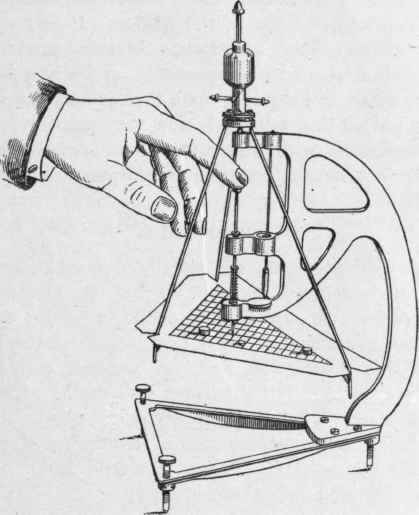
Professor Fisher's Diet Indicator.
We are now in a position to commence our study of the digestion and metabolism of each of the alimentary principles, in an endeavour to trace the building material of the body through its various stages of preparation and disintegration into the simplest molecules, until each one takes its place in its appropriate position in the edifice. It is only in this way that we can hope to estimate at their true value the various theories about to be submitted, or be in a position to deliver any accurate judgment upon them. As the information at our disposal on this subject is now very extensive, we must content ourselves with the barest summary of the facts compatible with a satisfactory presentation of the position.
Continue to:


My Books

