


The Appearance Of Tonic Constrictions
Description
This section is from the book "The A. B. - Z. Of Our Own Nutrition", by Horace Fletcher. Also available from Amazon: The A. B.-Z. Of Our Own Nutrition.
The Appearance Of Tonic Constrictions
It has already been noted that as the food accumulates in the ascending colon it is at first confined to this region by antiperistaltic waves. With further accessions, however, the contents naturally must be pressed more and more into the transverse and descending colon. In the early stages of this accumulation, while the food lies chiefly in the ascending colon, the only activity of the muscular walls is the antiperistalsis. As the contents extend along the intestine a deep constriction appears near the advancing end and nearly separates a globular mass from the main body of the food (Fig. 6). The contents of the large intestine progress farther and farther from the caecum; meanwhile new tonic constrictions appear which separate the contents into a series of globular masses. And as the number of these divisions increases they take a position farther from the caecum, so that they are present chiefly in the descending colon (Fig. 7). Raiser has recorded a similar appearance in the terminal portion of the rabbit's colon, in which deep circular constrictions separate the scybalous masses. He maintains that these masses are pushed onward by the constrictions.
Comparing tracings made at rather long intervals (forty-five minutes), I found that the rings disappear from the transverse colon, and then are present with the waste material in the descending colon. Thus in the cat also these rings, which seem with short observation to be remaining in one position, are in reality moving slowly away from the caecum, pushing the hardening contents before them. The contents at this stage are no longer fluid, and consequently they must offer considerable resistance to a force pushing them through the colon. It is an advantage to have this pultaceous substance propelled in divisions rather than in a uniformly cylindrical mass, since the fibre along the length of the mass are thereby rendered effective. Such are the functions of the persistent rings; they form the waste matter into globular masses at the end of the transverse colon and slowly push these masses onward.
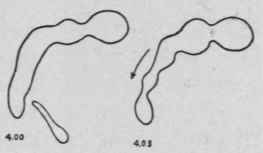
Figure 6. - Tracings showing changes when food enters the colon and also the first tonic constriction. 4.00, the colon relaxed as food approaches in the ileum. 4.03, the colon contracted and traversed by antiperistaltic waves after the food has entered.
In the transverse colon, which is free from the slowly moving rings, the antiperistaltic waves have full sway. In the region of the tonic rings an infrequent or even a slowly periodic relaxation and contraction are often to be observed. These changes seem to take place in all the rings at about the same time. Once I saw antiperistaltic waves running over the uppermost of four segments, but since the rings on either side of the segment held tightly, the waves had merely the effect of churning the material of the segment and did not move it onward. Inasmuch as the material in these segments at first is soft, so that the segments are easily compressible, while the faecal masses which are the final result are relatively hard and dry, it follows that even within the confines of these persistent rings some absorption is taking place.
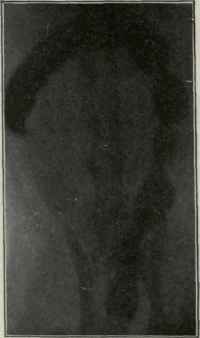
Figure 7. - Radiograph showing the region of tonic constrictions (descending colon) and the region of antiperistalsis (transverse and ascending colon).
Continue to:


My Books

