


Defecation
Description
This section is from the book "The A. B. - Z. Of Our Own Nutrition", by Horace Fletcher. Also available from Amazon: The A. B.-Z. Of Our Own Nutrition.
Defecation
The process of clearing the colon is a process of repeated reduction of the amount of material present. Figure 8 (3.11) is a radiograph showing the food in the colon at 3.11 P.M. About 3.25, with a slow, sweeping movement, the gut swung around so that the ascending colon was lying in the position of the last half of the transverse colon, and the transverse colon had taken the position of the descending part (Fig. 8, 3.25). At the same time the tonic constrictions disappeared and were replaced by a strong, broad contraction of the circular muscle, tapering the contents off on either side in two cones. The region of strongest contraction was apparently drawn downward with the rest of the gut by a shortening of the descending colon. As the intestine swung around, more material was forced into the rectum, and when the swinging of the intestine stopped, the constriction which divided the lumen passed slowly downward, and with the aid of the muscles surrounding the abdominal cavity, pushed the separated mass out of the canal.1 After the terminal mass had thus been pushed out, the colon with the remainder of its contents returned to nearly its former position (Fig. 8, 3.46). About two hours afterward this remnant had been spread throughout the length of the large intestine by means of the slowly moving rings.
Figure 7 is a radiograph of the same colon pictured in Figure 8; the radiograph was taken at 11.50 A.M., and at 12.15 P.M. the material in the lower descending colon was forced out in the manner above described. Within three hours the remaining portion had been spread into the evacuated region, as shown in Figure 8, 3.11. The manner in which the material is spread from the region of the antiperistaltic waves into the region of the slowly advancing rings presents a problem. During normal living new food constantly arriving in the colon must force the old contents forward just as the later parts of a meal force forward the earlier parts; there is no doubt, however, that most of the contents of the caecum and the ascending colon may be passed onward even during starvation. The emptying of these regions, according to my observations, is never complete; for after considerable time has elapsed and the large intestine is cleared and dilated with gas, some substance is still to be detected in the caecum and clinging to the walls of the ascending colon.
The only activities manifested here are the antiperistaltic waves and the strong tonic contraction of the whole circular musculature shown in Figure 6. It is clear that the latter activity would serve to press into the transverse colon a considerable portion of the contents of the ascending colon, and the remnant seen clinging to the walls would be the part not thus pressed forward.
1 In this case the fasces were soft.
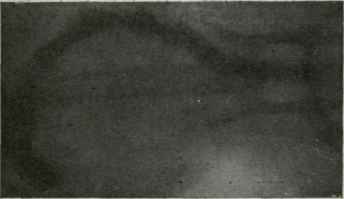
3.11.
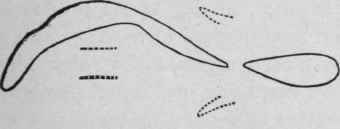
3.25.
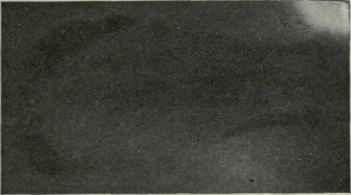
3.46.
Figure 8. - Two radiographs and a tracing showing the changes taking place in defecation. 3.11, material in the colon. 3.25, colon carried downward and terminal mass separated. 3.46, after defecation, when the colon returns to former position. Defecation occurred at 3.27.
Twice I have seen appearances which might account for the emptying of the first portion of the large intestine in a more thorough manner than that above described. At one time, without apparent stimulation, strong tonic contraction occurred along the entire length of the ascending colon, which forced the contents almost wholly into the transverse portion. This action seemed merely an exaggerated form of that observable after food passes the ileocecal valve (see Fig. 6). At another time, after a mass of food had passed through the ileocecal valve, after the ascending colon had contracted generally and the antiperistaltic waves had coursed over it in the usual manner, a deep constriction appeared at the valve and ran upward without relaxation nearly the length of the ascending colon, pushing the contents before it. For an instant the wave paused; then the constriction relaxed and the food returned towards the caecum. These observations indicate that either a general contraction of the wall of the large intestine or a true peristalsis may be effective in pressing waste matter from the region where antiperistalsis is the usual activity into the region where the slowly advancing rings may carry it on to evacuation (see Fig. 7).
Continue to:


My Books

