


Relation Between Chemical Constitution Of The Proteins And Their Food Value
Description
This section is from the book "Chemistry Of Food And Nutrition", by Henry C. Sherman. Also available from Amazon: Chemistry of food and nutrition.
Relation Between Chemical Constitution Of The Proteins And Their Food Value
Several facts bearing upon the relation between the feeding values of individual proteins and their amino acid make-up have been cited in the preceding pages. The subject is of great importance and is now under active investigation. Since the experimental facts are still being determined, any attempt to generalize broadly at this point would be premature. A few important conclusions may, however, be deduced from the facts already given.
Glycine, although an essential constituent of body tissue, need not be furnished by the food, for several proteins which do not yield glycine on hydrolysis have been shown to be adequate when fed as sole protein of an experimental ration. It appears therefore that supplies of glycine fully adequate to meet all normal needs may be formed within the body itself.
Tryptophane, on the other hand, apparently must always be supplied to the animal body; food furnishing no tryptophane has always proven inadequate even for maintenance of full-grown animals. Apparently the animal body is unable to make tryptophane (or at least to make it at the rate required for normal metabolism) and proteins lacking the tryptophane radicle must be regarded as always inadequate as a sole protein food.
Lysine, again, is especially important in connection with growth. Proteins which yield little, if any, lysine (and which are otherwise adequate in their amino acid make-up) appear to suffice as the sole protein food in the maintenance of full-grown animals (rats) but not to support a normal growth of the young.
As regards the influence of the presence or absence of glycine, lysine, and tryptophane radicles in the protein molecule, it seems possible to correlate the chemical structure and the nutritive value of the proteins quite definitely. In establishing this correlation, Osborne and Mendel have made one of the most important advances in the entire development of the chemistry of food and nutrition.
That the inadequacy of zein for maintenance is essentially due to the lack of tryptophane, they demonstrated by feeding a ration with zein as sole protein but with tryptophane added. This mixture permitted maintenance without growth (rat 1892, middle portion of Fig. 2). Then by the addition of lysine to the zein and tryptophane diet they induced normal growth as shown by the continuation of the weight curve of rat 1892 at the right of Fig. 2. In another case (rat 1773, at the left of Fig. 2) a rat which was rapidly losing weight on the zein diet was restored to a condition of normal growth by the addition of tryptophane and lysine to the food.
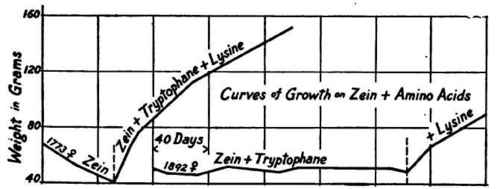
Fig. 2. - Showing the effect of adding tryptophane or tryptophane and lysine to a diet containing zein as the sole protein (compare Fig. 1, page 58). Courtesy of Dr. L. B. Mendel and the Journal of the American Medical Association.
As Mendel expresses it: "If we analyze the situation as revealed in the charts of some actual experiments, it becomes apparent that both lysine and tryptophane are unquestionably necessary as constructive units in growth. The decline brought about by the zein food can be stopped by the addition of tryptophane, as such, to the diet. This results in maintenance; but no growth ensues until lysine also is added."
Osborne and Mendel also showed that the addition of lysine to the gliadin ration made it adequate to support normal growth. They have also shown that retardation of growth may sometimes be due to restricted intake of some amino acid other than lysine.
In the experiments above described the rations always contained a liberal amount (usually 18 per cent) of protein. If, on the other hand, the percentage of protein in the food be sufficiently reduced, the growth may be retarded even though the protein be of a kind which is entirely adequate when liberally fed. Thus on a ration containing 9 per cent of casein the rats grew only about half as rapidly as when they received 18 per cent; * arid in this case the limiting factor was not lysine but cystine, for the addition of cystine to the low-casein diet induced a normal rate of growth which was immediately checked when the cystine was withdrawn and resumed when the cystine was again added to the ration (Fig. 3).
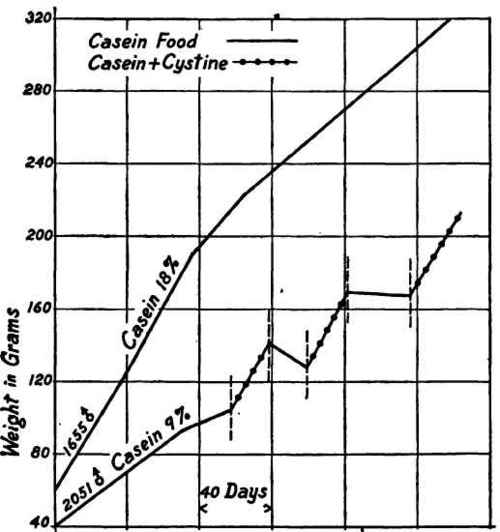
Fig. 3. - Showing that the insufficiency of a low-casein diet was essentially due to its relative deficiency in cystine. Courtesy of Dr. L. B. Mendel and the Journal of the American Medical Association.
* On account of the very different rates of growth, not to mention other differences between the species, one must not attempt to apply the quantitive data of the rat-feeding experiments directly to the problem of protein requirement in man.
In all of the experiments cited thus far each ration contained only a single isolated protein. This is the ideal condition for the experimental comparison of individual proteins, but is quite different from ordinary or "practical" conditions, since our common protein foods all contain mixtures of proteins, so that even if only a single article of food were consumed the diet would still furnish more than one protein at a time. By feeding definite mixtures of pure proteins Osborne and Mendel have beautifully demonstrated the way in which proteins supplement each other in nutrition. Thus zein alone is, as we have seen, always inadequate as a sole protein food; lactalbumin is adequate when fed in sufficient quantity but when constituting only 4.5 per cent of the food mixture of rats it supports only slow growth; but a food mixture containing 4.5 per cent of lactalbumin and 13.5 per cent of zein supports growth at a fully normal rate (Fig. 4). This shows that a relatively small amount of lactalbumin (one fourth of the protein fed) sufficed to furnish the amino acid groups which the zein lacked. It shows also that zein, which when fed as a sole protein is insufficient even for maintenance, is able as a constituent of a proper food mixture to take part in supplying the materials for growth, to such an extent as to more than double the growth-rate. Thus zein, although inadequate for either maintenance or growth when isolated and fed alone, may nevertheless take an important part in both maintenance and growth when fed as a part of a proper mixed diet. Moreover it may not even be necessary to resort to a mixture of food materials in order to make good the deficiencies of the individual incomplete protein. Corn (maize) itself, along with zein, contains an almost equal amount of another protein, maize glutelin, which Osborne and Mendel have shown to be capable of supporting a normal rate of growth - not to mention the proteins in the embryo of the maize kernel which appear to have a still higher nutritive efficiency (Hart and Humphrey; McCollum and Davis).
Thus it is plain that the mixtures of proteins contained in different articles of food as we eat them do not differ in such a striking way as do the individual proteins when isolated and fed singly; but neither is it true that the proteins of different articles of food are equivalent for all practical purposes. Hart, McCollum, and their associates have shown that the natural protein mixture of milk is more efficient than an equal weight of the mixed proteins of wheat or corn (maize) both for the support of growth in young animals (pigs) and as food for the production of milk in dairy cattle. While it is always possible that in comparisons between natural food materials the results may be influenced by differences in the unknown food constituents which may be present, yet in the cases here cited it is probable that the differing efficiencies ascribed to milk and grain proteins are mainly due to the same differences of chemical constitution ("amino acid make-up") to which are attributable the striking results obtained in the experiments previously cited in which isolated foodstuffs were fed.
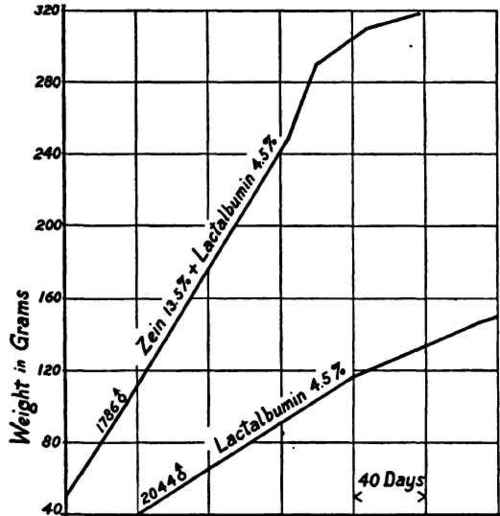
Fig. 4. - Showing the efficiency of lactalbumin as a supplement to zein, and also that zein may take an important part in growth although zein alone is inadequate either for growth or maintenance. Courtesy of Dr. L. B. Mendel and the Journal of the American Medical Association.
Continue to:


My Books

