


Manufacture. Chocolate
Description
This section is from the book "Food - What It Is And Does", by Edith Greer. Also available from Amazon: Food: What it is and Does.
Manufacture. Chocolate
Chocolate was not used in England until the beginning of the eighteenth century, though it was introduced into Spain early in the sixteenth. America began the preparation of chocolate in the latter half of the eighteenth century.
The ripened fruit is gathered from the tree, opened, and the seeds removed. These are sun-dried at once or subjected to a fermentation process ("sweating"), then dried. The flavor is improved by the fermentation and the bitterness is decreased. The roasting of the cocoa-beans is preceded by separating from them foreign particles and sorting the beans according to size. Thus flavor is further developed, and the tannin present is converted into cocoa-red that colors cocoa characteristically. The roasted beans then have their hulls cracked off and removed by winnowing. The beans themselves are next crushed and the germ removed. The cracked beans known as cocoa-nibs are prepared for a beverage and other uses noted below. The hulls are sometimes boiled for a beverage, but are more usually employed in adulterating cocoa or for cattle-food.
Chocolate is the product of grinding the cocoa-nibs (usually several times). This is then semiliquid and can be run into molds. It hardens as it cools and is unsweetened chocolate. When sugar or any flavoring, as vanilla or cinnamon, is added to chocolate, it is introduced while chocolate is in the paste state. The fat present (50%) can be partly removed under pressure. Cocoa butter is the fat so removed. Its use is largely for medical purposes and confectionery coatings. Cocoa in its purest form is chocolate with some fat removed. This makes its powdered form possible. Starch is added to keep it so.
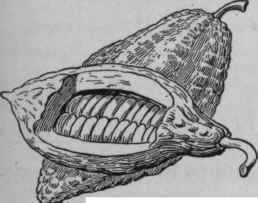
Cocoa-beans.
Continue to:


My Books

