


(2) Discrimination For The Pitch Of Tones
Description
This section is from the book "Human Vitality And Efficiency Under Prolonged Restricted Diet", by Francis G.BENEDICT, Walter R. Miles, Paul Roth, And H. Monmouth Smith. Also available from Amazon: Human Vitality and Efficiency Under Prolonged Restricted Diet.
(2) Discrimination For The Pitch Of Tones
Pitch discrimination is a measurement which can be easily given by the group method. A well-recognized standard form of procedure has been worked out by Seashore, and was used in the present case.1 Suitable wooden resonators were provided. The tuning-forks were all originally A435 vd. in pitch.2
This possible difficulty could have easily been provided against, as the linotype slugs could have been cut, making them just half as long. Each slug would then have contained 5 digits and the number of possibilities for combinations into columns of 10 would have been almost infinite. This method will be followed in any subsequent printing from these same slugs.
2Several of the, subjects in Squad A found considerable satisfaction in chewing gum. (See p.266.) They were asked to remove the gum from the mouth during the addition test.
It was first suggested to us by Professor H. S. Langfeld that we use the cancellation test in somewhat this form. Langfeld and Allport, An Elementary Laboratory Course in Psychology, Boston, 1916, p. 100. See also Burtt, Journ. Applied Psychol., 1917, 1, p. 201.
The pitch differences were produced by filing between the prongs, hence all of the steps were lower than the standard, i. e., the one fork which had not been filed and which was A435 vd. The pitch intervals between the standard and the other nine forks were 1, 2, 3, 5, 8, 12, 17, 23, and 30 double vibrations (vd.), respectively. The experimenter who sounded the forks was completely out of view of the subjects, and the usual precautions were taken concerning noises and such things as could serve as secondary criteria. Care was also taken to make the intensity of the tones equal and of similar duration. A chance order for the presentation of the tones was worked out previous to the tests and followed. Preliminary trials were given and explanations made to arouse interest in pitch discrimination. By numerous trials it was explained to all the subjects that the judgment was to be made in reference to the last of a pair of tones, i. e., he was to judge if the latter of any two tones was higher or lower than the former of the pair. A blank, ruled in centimeter squares, was provided, upon which these judgments could be recorded conveniently, the columns being lettered across the top and numbered down the side at the left. The upper left-hand corner of this blank is shown about full size in figure 21. The judgment for the first pair of tones is recorded in square A-l. This is given in the illustration as H, meaning that the second tone was judged higher than the first of the pair. The judgment for the second pair of tones is recorded in square B-l. In figure 21 it is given as L, meaning that the second tone was judged to be lower than the first. The particular square in which the judgment was to be recorded was called out in the first experiment and at the first of each experiment just before the pair of tones was given, so that the subject might have no doubt as to where to write his judgment. He was required to make a judgment of either higher or lower, that is, to fill in the appropriate square with either H or L, according as it sounded to him. There were no judgments of equality.
At the first session with each squad all the pairs of forks were used. This would give 9 pairs of tones for discrimination purposes. It was then discovered that in the case of both squads the pairs of tones, S-30, S-23, S-17, and S-12, were quite uniformly judged correctly. Therefore, it was necessary to use only the remaining pairs in succeeding sessions, that is, S-8, S-5, S-3, S-2, and S-l, or 5 pairs of tones. Really, the pair S-8 might also have been omitted, as the subjects were almost always correct with this judgment. However, some easy judgment is a great help in steadying the subject and giving him a feeling of sure-ness, so this interval was retained. The pairs were regularly given in order of difficulty, i. e., proceeding from S-8 to S-l, and the judgments were marked in sequence on horizontal lines in the blank forms. Thus: S-8 was marked in square A-l, and S-l in square E-l. Thirty judgments with each interval or 150 judgments in all constituted the test. After 100 of the pitch-discrimination judgments had been given, a short intermission was taken, during which the subjects made a pulse count on themselves, recording the same on the back of the pitch-discrimination blank. Immediately after the last pitch-discrimination judgment had been made, the blanks, which had been dated, and signed, were collected and the men were assigned to their next duties.
1Seashore. Report of the Committee of the American Psychological Association on the Standarduing of Procedure in Experimental Testa. Psychological Monograph. 1910.13, p. 21.
2 The tuning-forks were those luted as No. 1730 in the catalogue of C. H. Stoelting Co., Chicago.
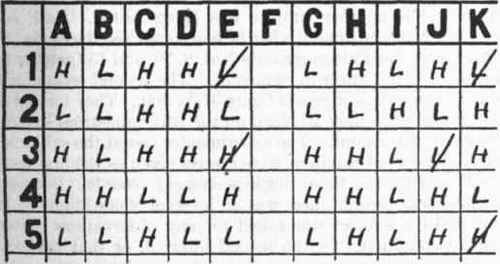
Fig. 21. - A portion of a pitch discrimination record.
Each square filled in with H or L represents a judgment on a pair of tones. Sometimes the subject was in error, as is indicated by the diagonal lines. In columns A and G the tones presented were S-8. This was the easiest pair to judge. The most difficult pair was S-l (see columns E and K).
Continue to:


My Books

