


Individual Body-Weight Curves. Part 2
Description
This section is from the book "Human Vitality And Efficiency Under Prolonged Restricted Diet", by Francis G.BENEDICT, Walter R. Miles, Paul Roth, And H. Monmouth Smith. Also available from Amazon: Human Vitality and Efficiency Under Prolonged Restricted Diet.
Individual Body-Weight Curves. Part 2
The first break in the descending line is at November 15, i. e., after the unrestricted meal on Sunday, November 11. This rise after a Sunday meal was also noted in the curves for Bro and Can. The irregular fluctuations in the next three weeks are somewhat difficult to interpret, for at this time the subject was on a very low diet. It was during this period that the trouble with his nose occurred. As may be noted from the subject's personal history (see p. 48), his nose was injured in a ball game on November 18. On November 30 he entered the hospital for an operation on the nose, when a piece of bone was removed. He was discharged from the hospital on the evening of December 1. As a matter of fact, the increments in the body-weight curve during the period of irregularity amount to a sum total of but 500 grams, which is probably not significant, and the general tendency is toward a lower level. A slight rise is evident after November 25, when an unrestricted meal was again taken. Evidently this subject adhered rigidly to a low diet during the Thanksgiving recess, for when he returned to college his weight was somewhat lower than the weight recorded on November 25. A marked drop in weight followed, which was so rapid and so consistent that it was decided that the calories could be safely increased. During his absence from college for the Christmas holidays (December 20 to January 12), there was a large increase in his weight of somewhat over 5 kg. The diet was again somewhat reduced, and this reduction, combined with excessive exercise and hard work, produced a rapid and consistent change until the weight had fallen to a fairly constant level at somewhat above 62 kg. for the last 14 days of the experiment. Another operation on the nose was performed on January 22, when a second portion of bone was removed.
But one post-diet record of weight was obtained for this man, showing that in 4 days the body-weight increased nearly 6 kg. This rapid increase in body-weight must have been due in large part to an increase in the water content of the body, for an addition of 6 kg. of organized muscle or fat would have been impossible during this short time.
Body-Weight Curve Ok Gab (Fig. 60)
The weight for Gar prior to the restricted diet was 71.25 kg. With the reduced diet there was a consistent and steady fall in the curve until the first record after November 11, which showed the rise commonly found after the unrestricted Sunday meal. The weight then continued to fall and showed no increase during the Thanksgiving recess. A great increment appeared when higher feeding was resumed. During the Christmas recess there was a gain of 5.8 kg. This was followed by a rather rapid fall incidental to an extremely low ingestion of food on the return to college, varied by one or two sharp rises. The last 15 days the weight fluctuated around 64 kg., which was evidently Gar's lower limit of weight. During the post-diet period there was the usual rapid rise in body-weight, with a total gain of 9.5 kg. When the measurements ceased, the subject was somewhat more than 1 kg. heavier than at the beginning of the observations.
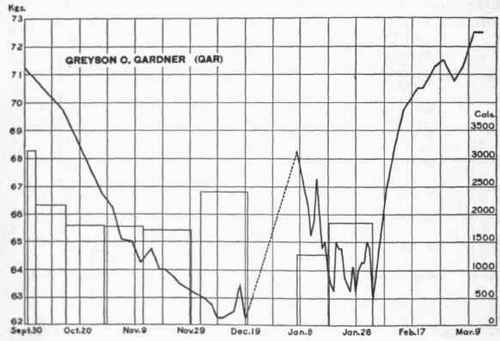
Fig. 60. - Body-weight curve of Gar.
Body-Weight Curve Of Gul (Flg. 61)
The first part of the curve for Gul follows the same course as the other curves thus far examined. The slight rise after the unrestricted meal on Sunday, November 11, is again noted; also an increase on November 23. The lower weight-level is evidently not far from 60 kg. In spite of the fact that the recorded weights for this subject show an increase of only 1 kg. during the Christmas vacation, it should be stated that, according to the report of the subject, very large increases and decreases in weight were observed during this time. The subject reported one increase of 5.9 kg., which necessitated a rapid reduction by exercise and purgatives. On returning to college, he voluntarily took a very low diet of approximately 1,000 calories, but even under these conditions there was an increase in weight, probably due to an increase in the water content of the body. During the final two or three weeks the body-weight fluctuated either side of 60.5 kg., which is not far from his minimum value. At the conclusion of the experiment the usual rapid rise in body-weight was observed, until the subject had reached a level nearly 3 kg. higher than the initial weight in September. This subject was noted among his colleagues as a heavy eater. His potentialities for consuming large quantities of food are indicated by the typical day's record selected from his report of unrestricted diet, which shows the large number of calories usually taken on the free days. (See table 33, p. 269).

Fig. 61. - Body-weight curve of GuL.
Body-Weight Curve Of Mon (Fig. 62)
Perhaps no subject in the whole squad adhered so rigidly to dietetic control as did Mon. He was a wrestler, and was rather anxious to secure a lower weight so that he might enter a lower wrestling class than the one in which he had formerly been. Consequently we find a rather consistent fall in the entire curve, with an almost inappreciable increase after November 11, no change throughout the Thanksgiving vacation, and a small rise during the Christmas holidays; the body-weight found a level thereafter, which was not far from 61 kg. It is evident, however, that at the conclusion of the test Mon decided to resume his original weight, for we have a marked post-diet increase which brought the weight not only to the initial level, but nearly 1.5 kg. above it.
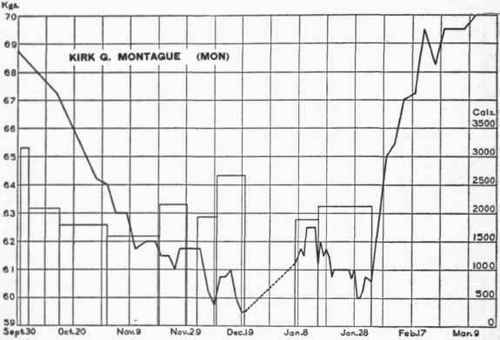
Fig. 62. - Body-weight curve of Mon.
Continue to:


My Books

