


Individual Body-Weight Curves. Part 3
Description
This section is from the book "Human Vitality And Efficiency Under Prolonged Restricted Diet", by Francis G.BENEDICT, Walter R. Miles, Paul Roth, And H. Monmouth Smith. Also available from Amazon: Human Vitality and Efficiency Under Prolonged Restricted Diet.
Individual Body-Weight Curves. Part 3
Body-Weight Curve Of Mot (Fig. 63)
From an initial weight of 63.5 kg., the weight of Moy fell rather slowly in comparison with the other curves. It was found that the diet was somewhat too large for a rapid reduction. The calories were therefore restricted still further three successive times, this restriction finally bringing Moy's weight just before Thanksgiving to a level of 58 kg. With this subject, also, there was an increase after the unrestricted meal of Sunday, November 11. In the month of December his weight remained constant at not far from 57 kg.; there was then a pronounced increase of 4.5 kg. during the Christmas holidays. When he returned to college a severe reduction was made in the diet, which was followed by a rapid loss in weight, although with considerable fluctuation. During the last two weeks of the experiment the body-weight fluctuated around 58 kg. The post-diet rise is especially interesting as showing an enormous increase, which is relatively the largest increase that occurred in the whole series of observations of body-weight, i. e., 21.2 per cent of his weight on February 3. This subject gained 12.25 kg. in slightly over a month. It is worthy of note that this is one of the subjects who was slightly under the normal weight at the beginning of the experiment. When the records for this subject ceased on March 14, that is, approximately six weeks after the end of the diet experiment, he weighed 6.5 kg. more than at the beginning of the observation in September.

Fig. 63. - Body-weight curve of Moy.
Body-Weight Curve Of Pea (Fig. 64)
Pea was distinctly of an athletic temperament and build, exercised a great deal, and lost weight rapidly on a restricted diet, falling from his initial weight of 69.25 kg. to 61.25 kg. on November 11. The first upward break in the curve occurred immediately thereafter in common with most of the subjects after the unrestricted meals on the Sundays in Boston. Until December 20 the body-weight fluctuated about this point, which was evidently a basal minimum. In the Christmas recess there was an increase of 6 kg., followed by a rapid fall on a very much restricted diet, with a fluctuating but slower fall thereafter to the end of the experiment. In the last week the body-weight remained constant at approximately 61.5 kg. With the resumption of free diet a very large increase in body-weight occurred. From February 3 to March 14 this subject gained in weight 12.7 kg., the record for the last date being actually 4.75 kg. greater than at the beginning of the experiment in September.

Fig. 64. - Body-weight curve of Pea.
Body-Weight Curve Of Pec (Fig. 65)
Pec was one of the subjects who was definitely under the normal weight at the beginning of the experiment. He was an unusually well-trained man, 44 years of age, and found great difficulty in losing weight. Even on a very restricted diet the weight curve did not fall so rapidly as one would expect. When at home, and also on a free Sunday," he found difficulty in limiting the amount eaten, as may be noted subsequent to November 11, when there was the usual gain of weight following a free day. Under strict training, however, he lowered his body-weight until he finally reached a minimum of 57.75 kg. on December 9. Throughout the month of December the weight was not far from 58.5 kg. at this lower level. A small increase was noted at the end of the Christmas recess, although, as the subject was for a week of this time on volunteer Y. M. C. A. duty at Camp Devens, he reported on unrestricted diet a material increase in weight which was rapidly-removed by severe training just prior to returning to college. During the last two or three weeks of the experiment the body-weight fluctuated somewhat above or below 59 kg. In the last week it had a tendency to be slightly below 59 kg. Owing to the great earnestness of this man, and the fact that the dietetic restrictions seemed to cause him considerable anxiety, it was necessary to be cautious about reducing the weight rapidly or to a great extent. It was finally decided that no attempt would be made to have him lose the 10 per cent expected of the other subjects. Greatly to his satisfaction, however, he succeeded in reaching the 10 per cent lower level, but he was not allowed to go below this weight. His earnestness of purpose and desire to hold his lower weight-limit are seen by the small number of calories that he consented to live upon during the last few weeks of the experiment. The usual rapid post-diet rise was observed for this subject, also. Between February 3 and March 14 there was an increase of somewhat over 12 kg., the final weight being more than 7 kg. above the initial weight in September.
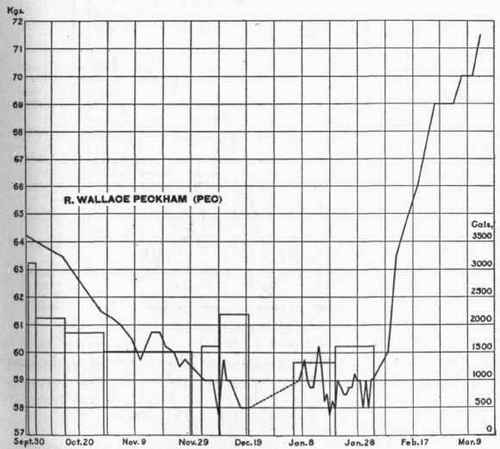
Fig. 65. - Body-weight curve of Pec.
Body-Weight Curve Of Spe (Fig. 66)
Although Spe could not complete the experiment, owing to an unforeseen and unfortunate illness which necessitated the observations being stopped on December 13, his body-weight curve indicates a consistent regular loss until November 11, when there was the usual noticeable rise. There was also a rise after the unrestricted meal on November 25, with a tendency for the weight to remain at the lower level of approximately 56 kg. during the period between November 11 and December 13. To hold him at this weight it was necessary to increase the calories to approximately 2,250 calories.

Fig. 66. - Body-weight curve of Spe.
Body-Weight Curve Of Tom (Fig. 67)
One of the most sedentary men in the whole squad was Tom, who was under normal weight at the beginning of the experiment. His duties in the college store prevented his taking a large amount of exercise and he found great difficulty in reducing his weight on the diet supplied to the other men. Consequently the fall in the body-weight curve is much slower than with the other subjects. There is, however, the characteristic rise after November 11 and another after November 25, both of these after the unrestricted diet on the Sundays following the Boston experiments. Subsequently, however, until the beginning of the Christmas recess, his body-weight remained essentially constant at about 55.5 kg. During the Christmas recess he was at home and was operated upon for hemorrhoids. He thus underwent hospital treatment with hospital dietetic regime. The day after he returned to college, i. e. on January 12, his body-weight was 1.25 kg. above the record on December 20. With continued low diet the weight fell to a point averaging not far from 55 kg. during the last two weeks of the experiment. The post-diet rise was by no means so striking or so extended as that for the other men, although he increased to somewhat over his initial level in about 10 days. The last weight recorded in the diet experiment was 55.1 kg. The first weight for the post-diet period, that of February 14, was 60 kg.; the last weight (March 11) was 62 kg., a weight 2.5 kg. greater than the initial weight for this man.
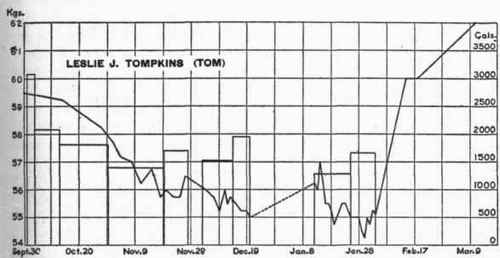
Fig. 67. - Body-weight curve of Tom.
Body-Weight Curve Of Vea (Fig. 68)
Vea, like Tom, was not so athletic as the other subjects, and found it somewhat difficult to reduce his weight on the number of calories given. The body-weight curve, however, runs a regular downward course, with the usual rise after the two unrestricted Sundays, November 11 and November 25. During the month of December the body-weight was about 59.5 kg. Although there was some increase in weight during the Christmas recess, Vea was able to reduce his weight by severe training, and came back to college with a body-weight only 0.75 kg. greater than when he left Springfield on December 20. From January 7 until February 3 the body-weight fluctuated about a point a little less than 59 kg. The initial post-diet rise was very pronounced. On February 3 (the end of the diet period) his weight was 58.5 kg.; on March 14, the last record obtained with him, the body-weight was 69.25 kg. After the diet period ended, therefore, this subject gained in weight nearly 11 kg. in less than six weeks, the final weight being, as a matter of fact, 3.5 kg. greater than the initial weight in September.
Continue to:


My Books

