


The Food Requirement During The Period Of Growth. Part 8
Description
This section is from the book "The Elements Of The Science Of Nutrition", by Graham Lusk. Also available from Amazon: The Elements of the Science of Nutrition.
The Food Requirement During The Period Of Growth. Part 8
The principal recent work upon this subject of the metabolism of children has been accomplished in the United States. It was begun by John Howland and continued by Benedict and Talbot, and by Murlin and Bailey, and Murlin and Hoobler.
Howland's1 experiments are the only reported calori-metric observations upon infants, and the close concordance between direct and indirect calorimetry as observed in hourly periods in these experiments gave confidence to subsequent observers that by the careful determination of the respiratory metabolism alone the actual heat production could be readily computed.
Howland gives the following summary of work with a normal male infant (Child I) five months old and with a boy (Child III) six months old who weighed only 3 kilograms and was literally "skin and bones." The children were fed with diluted milk with the addition of milk-sugar:
Correspondence Between Direct And Indirect Calorimetry In Infants
Food. | Calories per Sq. M. per Day. | Difference in Per Cent. | ||
Direct. | Indirect. | |||
Child I | Milk.......................... | 1046 | 1084 | 2 |
1113 | 1174 | |||
1196 | 1164 | |||
Same + nutrose .................. | 1218 | 1179 | 3 | |
Same + nutrose .................. | 1204 | 1180 | 0.6 | |
1235 | 1212 | |||
1181 | I25O | |||
Fasting ......................... | 1106 | 1177 | 2 | |
1226 | II56 | |||
1301 | 1243 | |||
Child III | Milk.......................... | 858 | 793 | 2 A |
913 | 933 | |||
Milk.......................... | 825 | 840 | ||
1 Howland: "Zeitschrift fur physiologische Chemie," 1911, lxxiv, 1; Transactions XV International Congress of Hygiene, 1912, ii, Part 2, 438.
To compute the surface area of children Lissauer's formula (10.3 3√ Weight2) is usually employed, though Howland has suggested one of still greater accuracy.
Just as in the case of the adult (see p. 476), the emaciated organism of an infant produces less heat per square meter of surface than the normal organism. Howland reported another case in which he determined the heat production of an eight-year old child, emaciated to a most extreme degree and almost devoid of musculature. The average heat production was 13.2 calories per hour, or 809 per square meter of surface per day.
Lusk1 pointed out that, whereas the metabolism of the dog and of a human dwarf was about 775 calories per square meter per day under conditions of complete rest, that of the two normal infants who were the subjects of Howland's experiments was 1100 calories per unit of surface. Howland's work furthermore showed that when nutrose was added to the diet there was a pronounced specific dynamic action, the heat production rising from 14.9 to 18.8 calories per hour, an increase of 26 per cent. Vigorous crying also increased the metabolism in the same child from 14.85 to 20.6 calories per hour, an increase of 39 per cent. (See p. 407).
In 1914 Benedict and Talbot2 published a monograph which included metabolism studies upon 37 infants, as the result of which they concluded, "We find ourselves thoroughly convinced that the metabolism is determined not by the body surface, but by the active mass of protoplasmic tissue".
Bailey and Murlin3 published observations upon the metabolism of 6 newborn infants shortly after the publication of a preliminary communication by Benedict and Talbot4 upon the same subject, which they later reported in detail.6
1Lusk: "Transactions XV International Congress of Hygiene," 1912, ii, Part 2, 400.
2 Benedict and Talbot: "The Gaseous Metabolism of Infants," Carnegie Institution of Washington, 1914, Bulletin 201.
3 Bailey and Murlin: "American Journal of Obstetrics," 1915, bm, 526.
4 Benedict and Talbot: "Amer. Jour, of Diseases of Children," 1914, viii, 1.
5 Benedict and Talbot: "The Physiology of the Newborn Infant," Carnegie Institution of Washington, 1915, Bulletin 233.
In the same year Murlin and Hoobler1 published their results concerning the energy metabolism of 10 hospital children and at the same time summarized the work of their predecessors and contemporaries. They pointed out that the heat production of sleeping children between the ages of two months and one year was about 2.5 calories per kilogram per hour; in other words, they state that 60 calories per kilogram per day may be called the heat production of normal, recently fed, sleeping infants. The newborn babies had a metabolism less than this, which did not exceed 48 calories per kilogram per day. Murlin was the first to emphasize that when age was taken into consideration there was a constancy in the heat production per square meter of surface. Two charts taken from Murlin illustrating the relations described are reproduced on pages 408 and 409, and the chart of Du Bois showing the influence of age on metabolism should also be consulted. (See p. 127).
In gratifying accord with this interpretation is the more recent announcement of Benedict and Talbot that in 48 newborn infants 80 per cent, of their cases showed a metabolism which was within 6 per cent, of 640 calories per square meter per day. Per kilogram of body weight 48 calories is given by them as the maintenance minimum.
In practical dietetics one must add to the maintenance requirement sufficient nourishment to provide for the crying of the child, and also the very considerable quota to meet the demands of growth.
The amount of energy expended by the crying of an infant will vary with the infant, for during this form of exercise the heat production is raised at least 40 per cent. It is certain that Heubner's figure of 100 calories per kilogram of body weight during the first month of the infant's nutrition is in excess of the requirement. Probably 80 calories per kilogram of body weight will be found to suffice during the whole of the first year of life, and the physician should remember very definitely the lower limits. It is not infrequent that a crying infant is merely hungry.
1 Murlin and Hoobler: "Amer. Jour, of Diseases of Children," 1915, ix, 81.
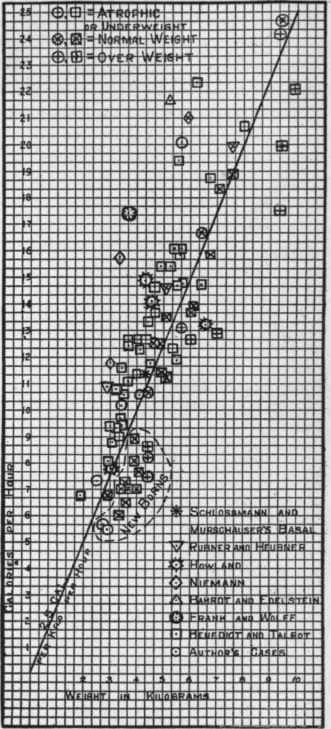
Fig. 24. - Showing relation of heat production to body weight. All infants whose metabolism has been studied by von Pettenkofer or Regnault-Reiset methods.

Fig. 25. - Showing relation of heat production to skin surface. All infants whose metabolism has been studied by von Pettenkofer or Regnault-Reiset methods.
Continue to:


My Books

