


The Regulation Of Temperature. Part 7
Description
This section is from the book "The Elements Of The Science Of Nutrition", by Graham Lusk. Also available from Amazon: The Elements of the Science of Nutrition.
The Regulation Of Temperature. Part 7
A temperature of 200 was readily borne by this dog without any increase of his metabolism. The period of unchanging metabolism extended over at least ten degrees between 200 and 300, during which time the physical regulation alone sufficed to maintain evenly the body's temperature. At 350 a decided increase of heat production set in, on account of the warming of the cells through insufficient heat loss. That the range of the physical regulation of the temperature of this small dog was due to his long hair is shown by the change in his metabolism after shaving him. Rubner shows this in the following table:
Temperature. | Calories per Kilo. | ||
Normal Coat of Hair. | Shaved. | ||
20°..... | 55.9 | 82.3 | |
25°..... | 54.2 | 61.2 | |
30°..... | 56.2 | 52.0 | |
It is clearly seen that this dog lost his power of physical regulation between 200 and 300 as soon as he lost his covering of hair. His metabolism became like that of the guinea-pig, increasing with a reduction of temperature from 300 downward, an illustration of chemical regulation.
E. Voit1 shows that the metabolism of a pigeon may be doubled after removing its feathers.
Babak2 finds that if rabbits are shaved and varnished with starch paste their metabolism rises 140 per cent., which increase maintains their body temperature at the normal for several weeks, although the room temperature be between 150 and 200.
To determine the influence of the second factor, that of the protecting layer of fat, Rubner3 investigated the influence of temperature on the metabolism of a fasting short-haired dog at a time when he was emaciated, and compared it with the fasting metabolism after the same dog had been fattened. The results were as follows:
Dog (Thin). | ||
Temperature. | Cal. per Kilo. | |
5.10º .. | ............ | 121.3 |
14.40 | .............. | . . 100.9 |
23.3°-- | ............ | 70.7 |
30.6°... | .............. | 62.O |
Same Dog (Fat). | ||
Temperature. | Cal. per Kilo. | |
7.3º | ........... | • 120.5 |
15.5°.... | ........... | 83.0 |
22.00. . .. | ............. | 67.0 |
31.00 | .............. | • • 64.5 |
It appears from the above that the metabolism of the dog was the same at a low temperature in both cases, but that the minimum metabolism was almost reached at a temperature of 220 when the dog had a protective covering of fat, which was not the case when he was thin. The presence of adipose tissue, therefore, acts in the same way as does a warm fur to extend the range of the physical regulation, and to delay the onset of the chemical regulation of body temperature.
The physical regulation may be increased by certain voluntary acts, such as are observed when a dog exposed to cold lies down and curls himself up in such a way as to offer as small an exposed surface as possible. The contrast to this is offered when on a hot day the dog lies on his back and extends his limbs so as to promote the loss of heat.
1 Voit: "Sitzungsber. der Ges. fur Morph. u. Physiol.," 1904, xix, 39. 2 Babak: " Pfluger's Archiv," 1905, cviii, 389. 3 Rubner: hoc. cit., 1902, p. 137.
Rubner1 also cites an important modification of metabolism through a variation in the humidity of the atmosphere.
At a medium temperature during fasting (as well as on a medium diet) the metabolism of a dog was practically unaffected by an increase of humidity in the air, as appears below:
Temperature 20.2 ° | Calories in 24 Hours. | Humidity in Per Cent. |
Dry day .............................. | 258.4 | 34 |
Humid day ...................... | 256.6 | 69 |
More on dry day .................... | 1.8 |
However, on a liberal diet the metabolism increases on a damp day even at a medium temperature, as for example:
Temperature 20.2° | Calories in 24 Hours. | humtdity in Per Cent. |
Very dry day ............... | 249.4 | 13 |
Humid day .................. | 261.9 | 66 |
More on humid day .................. | 12.5 | |
The increase is 5 per cent. |
On a very hot day (on a moderate fat diet) the dog's metabolism is increased by the presence of moisture in the atmosphere.
Calories per Kg. | Temperature 3s0. | Humidity in Per Cent. |
69.28 | 9.1 | |
73.54 | 30.0 |
Under these circumstances the metabolism rose 6.1 per cent, in the more humid air. There was probably an overwarming of the cells on account of the difficulty of heat loss by evaporation of water. A cold, damp environment of o° to 50 temperature also favors an increased metabolism. Rubner attributes this action of humidity to the increased conductivity of a hair covering containing moisture, and says that this loss may be partially balanced by a decreased evaporation of water from the lungs.
1 Rubner: "Energiegesetze," 1902, p. 188.
Murschhauser and Hidding1 have experimented with guinea-pigs' placed in various environmental temperatures and furnished either with perfectly dry air or air completely saturated with moisture. At 350 the well-known influence of air saturated with water increased the body temperature and, therefore, the metabolism. At both 200 and 50 the influence of cold was accentuated by excessive dryness of the air, so that the heat production was about 10 per cent, higher than in moist air at the same temperature. This is explained by the fact that in dry air evaporation of water from the lungs increased the loss of heat by the animal which was compensated for by an increased metabolism.
The metabolism and the manner of heat loss may, therefore, be variously affected by the condition of the atmosphere as regards moisture.
On days of ordinary dryness Rubner2 calculates the following division of the heat loss in a starving dog under the influence of different temperatures:
Influence Of Temperature On Manner Of Heat Loss
Temperature. | Calories Lost by Conduction and Radiation. | Calories Lost by Evaporation of Water. | Total Calories of Metabolism. | Humidity in Per Cent. |
7°........... | 78.5 | 7.9 | 86.4 | 24 |
15°........... | 55.3 | 7.7 | 63.0 | 34 |
20°........... | 45.3 | 10.6 | 55.9 | 29 |
25º........... | 41.0 | 132 | 54.2 | 19 |
30°........... | 33.2 | 23.0 | 56.2 | 14 |
It is clear that at 70 only a little heat is lost by the evaporation of water and the greater part by conduction and radiation. As the surrounding air becomes warmer the power to lose heat by radiation and conduction diminishes, and the loss through the evaporation of water increases.
Rubner has charted this experiment after making allowances3 for the varying moisture conditions. The chart is reproduced in Fig. 11, and epitomizes the method of heat loss in a starving dog under the influence of varying temperatures. The discussion of the metabolism has given a foundation for the understanding of the basic requirement of an organism. The minimum requirement for energy is seen to be present when the fasting organism is surrounded by an atmosphere having a temperature of 300 to 350. This may be called the basal metabolism, the minimum of energy compatible with cell life. This basal metabolism is modified by temperature, by food, and by work, and it is an important factor to keep in mind (see p. 124).
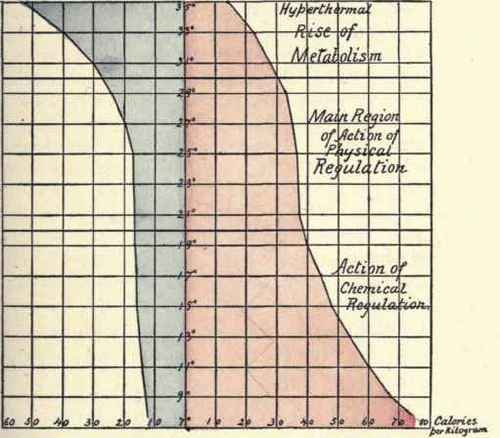
Fig. 11. - Rubner's chart showing the manner of heat loss at different room temperatures in the dog. Blue, Heat loss in calories through evaporation of water. Red, Heat loss in calories through radiation and conduction.
1 Murschhauser and Hidding: "Biochemische Zeitschrift," 1912, xlii, 357.
2 Rubner: "Energiegesetze," 1902, p. 193.
3 Rubner: "Archiv fur Hygiene," 1891, xi, 208.
Continue to:


My Books

