


Gas Burners For Boilers
Description
This section is from the "Blast Furnace Construction In America" book, by J. E. Johnson, Jr.. Also see Amazon: Blast Furnace Construction In America.
Gas Burners For Boilers
Blast-furnace gas is a relatively lean gas. When of the normal composition given above it requires about 60 per cent. of its own volume of air for theoretically complete combustion, to which a small excess is generally added because while the losses from heavy excess of air are very great, those from unburnt combustible are still greater, and as it is impossible to maintain an absolute adjustment of air to gas it is better to err on the side of having a small excess of air rather than any considerable quantity of unburnt fuel.
In order to get the best results with the least excess of air an intimate mixture of gas and air must be made, and as the velocity of the gas through the boilers under the effect of draught is high the time for making this mixture is limited to a small fraction of a second. For this reason the entering currents of gas and air must not only be in intimate contact, but must present a maximum surface of contact for the area of opening required. This result is obtained either by the use of multiple ports for gas with air ports between, or by the use of a narrow port for gas with air on both sides. The latter is the type shown in Fig. 70.
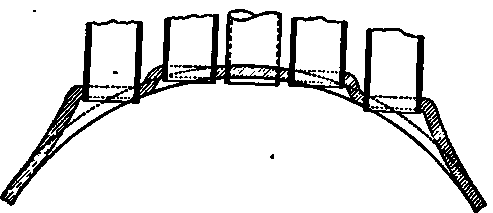
Fig. 68. Rust tube sheet.

Fig. 69. Rust boiler in setting.
The end of the curved flat burner projects into the front of the fire box with a clear space for air all around it. By the simple expedient of having a rectangular frame surrounding the burner and sliding on it, which can be pushed up close to the fire box front or drawn away as desired, the amount of air admitted may be varied at will, while the amount of gas may be controlled by the gas valve above. This provides independent regulation of air and gas, admitted to be a prime necessity for the most economical combustion of furnace gas.
In former times gas flues from the furnace to the boilers generally ran underground, and in these cases the burners were arranged to stand over an opening in the top of this flue. But such flues are unsatisfactory, both because of the difficulty of cleaning them out, which is even greater than in the case of the chimney flues, and because being under the ground their tightness can never be insured, nor the amount of leakage from them determined, and leakage of furnace gas is not to be tolerated because only a few cubic feet in a large room are sufficient to cause sickness and violent headaches, if not more serious consequences. Therefore, overhead mains of steel lined with fire brick are now commonly used, and the burners are suspended from them in some such way as that illustrated. This is a decided advantage, not only for the reasons given but because the burner is completely above and out of the way of the fire doors in case coal firing is necessary. This is by no means the case with burners coming up from below, which are not infrequently in the way at such times.
Fig. 70. Burners for blast furnace gas.
Precautions As To Grates
When a Dutch oven or combustion chamber such as I have recommended is used, the radiation downward from its roof or top surface is intense, while the grates are not protected by a current of air up through them as they are when coal is burned, since the air must be admitted with the gas for reasons explained above, and therefore the ash-pit or draught doors must be kept closed.
For this reason the grates should be lightly covered with some substance such as coal, ashes, or even a layer of brick laid loosely over them, to cut off the heat from above, otherwise the radiation from the arch is liable to melt them down or at least fuse shut the air openings. This might not be observed so long as the gas supply continues, but if in an emergency it suddenly becomes desirable to fire coal, the grates being worthless, none can be burned, and serious delay results, as well as the loss of the grates.
Very frequently the grates are protected by having a bed of coal spread on them which burns very slowly because no air comes up through it; the hot upper surface of this serves to light the gas instantly if the supply should fail momentarily and then start again. This is a matter of much importance, because if a mixture of gas and air fills the setting before ignition, an explosion will result when ignition takes place, and the setting at least will be seriously damaged; even the boilers may be thrown out of place and they or their steam connections ruptured. Accidents of this kind have frequently occurred, and too many precautions cannot be taken to avoid them.
Continue to:


My Books

