


Part III. Brass Foundry. Copper And Its Alloys
Description
This section is from the "The Construction Of The Modern Locomotive" book, by George Hughes. Also see Amazon: The Construction Of The Modern Locomotive.
Part III. Brass Foundry. Copper And Its Alloys
Copper has the capability of forming a combination with nearly all the metallic elements, producing compounds different in character from their component parts, possessing all the physical and chemical characteristics of metals, but often modified so as not to resemble either of those parts. This combination will either be of a complete chemical nature, or a solution of the chemical combination in an excess of one or the other. In itself copper possesses malleability and ductility to a considerable extent, which is clearly shown by the curve A, Fig. 108a. Its fluidity and tenacity is increased by a small addition of phosphorus, but unless alloyed with some other metal, such as tin, this addition of phosphorus increases its tendency to corrosion. The change in its physical properties, caused by the addition of zinc, is well illustrated by the curve B, Fig. 108a, each being autographic records of ordinary tensile tests taken by Aspinall's recorder. They do not require any further explanation, but those marked cohesive force have been plotted from the curve of tensile strain. utilising the data given by Professor Unwin on page 419, vol. lix. of the Engineer, where he shows that assuming the sample to he uniformly plastic throughout its length, which for our purpose is approximately correct up to its climax of resistance, the percentage of contraction of area is equal to the percentage elongation, calculated upon the stretched length of the bar. In the examples, this point has been ascertained, a new scale constructed, and the curve has been plotted in a convenient manner by raising the climax of resistance by the required percentage. Oblique lines have then been ruled across to the original scale, and the curve plotted by noting where the load curve crosses the load ordinates, and transferring this point vertically to the corresponding oblique line. The remainder of the curve is obtained by calipering the contracted area of the sample, which fixes the highest point; the intermediate ones however cannot be obtained, because the length subject to local contraction becomes more and more restricted as the moment of the fracture approaches, therefore the path of this portion of the curve is merely hypothetical A synopsis of the particular of these curves is given in Table I. Annealing the copper samples before testing would have produced 45 per cent, elongation.
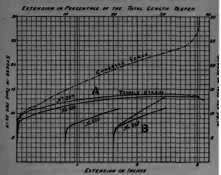
Fig. 108a.
Table I
Curve | Test No. | Stress in tons per sq. In. | Elongated per cent. on 8 inches | Construction per cent. |
A | 281 | 13.66 | 40.0 | 52.9 |
„ | 284 | 14.04 | 38.5 | 53-8 |
B | 233 | 11.00 | 11.5 | 20.9 |
" | 235 | 11.00 | 11.0 | 20.9 |
In the manufacture of homogeneous alloys, the following may be taken as characteristic difficulties, with their total or partial solution. Impurities in the diluting metals, which will seriously injure the physical properties of the resulting alloy, decreasing as the purity of the diluting metals increases by improved metallurgical methods of manufacture. The oxidation of the metals to an always varying extent, which occurs during the period of melting, and will always remain a difficulty, only to be mitigated by experience of the furnace, fuel, and quick melting. The occlusion of oxygen, the combination or mixture of oxides, produced from the constituting metals during melting, with the alloy, or the absorption of small quantities of the products of combustion, including carbon and sulphur, and then the evolution of these gases or expulsion of oxides during cooling, rendering the alloy porous, which may be remedied by the addition of phosphorus. Finally, liquation at the period of cooling, when the alloy will separate out in distinct groups of various grades of hardness, unequally diffused throughout the mass of the easting, which can be remedied to a certain extent by adopting means for rapid cooling. The larger portion of the heavier metals will assume a level in the crucible in order of their respective densities, unless they are prevented from doing so by violent agitation, and a partial separation will consequently take place in the casting, even when all the attention possible may have been bestowed upon the alloy during its formation, especially if the casting is large, and therefore the cooling slow, also if large proportions of lead or tin have been used; therefore, to obtain perfect homogeneous alloys, remelting is sometimes a great advantage, especially if it can be accomplished with the minimum amount of oxidation and occlusion going on. If there has been an appreciable amount of oxidation it is impossible to get good alloys, because, if the author may illustrate by Dalton's atomic theory, their atomic bonds are clogged with this slag, and consequently the metals will not "wet" each other.
Continue to:


My Books

