


Building Small Pools And Dams For Fun And Profit
Description
This section is from the book "Make It And Make It Pay!", by Catherine Roberts. Also available from Amazon: Make It And Make It Pay.
Building Small Pools And Dams For Fun And Profit
1. How To Begin
Wear old clothes, particularly old shoes, for all concrete and masonry work.
Rub vaseline or a protective cream into the hands to protect the skin from the drying effects of cement. Many professional masons make a habit of doing this before starting the day's work.
Use a pail to carry cement, sand or gravel in.
Use a long-handled or snow shovel to slide rocks along to desired position. Trying to lift them or to carry them is foolish and fatiguing.
Use a hose to bring the water to your mixing point. If your own hose is not long enough, borrow another one and hitch it up. Water is extremely heavy to carry, so avoid doing it whenever possible. If it must be pail-carried, cart it along in a child's express wagon. The wagon may be used to tote dry materials, too.
Take it easy. It is more fun in the long run.
2. How To Mix Concrete
Before starting any masonry job you have to know what concrete is, how to mix it, use and cure it. Professional masons know about eleven different ways of combining the necessary ingredients to make various kinds of mortar. For the work discussed here only a few different combinations are needed.
The most common concrete mixture is known as 1-2-3, which means I part cement to 2 parts sand to 3 parts gravel.
The cement used for most home and garden projects is called Portland. That is not a trade name but indicates a kind of cement and is manufactured by a number of different companies. It was named Portland because, when its method of manufacture was perfected in 1825, its color closely resembled that of the famous hard stone quarried on the island of Portland, England.
Portland cement is purchased in paper bags weighing 94 pounds and measuring, by volume, exactly one cubic foot. It costs approximately $ 1.65 per bag. Sand and gravel are bought by the cubic yard from supply houses dealing with bricks, cement and building supplies or from local trucking concerns. They cost about $ 1.50 per cubic yard each. These materials must be stored carefully until and during use. Cement must be kept absolutely dry. It will absorb moisture rapidly and become unfit for use. Sand and gravel should be kept in covered containers of some sort, as twigs, leaves and dirt in them will ruin your mix.
There is a definite procedure to the mixing so follow it right from the beginning. Have the proper tools at hand. They are a shovel, hoe and a pail in which to measure, and a mixing platform. The latter sounds formidable but really is not. A child's discarded sand box, if it has a sound bottom, makes an excellent mixing trough. An old metal wheelbarrow or express wagon will work well. You might even be able to borrow a professional trough from the trucking concern or supply house. If nothing similar is available, it is easy to build yourself one. Just take enough old boards to make a four foot square platform. Saw the boards the necessary length. Fasten them together by means of cleats (two 2 x 4's, each four feet long) on the underside. The boards must fit tightly together to prevent the water from leaking through.
Professional masons measure concrete by cubic feet or cubic yards.
Common mix is the 1-2-3. Dry materials are mixed thoroughly Then about 5 gallons of water are added and mixed in. Mixture should be plastic, not sloppy.
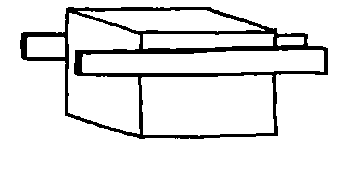
To make an accurate measuring container holding just one cubic foot of dry material: make a bottomless box with inside dimensions of 12" high, 12" wide and 12" long.
Professional masons deal in cubic yards as units of measurement in mixing. That large a unit will produce far more concrete than your first few jobs will require. It is more economical to mix up small batches since mixed cement cannot be saved to work with the next day. It is also less work to measure and handle small quantities. Since all the materials are measured by volume, you can pick your own measure as long as you use it consistently with all the materials. A galvanized pail is a handy unit to use and carry. Be sure, however, that the inside of the pail is perfectly dry before putting in any cement or sand.
To mix cement: (I pail cement, 2 pails sand, 3 pails gravel, plus about 1/2 pail water)
1. Measure sand and dump onto mixing platform. Spread it out into a flat circle.
2. Measure cement and dump on top of sand.
3. Mix sand and cement together with hoe until one even color. No streaks of dark or light should show.
4. Measure gravel and mix thoroughly with sand-cement combination.
5. Push dry materials into a ring having a hollow center.
6. Pour water into hollow and combine with dry materials.
Use the hoe to pull the dry ingredients from the inner side of the ring into the water and mix therein. Do not break down the ring at any point, or the water will run off and be lost. If towards the end of mixing, the concrete seems to be too stiff, add a bit more water and mix it thoroughly. Actually, the mix should be softer than modelling clay. Avoid making it sloppy or runny. It should be plastic enough to hold together when a bit of it is pressed in the palm of the hand.
The 1-2-3 mix is used for small pools, wading puddles, foundations for driveways, walks, poultry house and garage floors. If you leave out the gravel, the result will be a 1-2 mix which is smooth and rich in texture and is used for finishing coats. A 1-3 (I part cement to 3 parts sand) mix is used for bonding flagstones, for terraces and sometimes for bonding bricks for walls and walks. But more about these later.
Continue to:


My Books

