


How To Frost Designs On Glass
Description
This section is from the book "Make It And Make It Pay!", by Catherine Roberts. Also available from Amazon: Make It And Make It Pay.
How To Frost Designs On Glass
Another effective way of decorating glass bottles, cider and vinegar jugs, mirrors, picture glass and tumblers is to frost a design on the surface. A special etching paste is used together with a foil stencil. These are obtainable in handcraft supply stores. They are very easy to use as can be seen by consulting the directions on the package. Briefly, the etching or frosting is done by spreading the paste on the exposed area of glass, allowing it to remain on for two minutes and then washing it off under water.
All glass surfaces must be quite clean before attempting to frost them. Follow the same procedure for cleaning bottles and jugs as was done in preparing similar ones for painted decoration. Be sure that the final rinse water is hot and quite free of soap or washing powder. Polish the glass with a clean, soft towel.
While jugs and bottles may be effectively decorated with frosted designs, they are still jugs and bottles. You can change the picture completely by cutting off the tops, thus transforming them into lovely vases. Their simple shapes and good proportions lend themselves admirably to both flower arrangements and purely decorative pieces. When gallon cider or Chlorox jugs have their tops cut off, their sides decorated with simple frosted designs, they become smart and attractive ice cube containers, pop corn and pretzel bowls for parties.
The way to cut off the top from a jug or bottle is explained in the sketches on page 50. The position of the string, whether high up on the shoulder, centered, or low down, is determined by what you want to do with the jug or bottle after it is cut. High ones makes vases. Shallow ones may be used for centerpieces to hold fruit or candy. In between ones may be put to a number of practical and lovely purposes. After the cutting has been completed, and before any decoration is started, take the jug or bottle to the local glazier and have him grind off the edge. This is absolutely necessary as the cutting leaves an extremely sharp edge which must be blunted before you can work on or use the containers. The cost of grinding is negligible and you can, perhaps, make arrangements with the glazier to have quite a number of bottles ground for one flat price.
After the edges are safe to handle, the actual frosting may be started. The manufacturer has prepared a number of stencil foils, cut in various designs, that you may care to use for the first few times. You can also get plain sheets of foil with which to work out your own designs. These are fun to do and are more distincfive and individual than the commercially cut ones. Work out your design on paper, keeping it quite simple. As with any other kind of stencil, remember to leave connecting bars to hold the design together. When the design is complete, trace it on the foil, then cut it out with an Exacto knife. When carefully applied to the glass, and as carefully removed, the same stencil may be used a number of times.
Etched or frosted monograms, either individually or commercially cut, are attractive and highly personal. The monograms or initial letters may be used on vases as well as tumblers, on inexpensive decanters and glass candy jars. As with other frosting designs, the monograms must be kept simple and restrained in style.
One gains skill and speed in decorating only by experience. There is a tremendous and highly profitable field for this type of craft and for the young craftsman willing to spend the time and effort exploring its possibilities. What is attractive and salable in one locality may be a dud in another. What you personally like may be fine for gifts but quite unappealing to a store buyer. That is all part of the game. Keep practicing and experimenting. You'll find your niche.
HOW TO CUT GLASS BOTTLES
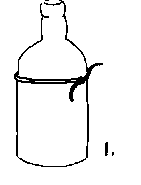
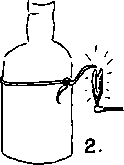
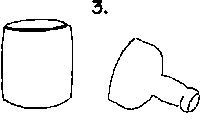
Soak a piece of cotton string in turpentine, 1. Tie string around the bottle at point to be cut. 2. Light end of string with match. The string will burn around and go out. 3. Neck of bottle is given a sharp rap on table edge. Top will break off. Have cut edges ground by local glazier. This will blunt and smooth them. Experiment with ginger ale bottles, then try gallon jugs.
HOW TO ETCH ON GLASS
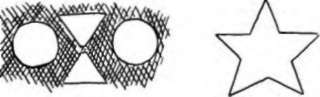
Cut simple designs in stencil
Paste stencil-foil on bottle, then apply etching paste to the cut-out areas.
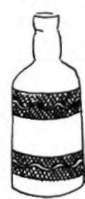
Leave paste on for two minutes. Rinse off under the faucet. Peel stencil off carefully.
Etching paste gives a delicate frosted appearance to surface of glass. Keep the designs simple- Repeat one or two motifs for smart and easily worked borders.

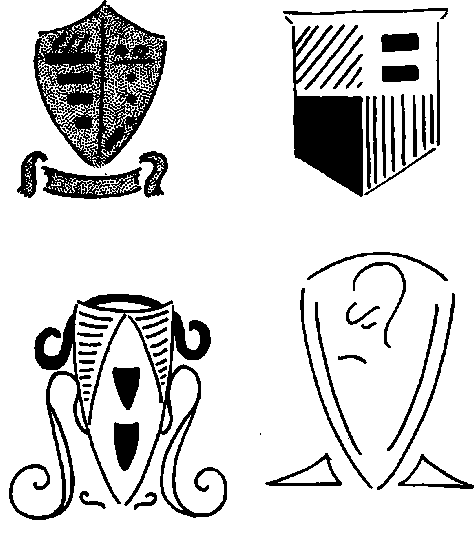
Books on Heraldry offer many interesting design possibilities for painted or etched decoration. Eliminate many small details. Concentrate on the silhouettes and large shapes particularly when working out designs for stencil cutting.
Continue to:


My Books

