


How To Make A Pond
Description
This section is from the book "Make It And Make It Pay!", by Catherine Roberts. Also available from Amazon: Make It And Make It Pay.
How To Make A Pond
The construction of a pond by the young mason is only practical when he can work in an area that has a natural water supply such as that given by a small brook. A completely artificial pond that must be filled by means of pipes run underground from the house or main water supply involves too much work and technical plumbing knowledge. The brook-fed pond, however, is relatively simple and is a lot of fun to construct.
The very first step is to decide how large the pond is going to be. Since all the necessary excavation will be done by hand don't let enthusiasm dictate too large a pond. One that is about twelve feet wide and fifteen feet long may sound small but remember the digging. You'll be glad to have some of your friends help on this part of the job, for several tons of dirt may have to be dug and removed before any other part of the work is started. This work is greatly simplified by having a small bulldozer come in and do the required excavation work. It should not take, depending upon the type of soil, more than two or three hours to do the job mechanically. At a cost of about $6 per hour for the bulldozer and operator, this may not be expensive when compared to the number of man hours needed to do the same amount of work.
The best time to excavate for the brook-fed pond is when the brook is dry. If it runs all year, wait until it has reached its lowest point. If it is a very small brook, and most of them are, it won't be necessary to divert it while digging the pond basin or building the dam.
Build A Dam
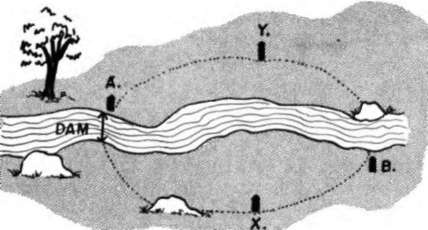
Mark outer border of pond with stakes:A-Y-B-X. Start digging from outside edge in to bed of brook. Deepest part should be at the dam end of the pond. Use dirt in dam building.
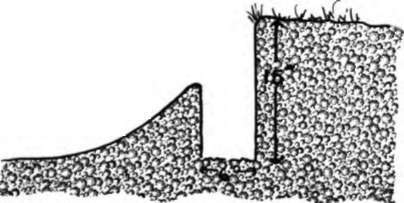
Stone retaining wall around pond requires foundation trench, 15" deep and 6" wide.
Large rough stones, concreted with a 1-2-3 mix, make a substantial wall. Rat stone top.
On page 12 there is a plan of a pond and dam that will be helpful in working out your own project. Select the place where you want the dam to be and drive a stake into the ground. Measure upstream from this stake the length the pond is to be (in this case, fifteen feet). Drive in another stake. Tie a cord, pulling it taut between the two stakes. From the center of the cord measure out at right angles to it a length of cord that equals half the width of the pond (six feet). Do this on the opposite side, allowing for the width of the brook, which is probably about ten or twelve inches. That will make this measurement about seven feet. Stakes are driven into the ground at both sides to mark the outer edges of the pond.
Now, check with the plan on page 12 which shows the position of the dam, stakes, and approximate shape of the pond. Draw a line on the ground with a pointed stick curving from A (site of dam) to Y . . . from Y to B (where brook enters pond basin) . . . from B to X . . . and from X to A. If this drawn line is lopsided or irregular, let it be. No pond created by nature was ever geometrically perfect, so why should you try to improve upon things?
Start the digging from the outside edge and work in towards the center. Be sure to throw the excavated dirt into a wheelbarrow or express wagon as you work. Then it can easily be hauled away and dumped. Dig straight down vertically until you reach hardpan or clay. All topsoil should be removed so that the pond will be reasonably clear and free of mud. Once the outer edge of the pond is dug, start working towards the brook, slanting the bottom of the pond basin in towards the center. If you come upon rocks, pry out the small ones and let the large ones stay there. Any rocks embedded along the outline of the pond should not be taken out. They will add to the natural appearance of the pond and will help keep the banks from washing in.
As you reach the normal banks of the brook the work will get sloppy. Wear boots. The water will spread out but it won't go far. It may even seem to disappear as it hits the soft areas beyond its original stream bed. Don't worry. As it reaches hard-pan or clay, the water will start to accumulate again.
Now, you can leave the banks of the pond just as you have dug them, relying upon grass and plants to keep the soil from washing in, or you can build a retaining wall around the pond. The latter method is not difficult.
Collect plenty of good sized rocks, preferably flat ones. Get friends to help on the rock pile by bringing additions to it every time they come over. You will need more rocks than you think, so make the pile a really generous one. Don't start the wall until you are fairly sure you have enough rocks to work with. Any that are left over can be used in the dam.
Continue to:


My Books

