


Water Motors. Part 2
Description
This section is from the book "A Working Manual Of American Plumbing Practice", by William Beall Gray, Charles B. Ball. Also available from Amazon: Plumbing.
Water Motors. Part 2
Tank installations are so often remote from a plumber that every reasonable means should be provided for enabling the users to avoid trouble. A branch from the pump delivery, connecting with the cold service over the reservoir by stop-cock, is permissible, that the reservoir may be filled directly from the pump, by pumping slowly, when the tank or regular supply is out of order. A branch with permanent upright cock-funnel, is often placed on the cold over the reservoir for the same purpose. One may then open the cock, and pour in water with a pail.
The hot service is sometimes brought down from the reservoir, and up behind the sink, for convenience in using the stop-cocks even though circulation is to be employed. In these cases a loop to the attic level is used to induce circulation. Instead of returning from the lavatory or end of the main line, as in other tank jobs and in pressure work, the relief continuation of the hot to the tank is used for the flow of the loop, and a branch is taken from it in the attic and carried back to the bottom pipe of the stove connection. The return of the loop should be larger than the balance - that is, larger than the rising relief from which it is taken. Circulation is dependent upon the difference in temperature of the water in the two lines of the loop; and the large return, by radiation, creates a greater variation of temperature than would be possible in two lines of the same size. It is thus sought to secure sufficient difference in the weight of the two columns to overcome the impediment due to trapping the supply, as stated.
A material auxiliary feature to which success should sometimes be credited in this type of installation, is the skilful arrangement of a tee or Y fitting at the junction with the stove connection. Water being heated in the stove, circulation through the heater is inevitable. To aid the general hot-service circulation, it is then but necessary to divide the work of furnishing water to the heater, between the reservoir connection and the return pipe of the loop. This is done by reducing, at the circulation connection, the flow from the reservoir to the stove, to much less than the capacity of the regular size from that point to the heater. This constriction makes the reservoir feed inadequate to supply the demand of the heater, and the deficit is drawn from the circulation loop, thus keeping the water in motion therein - which is the end in view. If a Y fitting is used, the circulation should attach to the branch, so that its flow will change direction only 45 degrees, If a tee fitting is used, the constriction should be in the branch, and the circulation connected at the end of the tee, so that its flow will not change course at all in joining the feed from the reservoir
The means of turning the sediment pipe on and off should always be a ground-key cock (especially if connected to the waste) so that one can see at a glance whether it is on or off, as accidental emptying of the reservoir is dangerous. Another reason for using cocks is that the shearing action of the core, when turning, will cut off a piece of lint or other foreign matter that would not permit a compression stop to close tight. Whether a cock has closed tight, is not observable; and the whole supply in a tank job may in this way be lost without warning, leaving the heater dry. Unknown waste through the sediment cock retards heating. The failure of hot faucets to close tightly will waste water as fast as it is heated. Hot faucets should have washers adapted to withstand heat, in order to avoid frequent repairing.
Where lime or other deposits choke the water-back and connections as ordinarily installed, both the annoyance and the danger may he avoided by following the plan shown in Fig. 94, in which the water is heated by water by conduction through a coil in the reservoir. The water-back is connected to the coil; and an expansion tank, piped as shown, is provided to take care of the expansion of the water in the primary heater or water-back. Distilled water is used in the back to avoid incrustation of the back and connections. C is the tank, which must be filled to above the flow connection. G is tank return; D, the drain to water-back and connections; E, a sediment cock on the reservoir proper. The flow from upper water-back connection to expansion tank should be at least one size less than either the coil in the reservoir or its connections.
When cost is not the desideratum, direct-pressure plumbing is generally better if a tank is used, even though the initial pressure is ample and not excessive. The pressure on the fixtures is then always constant, and also moderate unless the building is very high. This point is important where the city pressure is sufficient for fire purposes, or when the pressure is carried abnormally high only during the need for fire purposes and then reduced. A high-pressure line Feeding the house tank and controlled by a ball-cock, permits valves of simpler mechanism and lighter pipe and fittings, and reduces water-hammer, etc. Moreover, much foreign matter carried in suspension is got rid of, subsidence improving the water and reducing the wear and tear on valves and washers to a minimum.
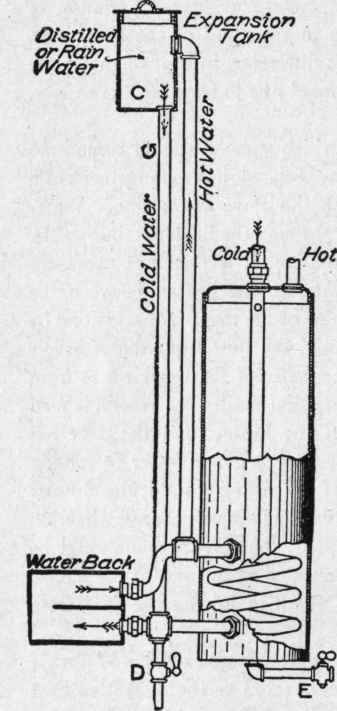
Fig. 94. Reservoir Heated by Hot-Water Coil, Connected to Water-Back, Avoiding Choking from Lime or Other Deposits..
Fig. 95 shows the essential connections of a house tank. B is the supply to tank. A ball-cock is used when city pressure supplies the tank; C is the drain-pipe, and B the overflow. K is the cold service to fixtures; and d the air-pipe enabling the line to drain when the cock is turned off. The cold-service connection rises above any possible sediment level in the tank. J, L, N, etc., are extensions of the hot and cold fixture lines.
Continue to:


My Books

