


Chapter IX. Kitchen Sinks And Grease-Traps
Description
This section is from the book "Improved Plumbing Appliances", by J. Pickering Putnam. Also available from Amazon: Improved Plumbing Appliances.
Chapter IX. Kitchen Sinks And Grease-Traps
OF all plumbing fixtures none is more dependent upon a proper form of discharge than the kitchen sink. Nowhere is the application of the principle of the flush tank more needed than here, because in no other manner than by thorough flushing can the greasy matters passing through the sink be disposed of wholly without harm. To remove these matters from the things which are washed in the sink, hot water is necessary, and this liquefies the grease.
If the volume of water into which this melted grease is led is not sufficient to control it and carry it through the waste-pipes with a powerful rush, it will congeal upon and putrefy in these pipes until a serious nuisance is formed. In ordinary sinks, as now made, the melted grease dribbles away through the sink strainer and chills upon the inside of the waste-pipe before it has traveled a rod from the sink. In chilling, it forms a coating upon these pipes so hard that it is subsequently often very difficult to remove, and sooner or later causes annoying stoppages. The obstructions can sometimes, but not always, be removed by pouring a hot solution of potash into the pipes until the grease dissolves and becomes converted into soap.
Where proper clean-out caps have been arranged in the sink waste-pipes, an obstruction can sometimes be reached and scraped out by suitable tools; but such opportune openings are seldom found when and where they are needed, and the removal of this putrid matter is, at best, so exceedingly offensive and unwholesome an operation, that it is usually deferred as long as possible, and the foul decomposition goes on in the waste-pipes out of sight.
For small houses, however, and wherever care is taken to save the grease in dish-washing, instead of pouring it out into the sink, and especially where a good grease-trap is used outside of the house, and the sink is placed close to the outer wall within a few feet of the grease-trap, the ordinary sink may suffice. No material is equal to white earthenware for kitchen sinks. They should be set open, as shown in Fig. 61.
This and the following figures I am enabled, through the courtesy of Mr. Gerhard, to borrow from his recent work

Fig. 61. - Porcelain Kitchen Sink set open. From Gerhard's "Domestic
Sanitary Appliances." on "Domestic Sanitary Appliances," published in "Good Housekeeping" in 1885.
A cheaper and more common kitchen sink is made of enameled iron. Still cheaper is the painted iron sink. A better protection for the iron is afforded by the magnetic oxide coating obtained in the Bower-Barff process. Mr, Gerhard writes of this subject in his interesting and valuable articles, above referred to, as following: "Sinks of plain wood, or lined with lead, zinc or copper, and those of slate or sandstone are gradually coming out of use. Sinks made of soapstone are still much employed, especially in the New
England States, but they soon acquire a black coloring, owing to the grease absorbed in the grains of the stone, which renders their appearance far from inviting. Nothing surpasses in purity and beauty a white porcelain sink, which, of course, should be built strong enough so as not to crack or break. If such a sink is used, it is quite important to have its outlet protected by strong brass or plated strainers, securely fastened to the sink, otherwise your servants will remove the strainer and brush all kinds of solid refuse into the pipes, to cause frequent stoppages and a never-ceasing demand for the 'family plumber.' Since it is the usual practice of washing dishes to set into the sink a vessel filled with water, which is quickly emptied after use, the waste-pipe and trap receive, at frequent intervals, a reasonable amount of scouring, provided the pipe and trap are restricted in size so as to concentrate the flushing water.

FIG. 62. - The "Dececo" Flush Pot.
"Where much grease is wasted, it is customary to use grease-traps. My experience with several kinds of grease-traps has led me to discard all those attached to the sink, or located close to the sink or else placed in the basement, all intended to arrest and retain the grease. It is a most difficult matter to get the cook to attend to its proper removal at frequent intervals, and the cleansing of the grease chamber. Hence, these are actually soon turned into a noxious cesspool inside of the house, and if, finally, water refuses to flow off freely, the removal of the putrefied grease causes an abominable nuisance. A grease-trap of stoneware or built of brickwork, located outside of the house, not too far away from the sink - for otherwise the grease would solidify before it would get to the grease-trap - is much less objectionable than the usual indoor appliances. I desire, however, to call your attention to a recent device, to be attached directly underneath the sink, invented by Col. Geo. E. Waring, Jr., which seems to answer all the requirements in preventing the grease from clinging to the inside of the waste-pipes, besides affording them a good flush. Fig. 62 illustrates this apparatus, which is called the 'Dececo' Flush Pot, and which can be attached to kitchen sinks of iron, soapstone or porcelain. To describe it I cannot do better than quote the words of the inventor:
" 'The Flush Pot is an entirely new departure. It holds back everything, water and all, until it is filled. The pot under the sink holds six or seven gallons. Its contents are then discharged - the whole volume suddenly - with such scouring force as to prevent adhesion to the walls of the waste-pipe. It is entirely simple in its construction and needs no special thought. When the water ceases to run from the sink, the cook knows that she must lift the plug of the flush pot. The strainer may easily be removed at will. The whole interior, then exposed to view, is within easy reach of a clout or a wisp, so that it may be kept as clean as a soup-kettle. We thus secure the entire removal of the whole of this greatest source of foul decomposition before its putrefaction begins. In discharging the flush pot, the handle should be raised only until the stop strikes the lower side of the strainer. The strainer should not be removed except for cleansing. It should never be removed while refuse of any kind is in the sink.' "
The "Dececo" Flush Pot is a very useful contrivance, and the facility with which it can be applied to any kind of sink renders it peculiarly serviceable. It requires, however, reasonable care in usage. Willful and careless servants will lift the strainer and brush into the flush pot matters which may sometimes be too coarse to be carried away even by its powerful flush. But such an abuse of a valuable sanitary contrivance is altogether unnecessary.
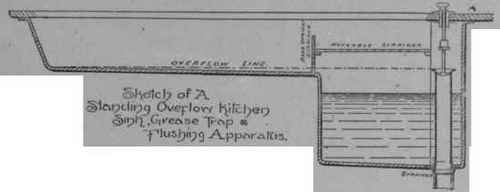
Fig. 63. - Section.
To lessen the difficulty, however, Mr. Gerhard has devised a very excellent sink, which I shall describe in the language of its author:
"The sink (Figs. 63 and 64) is divided by a partition wall into a shallow and a deep part. The shallow sink, with slightly inclined bottom, as shown in the illustration, is used in the same manner as ordinary sinks are. From it water flows into the deep receptacle, through an upright strainer in the partition, which retains all the coarser refuse, which is so conveniently gotten rid of by burning in the range. Whenever the deeper receptacle is filled to the overflow line of the stand-pipe, the cook lifts the latter by means of the knob, and the discharge is effected in the same manner as that of the flush pot described above. The deep receptacle might gradually accumulate some greasy slime, but this may be prevented by frequent cleansing, which is easily accomplished, the vessel being left entirely open. Nor is it difficult to lift and cleanse the stand-pipe as often as may be desired. The plate is simply a perforated dish drainer. The deep receptacle serves a further useful purpose in case it is desired to wash the utensils, pots, dishes, etc., directly in a vessel holding a greater volume of water. The sink shown is made of iron, but a slight modification renders this device equally applicable to the ordinary earthen sink."
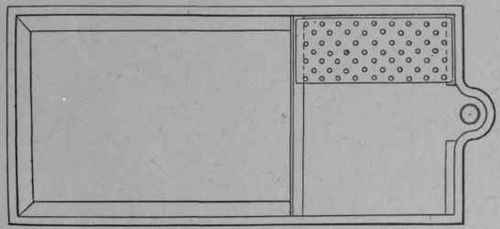
Fig. 61. - Plan.
It would be a considerable advantage to use with this sink some form of mechanism by which the stand-pipe could be slowly lowered automatically after opening, so as to allow all the water from the flush pot to escape at each discharge. A careless servant might otherwise be tempted to remove the stand-pipe altogether, if she were compelled to hold it up and wait while the water escaped from the flushing tank.
A catch on the stem such as has been described in connection with wash-basins and bath-tubs would not solve the problem, for although it would obviate the necessity of holding up the stand-pipe during the discharge, it would not lower it again when the sink was empty, and there would be the danger that the outlet would often be left open and the advantage of the flush tank at such times be lost.
Some form of retarding mechanism applied under the handle might be devised to cause the descent of the pipe to be gradual and automatic after its release, giving sufficient time for the entire discharge of the flush tank. Fig. 65 suggests a device designed with this in view, based on the principle of the air cylinders used in England for regulating the closing of water-closet valves, and in America for the closing of doors. The cylinder might be placed entirely above the sink slab, or partially below it. In the drawing the dotted lines near the top of the cylinder indicate the position of the slab in the latter case. In English regulators a cup leather, dipping in oil, is sometimes used, which permits of a rapid opening and a slow closing, and accomplishes the result in the smallest possible space. This principle is shown in the drawing. The downward movement of the piston is regulated by the nut and small air-hole just over the cylinder cap.

Fig. 65. - Device for Regulating the Closing of the Stand-pipe in kitchen sinks.
Continue to:


My Books

