


Development Of An Anti-Siphon Self-Cleansing Trap. Part 2
Description
This section is from the book "Improved Plumbing Appliances", by J. Pickering Putnam. Also available from Amazon: Improved Plumbing Appliances.
Development Of An Anti-Siphon Self-Cleansing Trap. Part 2
A very great incidental advantage of the present form of the trap is that the seal is not so deep. Hence, the flow of water through it is facilitated and its consequent scouring effect is improved.
Having now rendered the trap substantially self-cleansing, it remains to increase its power of resistance still further, for we find it by no means yet sufficiently anti-siphonic. There are two ways in which this may be done. The first is to increase the volume of water in the trap without diminishing its scour, in order that there may be an increased supply to reflect back into the trap after repeated siphon-ages, and the second is to multiply the reflecting surfaces, or baffles, which shall retain the water but allow the air to pass. The first desideratum is accomplished by simply increasing the length of the horizontal body of the trap. The air has room to escape above the surface of the water as indicated by the arrows in Fig. 29. We can readily see that,.
if this horizontal body could be indefinitely prolonged, the power of resistance of the trap would be indefinitely increased, while the velocity and scouring effect of the water would be diminished in a much smaller ratio. Practically, the only thing which limits us in this horizontal extension of the body is the awkwardness of form which would result therefrom. The long body is liable to sag and occupies far too much space laterally. Fortunately our second desideratum suggests the best means of overcoming this difficulty. We can best increase the number of reflecting surfaces by bending the long horizontal body and making it return upon itself in a quadrangle, as shown in perspective in Fig. 30. We shall now find that we have very greatly increased the power of the trap. The air rushing around the various corners throws off the water-spray in its passage centrifugally. The water adheres to the opposing surfaces while the air does not. Each bend forms an effective reflecting surface, and by the time the air current reaches the outlet, it will be found entirely freed from spray, however powerful the siphoning action. We have, in fact, now obtained a trap which has shown itself to be absolutely anti-siphonic in plumbing work, or, in other words, a trap whose seal cannot be broken by any amount of siphoning action that can be brought to bear upon it under the conditions met with in plumbing. At the same time, however, we have •obtained a trap which is exceedingly difficult to manufacture, awkward in appearance, and troublesome to clean out in case of accident - as when a match or any such foreign substance is dropped into the waste-pipe and becomes lodged in one of the bends. How can this form of trap be simplified so as to render it practical without losing any of the advantages we have thus far arrived at? It may be accomplished, as shown in Fig. 31, by merging the three horizontal cylinders into one simple vessel whose entire interior surface can be reached through a single clean-out hole, placed wherever desired. The effect of the four bends is obtained by constructing within the vessel an interior partition which shall extend from one end far enough towards the other to direct the currents of air and water around in a circuit without obstructing its passage.. Thus we have retained all the reflecting surfaces; the horizontal body, which allows the air to pass above the water after a certain quantity has been driven out, without disturbing the rest, and the slight contraction of the inlet mouth. To still further facilitate the manufacture of the trap, however, and remove the sharp angles which are objectionable both in operation and appearance, a still further modification, is necessary. Fig. 32 shows how this is done, and Figs. 33, 34 and 35 show the perfected trap in its marketable form. None of the valuable characteristics of Fig. 31 have been omitted, but we have so constructed the parts that the greatest economy and convenience of form is obtained, together with an agreeable and workmanlike appearance. A portion of the cylindrical body is made detachable, so that the whole-of the interior can be reached with the greatest possible facility. In Fig. 34 the reflecting partition, or tongue, has been omitted from the drawing in order to permit of a better view of the interior construction. This partition is intended in actual construction to be movable in all cases except when the trap is constructed entirely of brass.
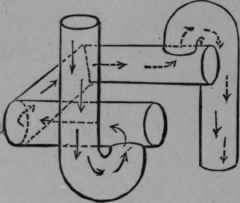
Pig. 30. - Fourth Form. Increase of length of body and of reflecting surfaces.
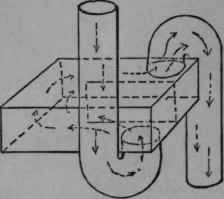
Fig. 31. - Fifth Form. The quadrangle simplified.
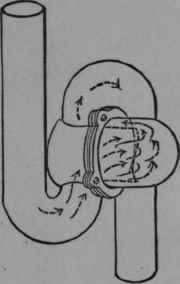
Fig. 32. - Sixth Form. Perfected Anti-siphon Trap.
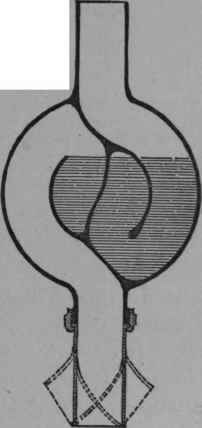
Fig. 33. - Section of Trap.
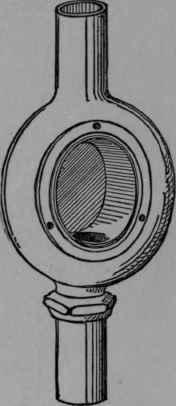
Pig. 34. - Perspective view of Trap, showing the interior.
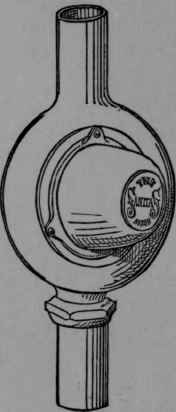
Fig. 35. - Perspective view of Trap.
This trap, which is known as the "Sanitas" trap, has shown itself to be practically anti-siphonic. The term "anti-siphonic," applied to a plumber's trap, signifies that it is capable of resisting the most powerful and long-continued siphoning action that can be brought to bear upon it by the movement of fluids and waste matters in good plumbing work. It does not mean that its seal cannot be destroyed by means of a suction pump or of a vacuum artificially produced in a laboratory or lecture room by a suction pump. It might seem superfluous to urge this, but it is only lately that one of our master plumbers, one of those who originated the famous tests on siphonage at Worcester, delivered a lecture in that city just before these tests were made, and decried our anti-siphon trap as ineffectual, because he was able to pump out its seal before his audience by means of a force pump. A few days afterwards, however, when the trap was tested unvented in the Worcester experiments, with apparatus used in actual plumbing practice, it was found impossible to break its seal, even though a force of siphonage - powerful enough to destroy instantly the seal of a fully vented S-trap, and to crush out of shape a tin cylinder - was brought to bear upon it many times in succession.
Continue to:


My Books

