


Applique Piano Scarf
Description
This section is from the book "Our Homes And Their Adornments", by Almon C. Varney. Also available from Amazon: Our Homes and Their Adornments.
Applique Piano Scarf
Fig. 57 is a piano scarf for an upright in the new Mosaic embroidery, or plush applique work. The ground is of lava gray plush and the design of autumn leaves is cut out of a variety of shades of plush, each half leaf being a separate piece and different shade. The pieces of plush are first pasted down on a foundation of crinoline, and when dry, cut out neatly with very sharp scissors and gummed to the plush foundation. The edges are then sewed down firmly with silk of the same shades as the plushes.
The neglect of this sewing down is what has caused many to regard Mosaic work as lacking in durability; but if the edges are well sewed down they will not fray or ravel out. After sewing down, the edges are concealed by a gold or tinsel cord caught down in couching stitches. A few stitches of chenille of darker shade than the plush it is used on, are added to show the veining of the leaves. A very pretty way of adjusting the scarf is to bring up the embroidered end, throwing it over from the back, and letting it hang over the front of the piano.
The work is very easily and quickly done with the exception of the preparation of the pattern, which requires a variety of odd shades of plush not easily obtained by the amateur, and without which the work loses much of its beauty. The patterns, however, can be procured already prepared on crinoline at any of the first-class fancy-work establishments in most of the large cities. They can be easily transferred to any foundation by moistening the crinoline to soften the gum.
A handsome tabic; scarf in "darned work" is shown in Fig. 58. The body of the scarf is of ecru plush. The ornamentation is of alternate squares of ecru satin, darned in a geometric pattern in colored embroidery silk in a variety of stitches, and squares of old blue plush, with a small spray embroidered in gold and steel beads. The ends are finished with silk fringe and four large tassels to correspond with the satin and plush.
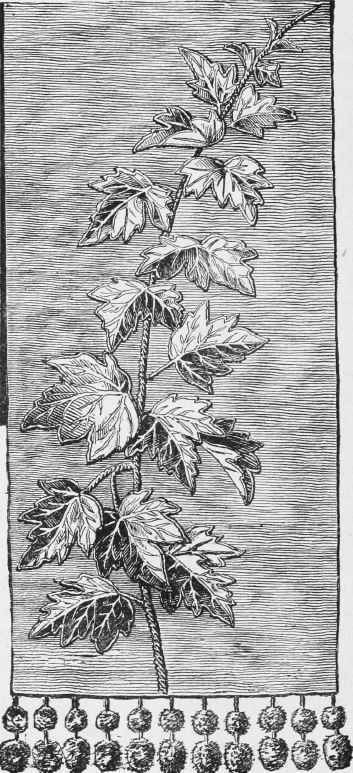
Fig. 57.
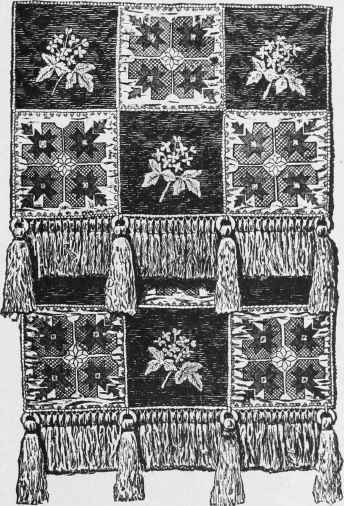
Fig. 58.
It is impossible in an engraving to do justice to this work, the rich, deep tints of which plush alone is capable of exhibiting, being quite lost when represented by printer's ink. Some of the specimens are exquisite, and by many would be preferred to the most elaborate embroidery.
Continue to:


My Books

