


Design I. - A Prairie House
Description
This section is from the book "Our Homes And Their Adornments", by Almon C. Varney. Also available from Amazon: Our Homes and Their Adornments.
Design I. - A Prairie House
In the accompanying engravings we have, perhaps, given a plan that may seem advisable for some of our prairie readers to follow.
There is hardly any one settling on the prairies who could not produce lumber sufficient to build a small "shanty," but is deterred from doing so, for, he says, "I will be able in a few years" - remember, the corn-growing and pork-producing farmer of the West accumulates fast when once started - " to build me a good, respectable house, and I hate to waste material upon something that will be nearly useless then." It is to help this class of builders that our designs are intended.

Fig. 3.
Fig. 3 represents a simple cottage of only one room, which can be erected at a very trifling expense, even on the prairies where lumber is high and scarce, and must be hauled a long distance. It is 12x14 feet, and 7 feet between joists, it will take material as follows: 800 feet of inch boards @ $30 per thousand, $24; 4 sills, 6x9, and 4 beams, 6x6, 10 rafters, and 12 joists, $6; 2 panel doors @$2.50 each, and 3 windows @ $1.50 each, $9.50; nails and paper for roofing, $10.. Total, $49.50.
Here is a cost of about fifty dollars; and any man of ordinary ingenuity can do all the work himself, with the aid of a carpenter to case the windows, and case and hang the doors. Let him first frame the sills and lay them upon the foundation in proper position; next frame the beams and lay them upon the sills; then securely nail two boards perpendicularly at each corner of the sills.
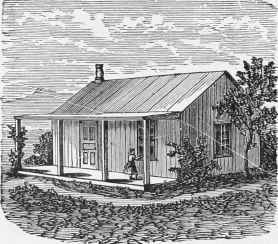
Fig. 4.
Use sixteen-foot boards, cut in the middle; this will make the building seven feet in the clear. Now cut four stanchions seven feet long; and with the aid of one person you can raise the beams one end at a time, slip under the stanchions, and nail the tops of the boards that had been previously nailed to the sills, securely to the beams, and you are ready to proceed with the planking, which any one can do who can saw off a board and drive a nail.
For roofing, use saturated tar paper, which is manufactured expressly for it, and is for sale in all Western towns. The cost is about one-fourth that of shingles; it is not as good, but will last several years, when you can lay your shingles right over it.
If you build in the spring or early summer, you can omit the clapboards until the fall; but don't omit the veranda.

Fig. 5.
We are like an architectural gentleman who once went into ecstacies over blinds. We have nothing rebutting to show; it is a blind subject; but we think the crowning glory of any house, large or small, is a veranda, or as the girl called it, "our folks's stoop." So much for Fig. 3.
Now we will suppose our humble farmer, at the end of one or two years, has acquired means to enlarge his humble domicile. This he can do, as shown in plan, Fig. 5, which consists of his first erection with a lean-to of one bed-room, a pantry, and a wood-shed. This can be erected upon the same principle as the first. The reason we recommended planking and clapboards in preference to studs and clap-boarding, is that any one can build with planks; but it will require a professional carpenter to build a studded house.
Fig. 5 will make a very convenient house for a small family. The inside can be finished with paper or plaster, to suit the taste of the occupants. Again we will suppose that "the lapse of years has brought round the time" when our friend wishes to again enlarge his house.

Fig. 6.
If he has followed our former plans, he will do so, as shown in Figs. 6 and 7. This consists of an upright part added to his former erections. He now, of course, has means sufficient at his command, and will call in the aid of a practical architect. He can build this last part two stories high if he wishes, but we would advise a low house in a prairie country. We think this will make a very convenient house, not devoid of beauty.
Plan, Fig. 3, is a room 12x14; V, veranda.
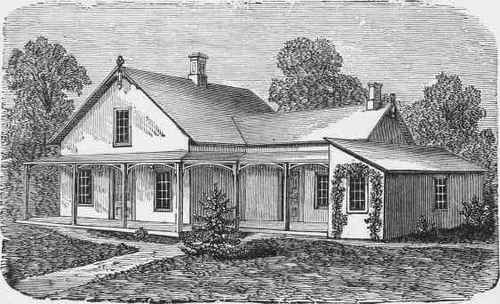
Fig. 7
Plan, Fig. 5, K, living room, 12x14; B, bed-room, 8x9; P, pantry, 8x8; W, S, wood-shed; V, veranda.
Plan, Fig. 6, L, living-room, 12x13; K, kitchen, 12 xl4; D, dining-room, 9 1/2 x l2; B, B, B, bed-rooms, 9x8, and 8x8; S, P, summer pantry, 8x8; P, pantry, 8x8; W, wood-shed; V, V, veranda.
The summer pantry can be used in winter for a place to keep meat, and as a store-room. Being away from the kitchen fire, it will keep meat fresh a long time in suitable weather.
The cost of the last design (the third addition) will not exceed $1,500, and could probably be built for less if one would do as much of the work as possible himself.

Continue to:


My Books

