


Embroidered Screens. Part 2
Description
This section is from the book "Our Homes And Their Adornments", by Almon C. Varney. Also available from Amazon: Our Homes and Their Adornments.
Embroidered Screens. Part 2
Lamp Screens
Very pretty lamp screens are made in the same way, and mounted upon smaller tripod stands.

Fig. 60.
Odd Fan Screens
The frame is made of two uprights of bamboo fishing rod joined at the top with a piece of bamboo about two inches in length, neatly glued and tacked in. The uprights are cut off within about four inches of the floor, and three short legs are fastened on so as to make a firm spread base. The thickest part of the rod serves for these legs, which are cut off so as to stand firm upon the floor. A small square of ebonized wood, or a little Japanese tray or box-cover, forms the front of a block in which six Japanese fans are set. The handles have to be somewhat cut off so as to fit the holes and radiate like the petals of a flower. A double purpose is served, - a screen in winter and a fan stand in summer.
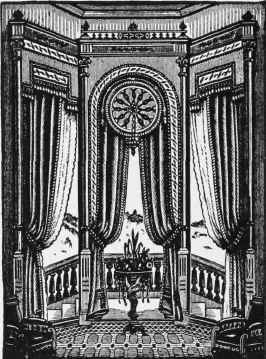
Fig. 61.
Mrs. Gen. Sheridan saw one made from this design, and has ordered several from a handy workman who has learned to join the bamboo nicely.
Old Clothes-Horse Screen
The frame-work was ebonized, the hinges were made of two long strips of old-gold colored leather, the two making the length of the upright. They were tacked on with brass nails on the right side of one panel,' on the wrong side of the other, and vice versa. A little piece of the wood was cut away under the hinges to let the frame fold. The panels were covered with some old linen curtains brought from the garret. They were nicely stretched, covered with Christmas and birthday cards, with a border of fancy paper, then varnished with white copal varnish.
Lambrequins
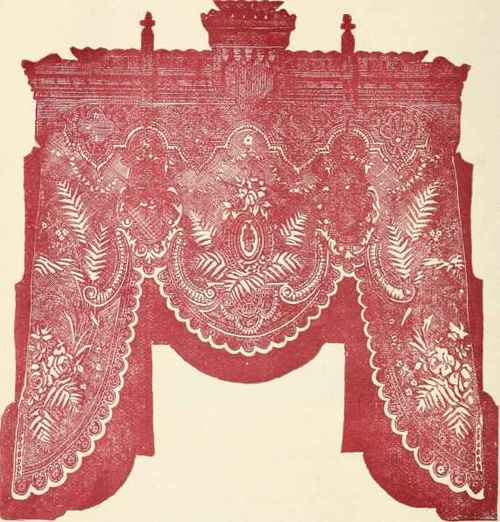
They are not as much in use as formerly, being superseded by a valence which will shove aside with the curtains. Their stationary character, and the fact that they exclude the light from the top, whence it is so desirable, has served to make them unpopular, though they are still made in rich material, cut in all manner of forms, and trimmed with fringe and heavy gimps.
Tables
Many an old table could be made good-looking and useful by ebonizing the lower part, laying a thickness of wadding over the top, and covering with a piece of crimson felting. Braid or ribbon could be appliqued on a band to go round' the table, and the edge could be trimmed with worsted fringe. I have seen a half-moon-shaped table covered with dark blue cloth, and with a fall of worsted embroidery which was worked in subdivisions by half a dozen different friends. A clover-leaf table is now often covered with fine crash, and the fall embroidered in crewels.
Table-Cover
The illustration shows a completed design of an ornamental table-cover. The cover is often made very much longer, affording an excellent opportunity for decoration, and adding, of course, to the cost and labor of making.
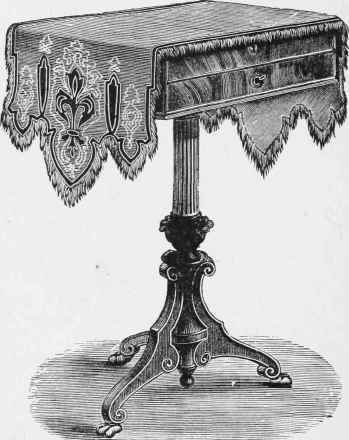
Fig. 62.
This cover is of fawn-colored cloth, ornamented elaborately on the ends in application embroidery.
The design figures which look dark in the illustration are applied in brown cloth; and on each leaf of the large middle application figure, apply a piece of dark brown velvet. Edge all the applied figures with fawn-colored soutache, and besides, ornament the pieces of velvet in point russe embroidery with fawn-colored saddler's silk. For the lines of the design, sew on broad soutache in two shades. The cover is bordered with light brown, open silk fringe, an inch and a quarter wide. The lining is brown percale.
Continue to:


My Books

