


Ventilation
Description
This section is from the book "Our Homes And Their Adornments", by Almon C. Varney. Also available from Amazon: Our Homes and Their Adornments.
Ventilation
The importance of pure air in our dwellings cannot be overestimated; inventions without number have been made and offered the public, and treatises without end have been written, each of which, if we should credit the inventor or author, afforded a perfect and the only possible means of escape from death by foul air. One after another they have been tried, and their adoption has resulted in failure and disappointment in too many cases, and yet many seem to bo looking for some patent self-regulating process or device, which, without knowledge, attention, or thought, shall ventilate a dwelling.
The expectation must always meet with disappointment, but with our present knowledge, and without waiting for any new facts or inventions, we can apply our common sense and thereby devise plans to secure air reasonably pure in our rooms.
The principal impurity in the air in our rooms, is carbonic acid which is produced in the act of breathing, hence it is being constantlv thrown off, and if not removed from the room it will soon vitiate all the air within.
In a nearly pure state carbonic acid is heavier than air, and where the air is of an even temperature, it will occupy the lower part of the room near the floor. Owing to the fact, however, that in most cases the air is warmer in some parts of the room than in others, it is not at all improbable that the carbonic acid diffuses itself throughout the room.
The problem then is to remove this vitiated air, and supply its place with pure air, by not subjecting the occupants to cold draughts. To secure this end, ample means of entrance and escape of air must be made.
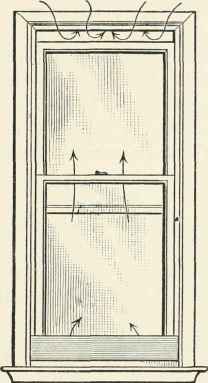
Fig. 1.
The best means which can be provided, is the open fire or grate for escape, as currents setting up the flue will change the air very quickly if means of entrance are provided by an open transom, a window lowered at the top, or other means.
Our illustration shows an easy, cheap method of ventilation adapted to any building. Fasten a neat piece of wood from 3 to 5 inches wide inside the bottom sash, fitting it tightly at ends and bottom, and leave it far enough away so that the sash will move up and down with ease, and if there is half an inch between, it will only act the better.
When the lower sash is raised, the air rushes into the room between the piece of wood set in and the sash, and also at middle between the two sash, as shown by the arrows pointing upward. It will be seen that the piece set in prevents the air from coming in and striking the occupants as a direct draught, as when the air strikes the board, it deflects it upward. A weather strip could be fastened to the bottom of sash between piece set in, and thus admit air only between the two sash at middle of window. If it is desired to establish an outward current, the top sash may be lowered, when the air will pass out as indicated by the four arrows.
The "revolving ventilator" which is sold at the hardware stores, is recommended by many. It is inserted in a circular hole cut in the glass near top of window.
Plenty of air should be admitted into the bed-room, - no danger of "colds" when abundance of pure air and clean bed-covers are at hand. Children's rooms should especially be looked after in this respect, as we owe it to them to give abundant supplies of nature's own disinfectants, - pure air and water.
Rooms that have their doors opened and closed frequently, as in the living-rooms, need but little attention in ventilation. In the morning the windows and doors of bed-rooms should be thrown open and allowed to remain so for some time, to permit the pure air to thoroughly search every nook and coiner, and drive out impurities.
Continue to:


My Books

