


Lacquer And Porcelain
Description
This section is from the book "The Art Of Decoration", by H. R. Haweis. Also available from Amazon: The Art Of Decoration.
Lacquer And Porcelain
Evelyn's allusion to Mr. Bohun who used Japan screens for wainscoting has been quoted: and about that time, in Paris at least, the new discovery, Japan lacquer, began to elbow aside the elaborate Boule marquetry with its rather oppressive glow. Collectors vied with each other in securing pieces for their cabinets, makers in devising new uses for the pieces. It was quiet, yet luminous, and quite novel. Among Boule's own works rare specimens of Oriental lacquer had already crept in, a very Gamelyn of furniture, one day to rise up and drive all before it. But the specimens were very few on account of the difficulties in reaching the Oriental markets. Presently it occurred to some one to panel ebony with small plaqties of precious lacquer, and then the rage for lacquer became so hot that, regardless of cost, delay, destruction, China, Japan, India and Persia were ransacked for boxes, screens, trays, anything which could be broken up and 'adapted.'
Under Louis XV. the passion reached its height, for the pressure had been so great that incessant efforts had at last resulted in an ingenious substitute for gum lac. The family Martin (originally coach builders) had made themselves immortal by their imitation, the vernis Martin. Now everything was driven into the new groove, and here commenced the inundation of snuff-boxes, book-covers, carriage-panels, in fact everything that could be lacquered, made of papier-mache stuck with mother-of-pearl chips, from which we so long have suffered.
Her Majesty the Queen, and various collectors such as Baron Gustave de Rothschild, possess fine specimens of vernis Martin. By-the-bye, Mr. Waring in his valuable book on 'Decorative Art,' speaks of this material as though it were the man's name. None of the Martins were christened 'Vernis.' Much of this manufacture was very perfect, and very brilliant. The black with raised gold ornaments was first copied: then the red lacquers were counterfeited; afterwards gaily illuminated panels were made by Le Sieur Simon Etienne Martin the younger, who obtained the exclusive right, by a decree of Council on February 19, 1744, of manufacturing during twenty years lacquer work of every possible kind.
Madame de Pompadour encouraged the manufacture of vernis Martin, The Dauphin employed one of the Martins for seven years in lacquering his apartments at Versailles: and the sums of money paid by the French Royal Family for their works was truly vast.
There is no doubt that in certain circles there was a perfect frenzy for everything Oriental 150 years ago, as there is to some extent now. Whether the extraordinary popularity of the 'Arabian Nights' may be considered the cause, or the effect, or whether they had anything to do with it at all, I know not; but it is noteworthy that they were first translated from the Arabic in 1704 - into French, of course, then English, and Moorish goods were as highly prized as everything else that came from the East.
The crowds of magots which nodded on every shelf with their restless mock-gaiety, so that no room was complete without magots, were kept in countenance by the Indian and Japan lacquer beneath and above them. And when fine ladies had filled their houses with such productions there remained but one step from intelligent appreciation to folly. For a time nothing was tolerated that was not Oriental.
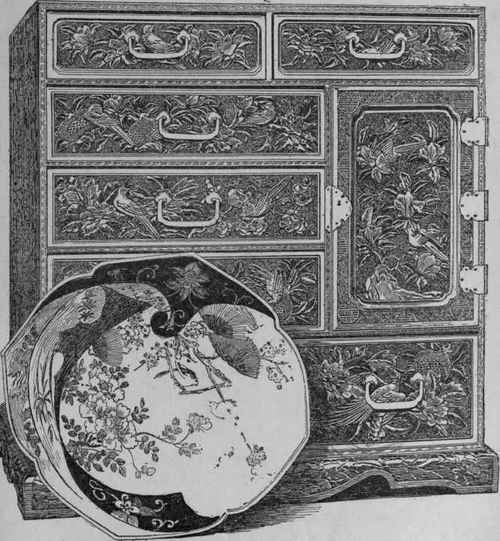
Fig. 37. - Lacquer cabinet.
Continue to:


My Books

