


Lace. Continued
Description
This section is from the "Historic Ornament - Treatise On Decorative Art And Architectural Ornament" book, by James Ward. Also see Amazon: Historic Ornament - Treatise On Decorative Art And Architectural Ornament.
Lace. Continued
Fig. 276. Genoese Point Lace.
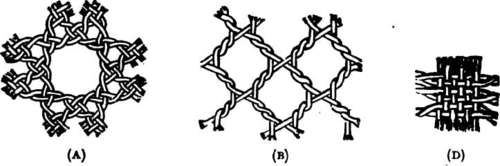
Fig. 277. a. Brussels ground; B, Two-thread Mesh; D, Woven Ground.
Fig. 278. Lappet Brussels; Eighteenth Century.
Fig. 279. Lappet; Point d'Alen*¡on; Eighteenth Century.
By degrees these patterns developed into a more solid massing of the flower forms, and the ties, or brides, became more irregular, but at the same time more evenly distributed.
Sometimes, as in Venetian point lace, the brides had little flowers worked on them, and in many instances the larger forms were raised to a considerable height or thickness. The groundwork in some of the scroll designs of Venetian point laces is composed of regular hexagons, and this was the starting-point of the future hexagonal mesh grounds.
Raised Scroll Work
Raised Scroll Work is peculiar to the Venetian point laces of the best period - the end of the seventeenth century.
Flemish Lace
Flemish Lace was mostly of the pillow-made variety, but some point work was also executed, principally at Brussels. Mechlin, Lille, and Valenciennes were all famous for their pillow-made laces.
Returning to the development of patterns in lace, we find that France led the way in design from the early years of the eighteenth century. Prior to this time, Colbert, the Minister of Louis XIV. - whose far-sightedness in the matters of art did so much for France - succeeded in establishing lace-making centres at Alen*¡on, Argentan, Quesnoy, Arras, Rheims, etc, and the patterns of lace then in favour partook of the prevailing style of Louis-Quatorze ornament with a mixture of floral forms, more or less realistic in character (Fig. 279). The latter illustration is that of a lappet of "point d'Alen*¡on "fabric, which is the most elaborate and most expensive of all French laces. Another French point lace is that known as "point d'Argentan," and if not a variety of Alen*¡on lace, is very much like it. This lace is noted for its clear and strong-meshed ground.
Valenciennes Lace
Valenciennes Lace, made in the French town of that name, is one of the oldest pillow-made laces, dating from the fifteenth century; the best Valenciennes, however, has been made at YprÅ es, and is a very soft and flat variety of fabric, with the meshes plaited, not twisted, has no cordonnet around the edges, and is very floral in design. "Fausse" Valenciennes is an irregular and slightly coarser variety than the "vraie" or true Valenciennes. Mechlin lace is similar in design to Valenciennes, but has the cordonnet outline, and has the meshes of the ground partly twisted and partly plaited (Fig. 283).
Lille And Arras Laces
Lille And Arras Laces have fine single grounds : four of the six sides of the mesh are formed by the twisting of two threads, and the other two sides by simply crossing the threads. Lille was formerly famous for its black straight-edged laces. Chantilly laces were made in white and black silk, but now similar black silk laces are made at Bayeux in Normandy, and at Auvergne, an old-established centre. Laces are now made in all kinds of materials.
Brussels Lace
Brussels Lace has always been a much-prized variety: it is made both in the "point *¦ l'aiguille" or needle-point, and in "point plat" or pillow-made, and sometimes it is a mixture of both, where the flowers are made separate in needle-point and are worked in afterwards to the various "modes" and mesh or net grounds. The Brussels mesh is peculiar in having two of its hexagonal sides longer than the other four, the former two being plaited with four threads, while the latter four are composed of a two-thread twist, and the cordonnet is well raised around the pattern and is plaited. The patterns in Brussels lace are of all kinds, but are chiefly imitations of French designs; it is a common thing to find Alen*¡on and other French patterns copied in this lace. In France, Brussels lace was known by the name of "point d'Angleterre," from the fact that great quantities of it were imported, and also smuggled into England during its prohibited importation in the lace-weaving period of Charles II.
Ancient Spanish Point-Lace
Ancient Spanish Point-Lace was like the Venetian raised work, but much of the so-called Spanish lace was really Flemish, and was largely imported from the Spanish Netherlands.
Honiton in Devonshire, and Buckinghamshire are the chief centres of the lace making in England. Honiton lace is pillow-made, and is similar to Brussels in fabrtcation, the designs of which were originally sprigs of flowers, but have developed to a kind of guipure work held together by "brides" (Fig. 284).
Buckinghamshire Lace
Buckinghamshire Lace is also pillow-made, and resembles Flemish lace in design, but is a little more irregular and weaker in drawing.
Irish Lace
Irish Lace is known under the name of Carrickmacross - a kind of cut linen work; Limerick - a species of embroidery; and point- lace, made in Ulster and elsewhere in Ireland (Fig. 285).
Many efforts have been made in recent years to revive the Irish lace-making industry, which have been attended with a good measure of success, particularly in the schools attached to the convents.
A Great Modern Revival Of Lace Making
A Great Modern Revival Of Lace Making has taken place in the island of Burano, near Venice, which dates from the year 1872. This is due to the energy and ability of Madame Bellario, assisted by the patronage of the Queen of Italy and other members of the royal family. The variety made is the needle-point, and the designs are mostly good copies of the old Venetian and seventeenth-century French patterns.
Machine-Made Lace
Machine-Made Lace has been brought to an advanced state of perfection, and Nottingham in England, where the first machines were set up, is now the great centre of this industry. The machine on which lace is made is a development of the stocking-knitting machine, and lace nets were first made on these machines about 1770. Heathcote, of Nottingham, invented the bobbin net machine, and Leaver invented the lace machine which is still in use with various improvements and modifications. Almost any kind of lace can now be imitated by the machine, but it is easily distinguished from the hand-made varieties by the greater regularity of texture, the absence in the machine-made point lace of any imitation of the button-hole stitch and of the elaborate plaiting that is found in the pillow hand-made laces.
Fig. 280. Guipure; Flemish; Seventeenth Century.
Fig. 281. Guipure Lace; Italian; Seventeenth Century.
Fig. 282. Finest Raised Venetian Point.
Fig. 283. Border of Mechlin Lace.
Fig. 284. Honiton; Modern.
Fig. 285. Irish Point; Modern.
Continue to:


My Books

