


Doors. Part 2
Description
This section is from the book "The Decoration Of Houses", by Edith Wharton, Ogden Codman Jr. Also available from Amazon: The Decoration of Houses.
Doors. Part 2
When a doorway is over three feet six inches wide, a pair of doors should always be used; while a single door is preferable in a narrow opening.
In rooms twelve feet or less in height, doorways should not be more than nine feet high. The width of openings in such rooms is therefore restricted to four feet six inches; indeed, it is permissible to make the opening lower and thus reduce its width to four feet; six inches of additional wall-space are not to be despised in a room of average dimensions.
The treatment of the door forms one of the most interesting chapters in the history of house-decoration. In feudal castles the interior doorway, for purposes of defense, was made so small and narrow that only one person could pass through at a time, and was set in a plain lintel or architrave of stone, the door itself being fortified by bands of steel or iron, and by heavy bolts and bars. Even at this early period it seems probable that in the chief apartments the lines of the doorway were carried up to the ceiling by means of an over-door of carved wood, or of some painted decorative composition.1 This connection between the doorway and the ceiling, maintained through all the subsequent phases of house-decoration, was in fact never disregarded until the beginning of the present century.
It was in Italy that the door, in common with the other features of private dwellings, first received a distinctly architectural treatment. In Italian palaces of the fifteenth century the doorways were usually framed by architraves of marble, enriched with arabesques, medallions and processional friezes in low relief, combined with disks of colored marble. Interesting examples of this treatment are seen in the apartments of Isabella of Este in the ducal palace at Mantua (see Plate XIV), in the ducal palace at Urbino, and in the Certosa of Pavia - some of the smaller doorways in this monastery being decorated with medallion portraits of the Sforzas, and with other low reliefs of extraordinary beauty.

PLATE XIV. DOORWAY WITH MARBLE ARCHITRAVE, DUCAL PALACE, MANTUA. XVI CENTURY.
The doors in Italian palaces were usually of inlaid wood, elaborate in composition and affording in many cases beautiful instances of that sense of material limitation that preserves one art from infringing upon another. The intarsia doors of the palace at Urbino are among the most famous examples of this form of decoration. It should be noted that many of the woods used in Italian marquetry were of a light shade, so that the blending of colors in Renaissance doors produces a sunny golden-brown tint in perfect harmony with the marble architrave of the doorway. The Italian decorator would never have permitted so harsh a contrast as that between the white trim and the mahogany doors of English eighteenth-century houses. The juxtaposition of colors was disapproved by French decorators also, and was seldom seen except in England and in the American houses built under English influence. It should be observed, too, that the polish given to hard-grained wood in England, and imitated in the wood-varnish of the present day, was never in favor in Italy and France. Shiny surfaces were always disliked by the best decorators.
1 See Viollet-le-Duc, Dictionnaire raisonne de l'Architecture francaise, under Port*.
The classic revival in Italy necessarily modified the treatment of the doorway. Flat arabesques and delicately chiselled medallions gave way to a plain architrave, frequently masked by an order; while the over-door took the form of a pediment, or, in the absence of shafts, of a cornice or entablature resting on brackets. The use of a pediment over interior doorways was characteristic of Italian decoration.
In studying Italian interiors of this period from photographs or modern prints, or even in visiting the partly dilapidated palaces themselves, it may at first appear that the lines of the doorway were not always carried up to the cornice. Several causes have combined to produce this impression. In the first place, the architectural treatment of the over-door was frequently painted on the wall, and has consequently disappeared with the rest of the wall-decoration (see Plate XV). Then, again, Italian rooms were often painted with landscapes and out-of-door architectural effects, and when this was done the doorways were combined with these architectural compositions, and were not treated as of the room, but as part of what the room pretended to be opressed Scuola della Carita (now the Academy of Fine Arts) at Venice, one may see a famous example of this treatment in the doorway under the stairs leading up to the temple, in Titian's great painting of the "Presentation of the Virgin."1 Again, in the high-studded Italian saloons containing a musician's gallery, or a clerestory, a cornice was frequently carried around the walls at suitable height above the lower range of openings, and the decorative treatment above the doors, windows and fireplace extended only to this cornice, not to the actual ceiling of the room.
Thus it will be seen that the relation between the openings and cornice in Italian decoration was in reality always maintained except where the decorator chose to regard them as forming a part, not of the room, but of some other architectural composition.
In the sixteenth century the excessive use of marquetry was abandoned, doors being panelled, and either left undecorated or painted with those light animated combinations of figure and arabesque which Raphael borrowed from the Roman fresco-painters, and which since his day have been peculiarly characteristic of Italian decorative painting.2
Wood-carving in Italy was little used in house-decoration, and, as a rule, the panelling of doors was severely architectural in character, with little of the delicate ornamentation marking the French work of the seventeenth and eighteenth centuries.3
In France the application of the orders to interior doorways was never very popular, though it figures in French architectural l This painting has now been restored to its proper position in the Scuola della Carita, and the door which had been painted in under the stairs has been removed to make way for the actual doorway around which the picture was originally painted works of the eighteenth century. The architrave, except in houses of great magnificence, was usually of wood, sometimes very richly carved. It was often surmounted by an entablature with a cornice resting on carved brackets; while the panel between this and the ceiling-cornice was occuped by an over-door consisting either of a painting, of a carved panel or of a stucco or marble bas-relief. These over-doors usually corresponded with the design of the over-mantel.
2 See the doors of the Sala dello Zodiaco in the ducal palace at Mantua (Plate XVI).
3 Some rooms of the rocaille period, however, contain doors as elaborately carved as those seen in France (see the doors in the royal palace at Genoa, Plate XXXIV).
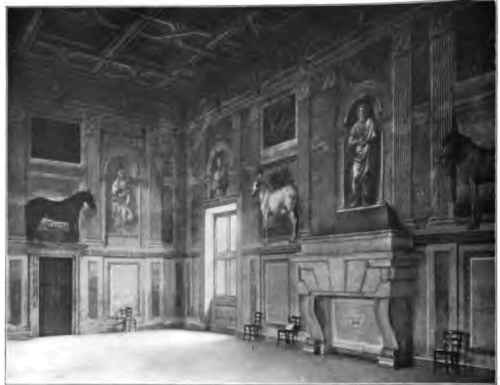
PLATE XV. SALA DEI CAVALLI, PALAZZO DEL T, MANTUA. XVI CENTURY. (EXAMPLE of painted architectural decoration).
Continue to:


My Books

