


The Historical Tradition. Part 2
Description
This section is from the book "The Decoration Of Houses", by Edith Wharton, Ogden Codman Jr. Also available from Amazon: The Decoration of Houses.
The Historical Tradition. Part 2
There were, of course, private houses in Renaissance Italy, but these were occupied rather by shopkeepers, craftsmen, and the bourgeoisie than by the class which in France and England lived in country houses or small private h6tels. The elevations of these small Italian houses are often admirable examples of domestic architecture, but their planning is rudimentary, and it may be said that the characteristic tendencies of modern house-planning were developed rather in the mezzanin or low-studded intermediate story of the Italian Renaissance palace than in the small house of the same period.
1 Charming as the Italian villa is, it can hardly be used in our Northern States without certain modifications, unless it is merely occupied for a few weeks in midsummer; whereas the average French or English country house built after 1600 is perfectly suited to our climate and habits. The chief features of the Italian villa are the open central cortili and the large saloon two stories high. An adaptation of these better suited to a cold climate is to be found in the English country houses built in the Palladian manner after its introduction by Inigo Jones. See Campbell's Vitruvius Britannicus for numerous examples.
It is a fact recognized by political economists that changes in manners and customs, no matter under what form of government, usually originate with the wealthy or aristocratic minority, and are thence transmitted to the other classes. Thus the bourgeois of one generation lives more like the aristocrat of a previous generation than like his own predecessors. This rule naturally holds good of house-planning, and it is for this reason that the origin of modern house-planning should be sought rather in the prince's mezzanin than in the small middle-class dwelling. The Italian mezzanin probably originated in the habit of building certain very high-studded saloons and of lowering the ceiling of the adjoining rooms. This created an intermediate story, or rather scattered intermediate rooms, which Bramante was among the first to use in the planning of his palaces; but Bramante did not reveal the existence of the mezzanin in his facades, and it was not until the time of Peruzzi and his contemporaries that it became, both in plan and elevation, an accepted part of the Italian palace.
It is for this reason that the year 1500 is a convenient point from which to date the beginning of modern house-planning; but it must be borne in mind that this date is purely arbitrary, and represents merely an imaginary line drawn between mediaeval and modern ways of living and house-planning, as exemplified respectively, for instance, in the ducal palace of Urbino, built by Luciano da Laurano about 1468, and the palace of the Massimi alle Colonne in Rome, built by Baldassare Peruzzi during the first half of the sixteenth century.
The lives of the great Italian nobles were essentially open-air lives: all was organized with a view to public pageants, ceremonies and entertainments. Domestic life was subordinated to this spectacular existence, and instead of building private houses in our sense, they built palaces, of which they set aside a portion for the use of the family. Every Italian palace has its mez-zanin or private apartment; but this part of the building is now seldom seen by travellers in Italy. Not only is it usually inhabited by the owners of the palace but, its decorations being simpler than those of the piano nobile, or principal story, it is not thought worthy of inspection. As a matter of fact, the treatment of the mezzanin was generally most beautiful, because most suitable ; and while the Italian Renaissance palace can seldom serve as a model for a modern private house, the decoration of the mezzanin rooms is full of appropriate suggestion.
In France and England, on the other hand, private life was gradually, though slowly, developing along the lines it still follows in the present day. It is necessary to bear in mind that what we call modern civilization was a later growth in these two countries than in Italy. If this fact is insisted upon, it is only because it explains the relative unsuitability of French Renaissance or Tudor and Elizabethan architecture to modern life. In France, for instance, it was not until the Fronde was subdued and Louis XIV firmly established on the throne, that the elements which compose what we call modern life really began to combine. In fact, it might be said that the feudalism of which the Fronde was the lingering expression had its counterpart in the architecture of the period. While long familiarity with Italy was beginning to tell upon the practical side of house-planning, many obsolete details were still preserved. Even the most enthusiastic admirer of the French Renaissance would hardly maintain that the houses of that period are what we should call in the modern sense "convenient." It would be impossible for a modern family to occupy with any degree of comfort the Hotel Vogue at Dijon, one of the best examples (as originally planned) of sixteenth-century domestic architecture in France.1 The same objection applies to the furniture of the period.
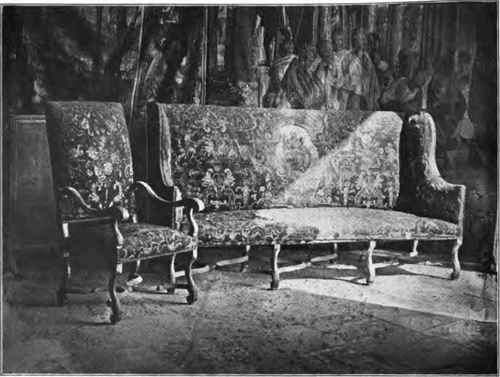
PLATE IV. FRENCH SOFA AND ARMCHAIR, LOUIS XIV PERIOD.
FROM THE CHATEAU DE BERCY.
This arose from the fact that, owing to the unsettled state of the country, the landed proprietor always carried his furniture with him when he travelled from one estate to another. Furniture, in the vocabulary of the middle ages, meant something which may be transported: "Meubles sont apelez qu'on peut transporter"; - hence the lack of variety in furniture before the seventeenth century, and also its unsuitableness to modern life. Chairs and cabinets that had to be carried about on mule-back were necessarily somewhat stiff and angular in design. It is perhaps not too much to say that a comfortable chair, in our self-indulgent modern sense, did not exist before the Louis XIV armchair (see Plate IV); and the cushioned bergere, the ancestor of our upholstered easy-chair, cannot be traced back further than the Regency. Prior to the time of Louis XIV, the most luxurious people had to content themselves with hard straight-backed seats. The necessities of transportation permitted little variety of design, and every piece of furniture was constructed with the double purpose of being easily carried about and of being used as a trunk (see Plate I). As Havard says, "Tout meu-ble se traduisait par un coffre." The unvarying design of the cabinets is explained by the fact that they were made to form two trunks,1 and even the chairs and settles had hollow seats which could be packed with the owners' wardrobe (see Plate II). The king himself, when he went from one chateau to another, carried all his furniture with him, and it is thus not surprising that lesser people contented themselves with a few substantial chairs and cabinets, and enough arras or cloth of Douai to cover the draughty walls of their country-houses. One of Madame de Sevigne's letters gives an amusing instance of the scarceness of furniture even in the time of Louis XIV. In describing a fire in a house near her own hotel in Paris, she says that one or two of the persons from the burning house were brought to her for shelter, because it was known in the neighborhood (at that time a rich and fashionable one) that she had an extra bed in the house!
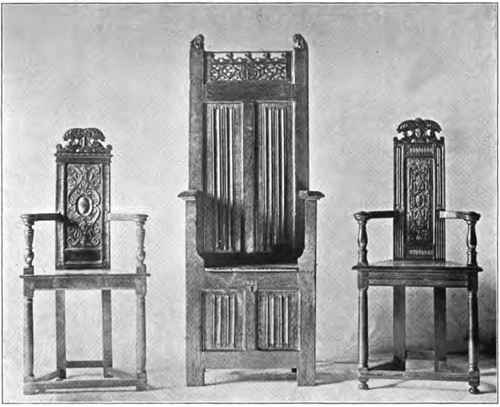
PLATE II. FRENCH CHAIRS, XV AND XVI CENTURIES.
FROM THE GAVET COLLECTION.
1The plan of the Hotel Vogue" has been greatly modified.
Continue to:


My Books

