


Chapter I. How To Rearrange A Room
Description
This section is from the book "The Art Of Interior Decoration", by Grace Wood, Emily Burbank. Also available from Amazon: The Art of Interior Decoration.
Chapter I. How To Rearrange A Room
LUCKY is the man or woman of taste who has no inherited eye-sores which, because of association, must not be banished! When these exist in large numbers one thing only remains to be done: look them over, see to what period the majority belong, and proceed as if you wanted a mid-Victorian, late Colonial or brass-bedstead room.
To rearrange a room successfully, begin by taking everything out of it (in reality or in your mind), then decide how you want it to look, or how, owing to what you own and must retain, you are obliged to have it look. Design and colour of wall decorations, hangings, carpets, lighting fixtures, lamps and ornaments on mantel, depend upon the character of your furniture.
It is the mantel and its arrangement of ornaments that sound the keynote upon first entering a room.
Conventional simplicity in number and arrangement of ornaments gives balance and repose, hence dignity. Dignity once established, one can afford to be individual, and introduce a riot of colours, provided they are all in the same key. Luxurious cushions, soft rugs and a hundred and one feminine touches will create atmosphere and knit together the austere scheme of line-the anatomy of your room. Colour and textiles are the flesh of interior decoration.
In furnishing a small room you can add greatly to its apparent size by using plain paper and making the woodwork the same colour, or slightly darker in tone. If you cannot find wall paper of exactly the colour and shade you wish, it is often possible to use the wrong side of a paper and produce exactly the desired effect.
In repapering old rooms with imperfect ceilings it is easy to disguise this by using a paper with a small design in the same tone. A perfectly plain ceiling paper will show every defect in the surface of the ceiling.
If your house or flat is small you can gain a great effect of space by keeping the same colour scheme throughout-that is, the same colour or related colours. To make a small hall and each of several small rooms on the same floor different in any pronounced way, is to cut up your home into a restless, unmeaning checkerboard, where one feels conscious of the walls and all limitations. The effect of restful spaciousness may be obtained by taking the same small suite and treating its walls, floors and draperies, as has been suggested, in the same colour scheme or a scheme of related keys in colour. That is, wood browns, beiges and yellows; violets, mauves and pinks; different tones of greys; different tones of yellows, greens and blues.
Now having established your suite and hall all in one key, so that there is absolutely no jarring note as one passes from room to room, you may be sure of having achieved that most desirable of all qualities in interior decoration -repose. We have seen the idea here suggested carried out in small summer homes with most successful results; the same colour used on walls and furniture, while exactly the same chintz was employed in every bedroom, opening out of one hall. By this means it was possible to give to a small, unimportant cottage, a note of distinction otherwise quite impossible. Here, however, let us say that, if the same chintz is to be used in every room, it must be neutral in colour - a chintz in which the colour scheme is, say, yellows in different tones, browns in different tones, or greens or greys. To vary the character of each room, introduce different colours in the furniture covers, the sofa-cushions and lampshades. Our point is to urge the repetition of a main background in a small group of rooms; but to escape monotony by planning that the accessories in each room shall strike individual notes of decorative, contrasting colour.
What to do with old floors is a question many of us have faced. If your house has been built with floors of wide, common boards which have become rough and separated by age, in some cases allowing dust to sift through from the cellar, and you do not wish to go to the expense of all-over carpets, you have the choice of several methods. The simplest and least expensive is to paint or stain the floors. In this case employ a floor painter and begin by removing all old paint. Paint removers come for the purpose. Then have the floors planed to make them even. Next, fill the cracks with putty. The most practical method is to stain the floors some dark colour: mahogany, walnut, weathered oak, black, green or any colour you may prefer, and then wax them. This protects the colour. In a room where daintiness is desired, and economy is not important, as for instance in a room with white painted furniture, you may have white floors and a square carpet rug of some plain dark toned velvet; or, if preferred, the painted border may be in some delicate colour to match the wall paper. To resume, if you like a dull finish, have the wax rubbed in at intervals, but if you like a glossy background for rugs, use a heavy varnish after the floors are coloured. This treatment we suggest for more or less formal rooms. In bedrooms, put down an inexpensive filling as a background for rugs, or should yours be a summer home, use straw matting.
A room with modern painted furniture is shown here. Lines and decorations Empire.
Note the lyre backs of chairs and head board in day-bed. Treatment of this bed is that suggested where twin beds are used and room affords wall space for but one of them.
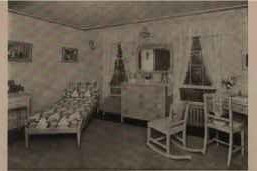
Bedroom in Country House. Modern Painted Furniture
For halls and dining-rooms a plain dark-coloured linoleum, costing not less than two dollars a yard makes an inexpensive floor covering.
If it is waxed it becomes riot only very durable but,also,extremely effective, suggesting the dark tiles in Italian houses. We do not advise the purchase of the linoleums which represent inlaid floors, as they are invariably unsuccessful imitations.
Continue to:


My Books

