


Chapter II. How To Create A Room
Description
This section is from the book "The Art Of Interior Decoration", by Grace Wood, Emily Burbank. Also available from Amazon: The Art of Interior Decoration.
Chapter II. How To Create A Room
ONE so often hears the complaint, "I could not possibly set out alone to furnish a room! I don't know anything about periods. Why, a Louis XVI chair and an Empire chair are quite the same to me. Then the question of antiques and reproductions - why any one could mislead mel"
If you have absolutely no interest in the arranging or rearranging of your rooms, house or houses, of course, leave it to a decorator and give your attention to whatever does interest you. On the other hand, as with bridge, if you really want to play the game, you can learn it. The first rule is to determine the actual use to which you intend putting the room. Is it to be a bedroom merely, or a combination of bedroom and boudoir? Is it to be a formal reception-room, or a living-room? Is it to be a family library, or a man's study? If it is a small flat, do you aim at absolute comfort, artistically achieved, or do you aim at formality at the expense of comfort?
If you lean toward both comfort and formality, and own a country house and a city abode, there will be no difficulty in solving the problem. Formality may be left to the town house or flat, while during week-ends, holidays and summers you can revel in supreme comfort
Every man or woman is capable of creating comfort. It is a question of those deep chairs with wide seats and backs, soft springs, thick, downy cushions, of tables and book-cases conveniently placed, lights where you want them, beds to the individual taste,-double, single, or twins!
The getting together of a period room, one period or periods in combination, is difficult, especially if you are entirely ignorant of the subject.However, here is your cue. Let us suppose you need, or want, a desk-an antique desk. Go about from one dealer to the other until you find the very piece you have dreamed of; one that gives pleasure to you, as well as to the dealer. Then take an experienced friend to look at it. If you have every reason to suppose that the desk is genuine, buy it. Next, read up on the furniture of the particular period to which your desk belongs, in as serious a manner as you do when you buy a prize dog at the show. Now you have made an intelligent beginning as a collector. Reading informs you, but you must buy old furniture to be educated on that subject. Be eternally on the lookout; the really good pieces, veritable antiques, are rare; most of them are in museums, in private collections or in the hands of the most expensive dealers. I refer to those unique pieces, many of them signed by the maker and in perfect condition because during all their existence they have been jealously preserved, often by the very family and in the very house for which they were made. Our chances for picking up antiques are reduced to pieces which on account of reversed circumstances have been turned out of house and home, and, as with human wanderers, much jolting about has told upon them. Most of these are fortified in various directions, but they are treasures all the same, and have a beauty value in line colour and workmanship and a wonderful fitness for the purposes for which they were intended. "Surely we are many men of many minds!"
The sofa large, strong and luxuriously comfortable; die curtains simple, durable and masculine in gender. The tapestry and architectural picture, decorative and appropriately impersonal, as the wall decorations should be in a room used merely for transacting business.
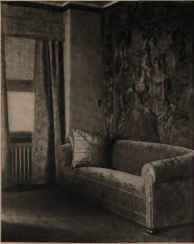
A Corner of the Same Office
Some prefer antiques a bit dilapidated; a missing detail serving as a hallmark to calm doubts; others insist upon completeness to the eye and solidity for use; while the connoisseur, with unlimited means, recognises nothing less than signed sofas and chairs, and other objets d'art. To repeat: - be always on the lookout, remembering that it is the man who knows the points of a good dog, horse or car who can pick a winner.
Wonderful reproductions are made in New York City and other cities, and thousands bought every day. They are beautiful and desirable pieces of furniture, ornaments or silks; but the lover of the vrai antique learns to detect, almost at a glance, the lack of that quality which a fine old piece has. It is not alone that the materials must be old. There is a certain quality gained from the long association of its parts. One knows when a piece has "found itself," as Kipling would put it. Time gives an inimitable finish to any surface.
If you are young an years, immature in taste, and limited as to bank account, you will doubtless go in for a frankly modern room, with cheerful painted furniture, gay or soft-toned chintzes, and inexpensive smart floor coverings. To begin this way and gradually to collect what you want, piece by piece, is to get the most amusement possible out of furnishing. When you have the essential pieces for any one room, you can undertake an ensemble. Some of the rarest collections have been got together in this way, and, if one's fortune expands instead of contracting, old pieces may be always replaced by those still more desirable, more rare, more in keeping with your original scheme.
To buy expensive furnishings in haste and without knowledge, and within a year or two discover everything to be in bad taste, is a tragedy to a person with an instinctive aversion to waste. Antique or modern, every beautiful thing bought is a cherished heirloom in embryo. Remember, we may inherit a good antique or objet d'art, buy one, or bequeath one. Let us never be guilty of the reverse, - a bar-sinister piece of furniture! Sympathy with unborn posterity should make us careful.
It is always excusable to retain an ugly, inartistic thing - if it is useful; but an ornament must be beautiful in line or in colour, or it belies its name. Practise that genuine, obvious loyalty which hides away on a safe, but invisible shelf, the bad taste of our ancestors and friends.
Continue to:


My Books

