


Chapter IV. The Story Of Textiles
Description
This section is from the book "The Art Of Interior Decoration", by Grace Wood, Emily Burbank. Also available from Amazon: The Art of Interior Decoration.
Chapter IV. The Story Of Textiles
THE story of the evolution of textiles (any woven material) is fascinating, and like the history of every art, runs parallel with the history of culture and progress in the art of living, - physical, mental and spiritual.
To those who feel they would enjoy an exhaustive history of textiles we recommend a descriptive catalogue relating to the collection of textiles in the South Kensington Museum, prepared by the Very Rev. Daniel Rock, D.D. (1870).
In the introduction to that catalogue one gets the story of woven linens, cottons, silks, paper, gold and silver threads, interspersed with precious jewels and glass beads - all materials woven by hand or machine.
The story of textiles includes: 1st, woven materials; 2nd, embroidered materials; 3rd, a combination of the two, known as "tapestry." If one reads their wonderful story, starting in Assyria, then progressing to Egypt, the Orient, Greece, Rome and Western Europe, in any history of textiles, one may obtain quickly and easily a clear idea of this department of interior decoration from the very earliest times.
The first European silk is said to have been in the form of transparent gauze, dyed lovely tones for women of the Greek islands, a form of costume later condemned by Greek philosophers.
We know that embroidery was an art three thousand years ago, in fact the figured garments seen on the Assyrian and Egyptian bas-reliefs are supposed to represent materials with embroidered figures - not woven patterns - whereas in the Bible, when we read of embroidery, according to the translators, this sometimes means woven stripes.
The earliest garments of Egypt were of cotton and hemp, or mallow, resembling flax. The older Egyptians never knew silks in any form, nor did the Israelites, nor any of the ancients. The earliest account of this material is given by Aristotle (fourth century). It was brought into Western Europe from China, via India, the Red Sea and Persia, and the first to weave it outside the Orient was a maiden on the Isle of Cos, off the coast of Asia Minor, producing a thin gauze-like tissue worn by herself and companions, the material resembling the Seven Veils of Salome. To-day those tiny bits of gauze one sees laid in between the leaves of old manuscript to protect the illuminations, as our publishers use sheets of tissue paper, are said to be examples of this earliest form of woven silk.
An ideal dining-room of its kind, modern painted furniture, Empire in design. In this case yellow with decoration in white. Curtains, thin yellow silk.
Note the Empire electric light fixtures in hand-carved gilded wood, reproductions of an antique silver applique.
Even the steam radiators are here cleverly concealed by wooden cases made after Empire designs.
The walls are white and panelled in wood also white.
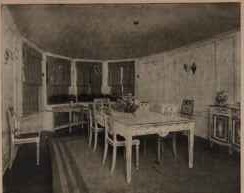
Dining-room in Country House, Showing Modern Painted Furniture. Style Directoire
The Romans used silk at first only for their women, as it was considered not a masculine material, but gradually they adopted it for the festival robes of men, Titus and Vespasian being among those said to have worn it.
The first silk looms were set up in the royal palaces of the Roman kings in the year 533 A. D. The raw material was brought from the East for a long time but in the sixth century two Greek monks, while in China, studied the method of rearing silk worms and obtaining the silk, and on their departure are said to have concealed the eggs of silk worms in their staves. They are accredited with introducing the manufacture of silk into Greece and hence into Western Europe. After that Greece, Persia and Asia Minor made this material, and Byzantium was famed for its silks, the actual making of which got into the hands of the Jews and was for a long time controlled by them.
Metals (gold, silver and copper) were flattened out and cut into narrow strips for winding around cotton twists. These were the gold and silver threads used in weaving. The Moors and Spaniards instead of metals used strips of gilded parchment for weaving with the silk.
We know that England was weaving silk in the thirteenth century, and velvets seem to have been used at a very early date. The introduction of silk and velvet into different countries had an immediate and much-needed influence in civilising the manners of society. It is hard to realise that in the thirteenth century when Edward I married Eleanor of Castile, the highest nobles of England when resting at their ease, stretched at full length on the straw-covered floors of baronial halls, and jeered at the Spanish courtiers who hung the walls and stretched the floors of Edward's castle with silks in preparation for his Spanish bride.
The progress of art and culture was always from the East and moved slowly. Do not go so far back as the thirteenth century. James I of England owned no stockings when he was James VI of Scotland, and had to borrow a pair in which to receive the English ambassador.
In the eleventh century Italy manufactured her own silks, and into them were woven precious stones, corals, seed pearls and coloured glass beads which were made in Greece and Venice, as well as gold and silver spangles (twelfth and thirteenth centuries).
Here is an item on interior decorations from Proverbs vii, 16: "I have woven my bed with cords, I have covered it with painted tapestry brought from Egypt." There were painted tapestries made in Western Europe at a very early date, and collectors eagerly seek them (see Plate XIV). In the fourteenth century these painted tapestries were referred to as "Stained Cloth."
Embroidery as an art, as we have already seen, antedates silk weaving. The youngest of the three arts is tapestry. The oldest embroidery stitches are: "the feather stitch," so tailed because they all took one direction, the stitches over-lapping, like the feathers of a bird; and "cross-stitch" or "cushion" style, because used on church cushions, made for kneeling when at prayer or to hold the Mass book.
Hand-woven tapestries are called "comb-wrought" because the instrument used in weaving was comb-like.
"Cut-work" is embroidery that is cut out and appliqued, or sewed on another material.
Carpets which were used in Western Europe in the Middle Ages are seldom seen. The Kensington Museum owns two specimens, both of them Spanish, one of the fourteenth and one of the fifteenth century.
In speaking of Gothic art we called attention to the fostering of art by the Church during the Dark Ages. This continued, and we find that in Henry VIII's time those who visited monasteries and afterward wrote accounts of them call attention to the fact that each monk was occupied either with painting, carving, modelling, embroidering or writing. They worked primarily for the Church, decorating it for the glory of God, but the homes of the rich and powerful laity, even so early as the reign of Henry III (1216-1272), boasted some very beautiful interior decorations, tapestries, painted ceilings and stained glass, as well as carved panelling.
Bostwick Castle, Scotland, had its vaulted ceiling painted with towers, battlements and pinnacles, a style of mural decoration which one sees in the oldest castles of Germany. It recalls the illumination in old manuscripts.
Continue to:


My Books

