


Chapter XII. Treatment Of Bathrooms
Description
This section is from the book "The Art Of Interior Decoration", by Grace Wood, Emily Burbank. Also available from Amazon: The Art of Interior Decoration.
Chapter XII. Treatment Of Bathrooms
SUMPTUOUS bathrooms are not modern inventions, on the contrary the bath was a religion with the ancient Greeks, and a luxury to the early Italians, What we have to say here is in regard to the bath as a necessity for all classes.
The treatment of bathrooms has become an interesting branch of interior decoration, whereas once it was left entirely to the architect and plumber.
First, one has to decide whether the bathroom is to be finished in conventional white enamel, which cannot be surpassed for dainty appearance and sanitary cleanliness. Equally dainty to look at and offering the same degree of sanitary cleanliness, is a bathroom enamelled in some delicate tone to accord in colour with the bedroom with which it connects.
Some go so far as to make the bathroom the same colour as the bedroom, even when this is dark. We have in mind a bath opening out of a man's bedroom. The bedroom is decorated in dull blues, taupe and mulberry. The bathroom has the walls painted in broad stripes of dull blue and taupe, the stripes being quite six inches wide. The floor is tiled in large squares of the same blue and taupe; the tub and other furnishings are in dull blue enamel, and the wall-cabinets (one for shaving brushes, tooth brushes, etc., another for shaving cups, medicine glasses, drinking glasses, etc., and the third for medicines, soaps, etc.) are painted a dull mulberry. Built into the front of each cabinet door is an old coloured print covered with glass and framed with dull blue moulding and on the inside of each cabinet door is a mirror. One small closet in the bathroom is large enough to hang bath robe, pajamas, etc., while another is arranged for drying towels and holds a soiled clothes basket. On the inside of both doors are full-length mirrors.
This illustration speaks for itself - fruit dishes and fruit, candlesticks, covered jars for dried rose leaves, finger bowls, powder boxes, flower vases and scent bottles - all of Venetian Glass in exquisite shades.
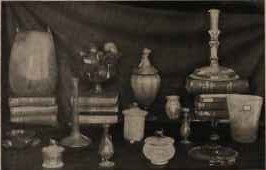
Venerian Glass, Antique and Modern
The criticism that mirrors in men's bathrooms are necessarily an effeminate touch, can be refuted by the statement that so sturdy a soldier as the Great Napoleon had his dressing room at Fontainebleau lined with them! This fact reminds us that we have recently seen a most fascinating bathroom, planned for a woman, in which the walls and ceiling are of glass, cut in squares and fitted together in the old French way. Over the glass was a dull-gold trellis and twined in and out of this, ivy, absolutely natural in appearance, but made of painted tin. The floor tiles, and fixtures were white enamel, and a soft moss-green velvet carpet was laid down when the bath was not used.
Bathroom fixtures are to-day so elaborate in number and quality, that the conveniences one gets are limited only by one's purse. The leading manufacturers have anticipated the dreams of the most luxurious.
Window-curtains for bathrooms should be made of some material which will neither fade nor pull out of shape when washed. We would suggest scrim, Swiss, or China silk of a good quality.
When buying bath-mats, bath-robes, bath-slippers, bath-towels, wash-cloths and hand-towels, it is easy to keep in mind the colour scheme of your rooms, and by following it out, the general appearance of your suite is immensely improved.
For a woman's bathroom, Venetian glass bottles, covered jars and bowls of every size, come in opalescent pale greens and other delicate tints. See Plate XI. Then there are the white glass bottles, jars, bowls, and trays with bunches of dashing pink roses, to be obtained at any good department store. Glass toilet articles come in considerable variety and at all prices, and to match any colour scheme; so use them as notes of colour on the glass shelves in your bathrooms. Here, too, is an opportunity to use your old Bristol or Bohemian glass, once regarded as inherited eyesores, but now unearthed, and which, when used to contribute to a colour scheme, have a distinct value and real beauty.
To-day a bathroom is considered the necessary supplement to every bedroom in an apartment or house, where the space allows, and no house is regarded as a good investment if built with less than one bath to communicate with every two rooms. Yet among the advertisements in the New York City Directory of 1828 we read the following naive statement concerning warm baths, which is meant in all seriousness. It refers to the "Arcade Bath" at 32 Chambers Street, New York City.
"The warm bath is more conducive to health than any luxury which can be employed in a populous city; its beneficial effects are partially described as follows:
"The celebrated Count Rumford has paid particular attention to the subject of Warm Bathing; he has examined it by the test of experiments, long and frequently repeated, and bears testimony to its excellent effects. 'It is not merely on account of the advantages,' says the count,'which I happen to see from Warm Bathing, which renders me so much an advocate of the practice; exclusive of the wholesomeness of the warm bath, the luxury of bathing is so great, and the tranquil state of the mind and body which follows, is so exquisitely delightful, that I think it quite impossible to recommend it too highly, if we consider it merely as a rational and elegant refinement. The manner in which the warm bath operates, in producing the salutary consequences, seems very evident. The genial warmth which is so applied to the skin in the place of the cold air of the atmosphere, by which we are commonly surrounded, expands all those very small vessels, where the extremities of the arteries and veins unite, and by gently stimulating the whole frame, produces a full and free circulation, which if continued for a certain time, removes all obstructions in the vascular system, and puts all the organs into that state of regular, free, and full motion which is essential to health, and also to that delightful repose, accompanied by a consciousness of the power of exertion, which constitutes the highest animal enjoyment of which we are capable.'
Part of a room in a small suite where the furniture is all old and the majority of it Empire in style. However, the small piano at once declares itself American Empire. The beautifully decorative nameplate on its front reads, "Geib & Walker, 23 Maiden Lane, N. Y." The date of piano is about 1830.
The brown mahogany commode on the right has the lion's claw-feet, and pilasters are topped by women's heads in bronze. This piece was bought in France. It has the original marble top, dark pink veined with white. The knobs on drawers are bronze lions' heads, holding rings in their mouths. Chairs are Italian and between Directoire and Empire.
The table, a good specimen, was also found in France. On the table is a French vanity mirror, Louis XVI in time, very Greek in design. The mirror is on both sides and turns on a gold arrow which pierces it. The bronze frame of mirror has a design so intricate in detail that it resembles lace work.
The vase on the piano is Empire and antique, decoration of green and gold. The flowers on table are artificial, a quaint Victorian contrast.
Through the doorway one sees the end of an Empire bed which came from an old chateau in Brittany. Note the same pilasters as on bureau, only that in this case the woman's head is gilded wood and two little feet of gilded wood appear at base of mahogany pilaster.
A gilded urn rests on a mahogany post of bed against the wall, the only position possible for beds of this style. The head and foot board are of equal height and alike.
Few Empire beds are now on the market. This one is used with a roll at each end and is covered with genuine Empire satin in six-inch stripes of canary yellow and sage green divided by two narrow black stripes and a narrow white stripe between them.
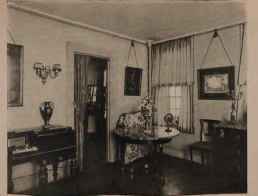
Corner of a Room in a Smalt Empire Suite
"N. B.: As the Bath is generally occupied on Saturday evenings and Sunday mornings, it is recommended to those who would wish to enjoy the Bath and avoid the crowded moment, to call at other times. The support of the public will be gratefully received and every exertion made to deserve it. For the Proprietor, G. Wright.
"Strangers will recognise the Bathing House from the front being extended over two lots of ground, and the centre basement being of freestone."
The bathtub then was the simple tin sort, on the order of the round English tub. To-day the variety of bathtubs as to size, shape, material and appointments is bewildering; tubs there are on feet and tubs without feet, tubs sunken in the floor so that one goes down steps into them, tubs of large dimensions and tubs of small, and all with or without "showers," as the purchaser may prefer. Truly the warm baths so highly recommended in Count Rumford's rhapsody are to be had for the turning of one's own faucet at any moment of the day or night I
The Count Rumford in question is that romantic figure, born of simple English parents, in New England (Woburn, Mass., 1753), who went abroad when very young and by the great force of his personality and genius, became the power behind the throne in Bavaria, where he was made Minister of War and Field Marshal by the Elector, and later knighted in recognition of his scientific attainments and innumerable civic reforms. There is a large monument erected to the memory of Count Rumford in Munich. He died at Auteuil, France, in 1814.
Continue to:


My Books

