


Chapter XIX. The Periods Of The Three Louis
Description
This section is from the book "The Art Of Interior Decoration", by Grace Wood, Emily Burbank. Also available from Amazon: The Art of Interior Decoration.
Chapter XIX. The Periods Of The Three Louis
THE only way to learn how to distinguish the three Louis is to study these periods in collections of furniture and objects of art, or, where this is impossible, to go through books showing interiors of those periods. In this wayone learns to visualise the salient features of any period and gradually to acquire a feeling for them, that subtle sense which is not dependent wholly upon outline, decoration, nor colour, but upon the combined result.
French writers who specialise along the lines of interior decoration often refer to the three types as follows:
Period of Louis XIV - heavily, stolidly masculine;
Period of Louis XV - coquettishly feminine; Period of Louis XVI - lightly, alertly masculine.
One soon sees why, for Louis XIV furniture does suggest masculinity by its weight and size. It is squarely made, straight (classic) in line, equally balanced, heavily ponderous and magnificent. Over its surface, masses of decoration immobile as stone carving, are evenly dispersed, and contribute a grandiose air to all this furniture.
There was impressive gallantry to the Louis XIV style, a ceremonious masculine gallantry, while Louis XV furniture - the period dominated by women when "poetry and sculpture sangof love" and life revolved about the boudoir - shows a type entirely intime, sinuously, lightly, gracefully, coquettishly feminine, bending and courtesying, with no fixed outline, no equal balance of proportions. Louis XV was the period when outline and decoration were merged in one and the shell which figured in Louis XIV merely as an ornament, gave its form (in a curved outline) and its name "rococo" (Italian for shell) to the style.
As a reaction from this we get the Louis XVI period, again masculine in its straight rigidity- of line, its perfectly poised proportions, the directness of its appeal to the eye, a "reflection of the more serious mental attitude of the nation." Louis XVI had an aristocratic sobriety and was masculine in a light, alert, mental way, if one can so express it, which stimulates the imagination, in direct contrast to the material and literal type of Louis XIV which, as we have said, was masculine in its ponderous magnificence, and unyielding over-ornamentation.
So much for outline. Now for the decoration of the three periods.
Remember that the Louis XIV, XV and XVI periods took their ideas for decoration from the Greeks, via Italy, and the extreme Orient A national touch was added by means of their Sevres porcelain medallions set into furniture, and the finely chiselled bronzes known as or-moulu, a superior alloy of metals of a rich gold colour. The subjects for these chiselled bronzes were taken from Greek and Roman mythology; gods, goddesses, and cupids the insignia of which were torches, quivers, arrows, and tridents. There were, also, wreaths, garlands, festoons and draperies, as well as rosettes, ribbons, bow-knots, medallion heads, and the shell and acanthus leaf.
One finds these in various combinations or as individual motives on the furniture of the Louis.
Shows the red-tiled entrance hall of a duplex apartment in New York.
On the walls are two Italian mirrors (Louis XVI), a side table (console) of the same epoch, and two Italian carved chairs.

Entrance Hall in New York Duplex Apartment. Italian Furniture
The backgrounds for these mounts were the woods finely inlaid with ivory shell and brass in the style of the Italian Renaissance. Oriental lacquer and painted furniture, at that time heavily gilded.
The legs of chairs, sofas and tables of the Louis XIV period were cabrioles (curved outward) - a development of the animal legs of carved wood, bronze or gold, used by the ancient Assyrians, Egyptians and Greeks as supports for tables and chairs. Square grooved legs also appeared in this type.
The same grooves are found on round tapering legs of Louis XVI's time. In fact that type of leg is far more typical of the Louis XVI period than the cabriole or square legs grooved, but one sees all three styles.
Other hallmarks of the Louis XVI period are the straight outlines, perfectly balanced proportions, the rosettes, ribbon and bow-knot with torch and arrows in chiselled bronze.
That all "painting and sculpture sang of love" is as true of Louis XVI as of Louis XV. In both reigns the colouring was that of spring tender greens, pale blossoms, the grey of mists, sky-blues, and yellows of sunshine.
During Louis XV's time soft cushions fitted into the sinuous lines of the furniture, and as some Frenchman has put it, "a vague, discreet perfume pervaded the whole period, in contrast to the heavier odour of the First Empire."
The walls and ceilings of the three Louis were richly decorated in accordance with a scheme, surpassing in magnificence any other period.
An intricate system of mouldings (to master which, students at the Ecole des Beaux Arts, Paris, must devote years) encrusted sidewalls and ceilings, forming panels and medallions, over-doors and chimney-pieces, into which were let paintings by the great masters of the time, whose subjects reflected the moods and interests of each period. The Louis XV and XVI paintings are tender and vague as to subject and the colours veiled in a greyish tone, full of sentiment.
That was the great period of tapestry weaving - Beauvais, Arras and Gobelin, and these filled panels or hung before doors.
It may be said that the period of Louis XVI profited by antiquity, but continued French traditions; it was a renaissance of line and decoration kept alive, while the First Empire was classic form inanimate, because an abrupt innovation rather than an influence and a development. One may go farther and quote the French claim that the colour scheme of Louis XVI was intensely suggestive and personal, while the Empire colouring was literal and impersonal.
Under Louis XVI furniture was all but lost in a crowd of other articles, tapestry, draperies of velvet, flowered silks, little objects of art in porcelain, more or less useless, silver and ormoulu, exquisitely decorated with a precieuse intricacy of chiselled designs.
The Louis XVI period was rigid in its aristocratic sobriety, for although torch and arrows figured, as did love-birds, in decoration - (souvenirs of the painter Boucher), everything was set and decorous, even the arrow was often the warrior's not cupid's; in the same way the torch was that of the ancients, and when a medallion showed a pastoral subject, its frame of straight lines linked it to the period. Even if Cupid appeared, he was decorously framed or pedestaled.
To be sure, Marie Antoinette and the ladies of her court played at farming in the Park of the Petite Trainon, at Versailles; but they wore silk gowns and powdered wigs. To be rustic was the fad of the day (there was a cult for gardening in England); but shepherdesses were confined to tapestries, and, while the aristocracy held the stage, it played the game of life in gloves.
There was about the interior decoration of Louis XVI, as about the lives of aristocratic society of that time, a "penetrating perfume of love and gallantry," to which all admirers of the beautiful must ever return for refreshment and standards of beauty and grace.
Speaking generally of the three Louis one can say that on a background of a great variety of wonderful inlaid woods, ivory, shell, mother-of-pearl and brass, or woods painted and gilded, following the Italian Renaissance, or lacquered in the manner of the Orient, were ormoulu wrought and finely chiselled, showing Greek mythological subjects; gods, goddesses and their insignia, with garlands, wreaths, festoons, draperies, ribbons, bow-knots, rosettes and medallions of cameo, Sevres porcelain, or Wedgwood paste. Among the lost arts of that time are inlaying as done by Boule and the finish known as Vernis Martin.
This large studio is a marked example of comfort and interest where the laws of appropriateness, practicableness, proportion and balance are so observed as to communicate at once a sense of restfulness.
Here the comfortable antiques and beautifully proportioned modern furniture make an ideal combination of liv-ing-room and painter's studio.
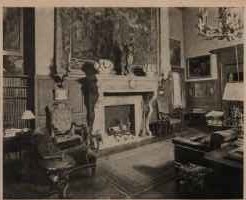
Combination of Studio and Living Room in a New York Duplex Apart-memt
Tapestries and mural paintings were framed by a marvellous system of mouldings which covered ceilings and sidewalls.
The colour scheme was such as would naturally be dictated by the general mood of artificiality in an age when dreams were lived and the ruling classes obsessed by a passion for amusements, invented to divert the mind from actualities. This colour scheme was beautifully light in tone and harmoniously gay, whether in tapestries, draperies and upholstery of velvets, or flowered silks, frescoes or painted furniture. It had the appearance of being intended to act as a soporific upon society, whose aim it was to ignore those jarring contrasts which lay beneath the surface of every age.
Continue to:


My Books

