


Chapter XXXI. Treatment Of A Woman's Dressing-Room
Description
This section is from the book "The Art Of Interior Decoration", by Grace Wood, Emily Burbank. Also available from Amazon: The Art of Interior Decoration.
Chapter XXXI. Treatment Of A Woman's Dressing-Room
EVERY house, or flat, which is at all pretentious, should arrange a Vanity Room for the use of guests, in which there are full-length mirrors, a completely equipped dressing-table with every conceivable article to assist a lady in making her toilet, slip-per-chairs and chairs to rest in, and a completely equipped lavatory adjoining.
The woman who takes her personal appearance seriously, just as any artist takes her art (and when dressing is not an art it is not worth discussion) can have her dressing-room so arranged with mirrors, black walls and strong, cleverly reflected, electric lights, that she stands out with a cleancut outline, like a cameo, the minutest detail of her toilet disclosed. With such a dressing-room, it is quite impossible to suffer at the hands of a careless maid, and one can use the black walls as a background for vivid chair covers, sofa cushions and lamp shades.
Off this dressing-room should be another, given over to clothes, with closets equipped with hooks and shelves, glass cabinets for shoes and slippers, and the "show-case" for jewels to be placed in by the maid that the owner may make her selection.
At the time of the Louis, knights and courtiers had large rooms devoted to the care and display of their wardrobes, and even to-day there are men who are serious connoisseurs in the art of clothes.
The dressing-table should be constructed of material in harmony with the rest of your furniture. It may be of mahogany, walnut, rose wood, satin wood, or some painted variety, or, as is the fashion now, made of silk, - a seventeenth and eighteenth century style (in vogue during the time of the Louis). These are made of taffeta with lace covers on top, and in outline are exactly like the simple dotted-swiss dressing-tables with which every one is familiar, - the usual variety, so easily made by placing a wooden packing box on its side. In this case have your carpenter put shelves inside for boots, shoes and slippers. The entire top is covered with felt or flannel, over which is stretched silk or sateen, in any colour which may harmonise with the room. A flounce, as deep as the box is high, is made of the same material as the top, and tacked to the edges of the table-top. Cover the whole with dotted or plain swiss. A piece of glass, cut to exactly fit the top of the table, is a practical precaution. A large mirror, hung above yet resting on the table, is canopied in the old style, with the same material with which you cover your dressing-table.
Interior decoration not infrequently leads to a desire to chic the appearance of one's "out-of-doors." We give an example of a perfectly commonplace barn made interesting by adding green latticework, a small iron balcony, an ornamental gate and setting out a few decorative evergreens. Behold a transformation!
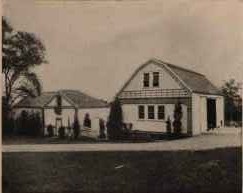
A commonplace Barn Made Interesting
If the table is made of the beautiful taffeta, now so popular for this purpose, as well as for curtains, it is, of course, not covered with swiss or lace, except the top, on which is used a fine, handmade cover, of real lace and hand embroidery, in soft creams, - cream from age, or a judicious bath in weak tea. The glass top laid over this cover protects the lace.
If the table has drawers, each can be neatly covered with the taffeta, as can the frame of any table. A good, up-to-date cabinet-maker understands this work as so much of it is now done.
Continue to:


My Books

