


Chapter VII. The French Renaissance And The French Styles
Description
This section is from the book "Interior Decoration: Its Principles And Practice", by Frank Alvah Parsons. Also available from Amazon: Interior Decoration: Its Principles and Practice.
Chapter VII. The French Renaissance And The French Styles
GOTHIC art was indigenous to the soil of France. By temperament, association and practice the French people were the logical ones to accept, mature and express the Gothic idea. Unhampered for the most part by classic traditions, unfettered by a strong national expression, and still in a somewhat formative state, they accepted in the tenth, eleventh and twelfth centuries the material which blossomed and bore fruit in the twelfth, thirteenth and fourteenth centuries.
Gothic as an expression - particularly in architecture and furnishings - was an idea foreign to England and Italy, and by them expressed with a very strong tinge of national colouring. This betrays the national difference quite as strongly as it emphasizes the original Gothic formulation. Having matured and expressed the Gothic idea, the flower of its expression was found in cathedrals, monasteries, libraries, and in some details of the palaces of the king and of the highest nobles. So far as general domestic architecture, furnishings and decorative material are concerned, little remains, and probably little was produced, up to the time of Louis XII in the late fifteenth century.
On the other hand, the Renaissance, with all it signified, was indigenous to the Italian soil because Italy was the home of classic and Roman traditions and everything classic in form was acceptable as an expression of that tradition. In France, however, the Renaissance was an affected style, as it was also in England and the northern European countries. It must necessarily be so, equally, in this country and at this time.
Consumed with the Gothic idea and having exhausted in ecstasy the materials necessary in telling its story, the French were ready by 1495 for a new idea. Earlier periods had seen the Crusades, and those taking part in them had passed through the land of the Renaissance into the influence of the Orient and, naturally, they had brought back with them to France more or less of the feeling which they had unconsciously absorbed. They also brought back souvenirs of these strange civilizations, and gradually public notice was drawn to the difference between their own products and these foreign forms of expression.
Louis XII, in his Italian campaign, grasped more than had any of his predecessors of the advanced state of civilization in that country and the forms in which this was expressed. His followers, too, returned with more and more accumulated souvenir material, some forms of which were applied to the Gothic background of the palaces in France. He may, therefore, be styled the forerunner of the Renaissance in France.
The Renaissance really began with Francis I who came to the throne in 1515. By birth, association, temperament and disposition he was of the quality likely to demand change, refinement, a more or less flippant expression of social ideals, and a fulness of beauty in social expression which the pure Gothic idea forbade. Three great influences were set in motion by Francis I, which changed the whole complexion and direction of French endeavour and worked out the two great periods in French art which may be called the French Renaissance and the French period styles.
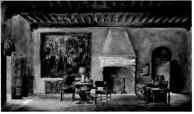
(A.) SKETCH SHOWING THE EARLY ITALIAN RENAISSANCE ADAPTED TO THE COMFORTS OF A MODERN LIVING-ROOM, BUT RETAINING THE QUALITIES OF FORMALITY, STRENGTH AND RESTFUL ARRANGEMENT.
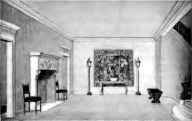
(B.) LATER ITALIAN RENAISSANCE ADAPTED IN LIGHTER SCALE TO A MODERN HALL. THIS POSSESSES THE SAME QUALITY OF REPOSE. RESTRAINT AND FORMALITY.
The first of these influences was the change in religious viewpoint during his reign. Instead of the concentration on religious idealism which characterized the earlier centuries, he focussed his thought and spent his time and his energy as well as that of his associates upon the development of the commercial social ideal. This phase of life involved the turning of constructive creative energies into the channels of architecture, furnishings and decoration, in order to satisfy its new demands.
Naturally, since Gothic was the expression of the centuries already past, he turned his attention to the cultivation and promulgation of the newer ideas of the Italian Renaissance. He visited Italy and saw for himself, persuaded artists to leave their country, furnished materials and directed forces - all to the attainment of this end.
The second modifying influence was the change which resulted in the social or domestic ideal. The strict adherence to the family vows and all that that entails had been the social ideal of the earlier national development. Francis, by openly inviting to court the most beautiful, cultured and fascinating women of the land, and by choosing successively the companionship of one or more of these to the exclusion of the rights of the queen, developed a new attitude toward social and domestic relations. This social change reached its culmination in the days of Louis XV in the eighteenth century. This difference in the power and place of woman in social and court life led to wild extravagances, and the most ingenious methods were employed to obtain new and subtle art expressions for the satisfaction of each favourite as she, in turn, enjoyed the royal favour.
Art, from this time on became, in France, more or less an art for women. Each epoch showed to a great extent the striving of artists in every field for something extravagant and beautiful which should be suited to the taste and refinement of Milady, whoever she might be. This fact places the French Renaissance and the French period styles at once in a category by themselves, their qualities being quite individual when compared with those of other nations.
Continue to:


My Books

