


The French Renaissance And The French Styles. Part 2
Description
This section is from the book "Interior Decoration: Its Principles And Practice", by Frank Alvah Parsons. Also available from Amazon: Interior Decoration: Its Principles and Practice.
The French Renaissance And The French Styles. Part 2
The third influence was the rapidity with which France was organized, politically and socially, during this reign and, through the extension of commerce and international association, the accumulation of wealth which was lavishly expended in the social lines before indicated.
It is not our intention here to enter into details of the period of the Early Renaissance in France, but to set in motion certain ideas which account for the maturity of the French styles as we know them and lead up to an appreciation of the value of these styles in modern decoration.
The French Renaissance may be said to include the time from the accession of Francis I in 1515 to the accession of Louis XIII in 1610, and was developed largely during the reign of Francis I, Henry II and Henry IV. The short reigns of Francis II and Henry III have made so little impress on art styles that they are not worth mentioning in this connection.
The reign of Francis I, Henry II and Henry IV, however, are each dominated by particular ideas, and still the fundamental influences are the change in religious attitude, the birth and development of the new social ideas and practices, and the commercial relationships which made possible the rapid advancement in every line of creative endeavour.
It must be remembered here that there are three stages of development in all art periods. They may be called the Early, the High and the Decline. We look to the Early period for the finest expression of sane idealism which the period gives, to the High period for the rich, full, material display demanded by the principles which control the inception of the thought, and to the Decline for the complete materialization of the original idea with the loss of simple constructive necessities in the deluge of ornament and ostentatious display. We find also in the Decline an injection of materialistic, physical idealism where the aesthetic or the spiritual idea had dominated the original thought.
The period of Francis I represents the first idealism of the Renaissance in France. It may be said to express in its entirety the best period of the Italian Renaissance modified first by the temperamental qualities of the French people and then by the personality of Francis I and his immediate associates. Its architecture represents a tremendous step in the evolution of modern luxury and comfort. Its decorative appearance embodies the laws of decorative choice and arrangement sensed keenly and worked out in the adaptation of the best statement of Italian Renaissance forms. The textiles and textures are the expression of the fairly restrained, though beautifully decorated, ideas of the Middle Renaissance. The development of furniture was intensely interesting because the two new ideas, of beauty for the senses and of comfort for the body, were vying with each other for new fields in which to exercise the lately awakened instincts of a slumbering consciousness.
Tables, chairs, cabinets and chests were modified from the Italian material, scale, construction and combination to the distinctly French, which was smaller, lighter, less dignified, more domestic and less formal. In all other fields of endeavour the same general qualities of refinement, scope and concrete beauty are clearly felt. This was the beginning of the second great temperamental expression of the French people.
The period of Henry II may be briefly described as a cross between the style Francis I and the Baroque Italian Renaissance, with Francis I and Early Italian ideas strongly prevailing. Added to these two influences was the new Oriental idea, espoused and promulgated by many in the court, including the court favourite Diane de Poitiers. For her and through her came some of the finest expressions in the period of Henry II. Naturally a woman of exquisite taste, of liberal education and unlimited power, it was possible for her to develop, particularly in the interior of houses, the ideas to which the Early period had given birth.
Much of this period was devoted to the advancement of the art of tapestry weaving, wood carving and textile manufacture. At times the art seems to be dominated by the High Renaissance or the early stages of the Decline in Italy. This was due, no doubt, to the influence exercised by the queen - Catherine de Medici - whose ideas and practices were always strictly Italian. She surrounded herself as much as possible with such Italian prelates, workmen and court ladies as would throw the weight of their influence toward Italian expression as opposed to that broadening type which was embraced by Diane de Poitiers. New kinds and more articles of furniture were in demand to satisfy the growing taste for display and comfort. Certain types of chests became cabinets, cabinets became sideboards, sideboards, dressing tables and writing desks, things unheard of in any country, even in Italy at that time. Ornament was a no less prolific field for creative genius.
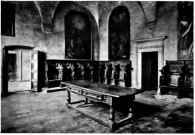
EARLY ITALIAN ROOM EXPRESSING RESTRAINT AND STRENGTH OF THE EARLY MASCULINE TYPE.
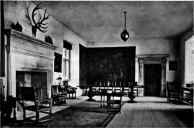
EARLY ENGLISH ROOM EXPRESSING A DISTINCTLY FEELING, BUT LESS RUGGED IN APPEARANCE. FOR MODERN CONSIDERATION THE DEER HEAD MAY BE OMITTED.
The whole range of Italian Renaissance was exploited, resulting in a heaviness, a mixed aggregate, and a collection of forms lacking the delicacy, simplicity and refinement with which the period of Francis I speaks so eloquently. Architecture received little impetus although it became the function of the royal power to complete and add to the great number of buildings begun by Francis I and either left unfinished or found too small adequately to express the needs of his epoch.
Continue to:


My Books

