


Historic Art Periods And The Ideas Which They Represent. Part 2
Description
This section is from the book "Interior Decoration: Its Principles And Practice", by Frank Alvah Parsons. Also available from Amazon: Interior Decoration: Its Principles and Practice.
Historic Art Periods And The Ideas Which They Represent. Part 2
In the working out of these three ideas man has been moved or impelled to create by three distinct impulses. The highest and most important of these may be called the religious or spiritual impulse. Because of his desire to embody his highest ideals of religious duty we have the monuments of Egypt, the beautiful temples of the Greeks, and the cathedrals of the Gothic period.
MEANING OF THE GOTHIC AND HUMANISTIC IDEALS THE SPIRIT, FEELING, OR MEANING OF THE GOTHIC AND HUMANISTIC INFLUENCES AS THEY WERE EXPRESSED IN MATERIALS IS PERHAPS MORE CLEARLY SHOWN IN PAINTING AND TAPESTRY THAN IN ANY OTHER FORM OF ART. THE IDEAL SPIRITUAL DISREGARD OF NATURE'S LAWS AS THEY INFLUENCE THE APPETITES AND SENSES OF MAN APPEARS IN GOTHIC ART EXPRESSIONS. THIS PERIOD IN ITS IDEAL IS THE ECSTATIC, EMOTIONAL, IMAGINATIVE EXPRESSION OF THE SPIRITUAL NATURE AS IT SEEKS TO THROW OFF THE NECESSITY FOR ADHERENCE TO MATERIAL LAW IN THE EXPRESSION OF THE SPIRITUAL OR DIVINE IDEA. IT DOES NOT SEEK TO BE HUMAN FIRST.
THE HUMANISTIC IDEAL SEEKS TO ASSOCIATE IN A RELATIVELY HARMONIOUS WAY THE PRIMAL INTENSIONS OF SPIRIT AND MATERIAL AS THEY ARE EXPRESSED IN PHYSICAL MATERIAL.
IN THE EARLIEST STAGES, WHERE THE SPIRITUAL IDEA WAS DOMINANT, THE RESULTS ARE BEAUTIFUL THOUGH CLEARLY HUMAN. IN THE LATER STAGES, WHERE SELF-GRATIFICATION OF THE SENSES IS THE ACCEPTED PRACTICE, THE EXPRESSION BECOMES EXTRAVAGANT, MIXED, OVER-LUXURIOUS, SENSUOUS, NATURALISTIC AND WHOLLY MATERIALISTIC.
PRECISELY THESE SAME QUALITIES APPEAR IN ARCHITECTURE, FURNITURE, THE LESSER ARTS, AND IN THE CHOICE AND TREATMENT OF ORNAMENT. THIS IS CONFINED TO NO ONE COUNTRY, BUT IS A COMMON INHERITANCE OF ALL PEOPLE POSSESSED OF THE SAME IDEALS.
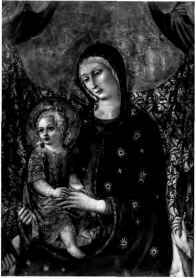
I. AN EARLY SIENESE GOTHIC MADONNA AND CHILD EXPRESSING THE SPIRITUAL QUALITY FIRST, THEN THE AESTHETIC IN CHOICE AND ARRANGEMENT WITH DISREGARD FOR THE PHYSICAL LAWS OK ANATOMY, AGE MARKS AND SO-CALLED PRINCIPLES OF REPRESENTATION. THE RESULT AIMS AT A SPIRITUAL IDEAL EXPRESSED THROUGH MATERIAL.
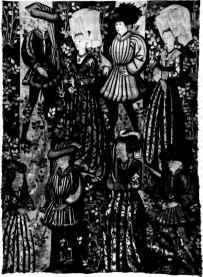
1. AN EARLY TAPESTRY WITH THE GOTHIC SPIRIT AND A DECORATIVE QUALITY MOST APPARENT; BUT THE IMAGINATIVE, CHIVALRIC, SECULAR QUALITIES BEAUTIFULLY COMMINGLED. THE RESULT IS CHARMINGLY DECORATIVE AND SUITABLE TO ITS MATERIAL.
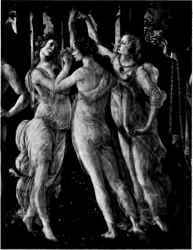
8. A PAINTING WHICH SHOWS PLAINLY THE LINGERING TRACES OF REFINEMENT. IMAGINATIVE AND DECORATIVE QUALITY OF THE GOTHIC IDEA, BUT EXPRESSING FIRST THE IDEAL CHARM OF THE PAGAN CLASSIC HUMANISM AT ITS BEST.
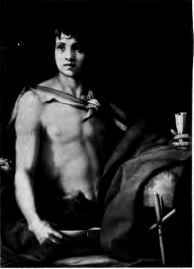
4. A PAINTING WHERE THE APPEAL OF THE SAINT IS ONE OF HUMAN SENTIMENT THROUGH SEEMINGLY DESIRABLE PHYSICAL QUALITIES.
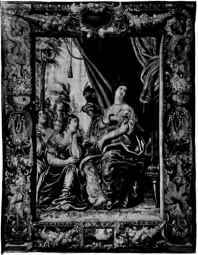
5. A LATER TAPESTRY IN WHICH THE HUMANISTIC IDEAL IS TRIUMPHANT. THE SENSES ARE SUPREME.
When the second, or political impulse prevails, man's greatest energy is bent toward the creation of imposing public structures with accessories which will embody his ideas of political power and will tend duly to impress others with their national strength and importance. The Roman period is perhaps a good example of such domination.
The third impulse to create is found in man's social ideal. Whenever the social idea has been dominant - as it was in the days of the High French Renaissance - then man's energies have been directed toward the creation and expression of all those things which social intercourse and refined social practice seem to make essential.
In this era we live in the grasp of a commercially social impulse, with the leading idea, commercial advancement, dominating even the social quality. This, of course, is the lowest and most inartistic viewpoint possible, since the creation of beautiful things demands a love for those things which is stronger than any mere material gain which can result from their creation. The art standard of the modern period is in consequence less sensitive, less clearly defined and less exalted than perhaps any that has previously existed.
In treating of the three great influences - Hellenic, Gothic and Humanistic - it is essential to get the clearest possible idea of what each of these periods sought to embody. The ancient Greek lived for centuries with one idea in mind - namely, the expression of divinity in perfect material form. Education and practice were both planned to develop the highest standards and the highest ideals of physical expression in the human body and in all material forms that men produced. Greek statuary did not happen to be what it is. Each piece is the concrete embodiment of an idea, the development of which took centuries of inheritance and a nation-wide devotion to the idea that beauty is God, Certain qualities must be held supreme in consciousness in order to bring out those qualities in the materials which man touches. This short treatise cannot point out the analogies which exist between the objects of visual art and the literature or music of the time, but it can indicate some of the qualities of mind necessary to the realization of this perfect, intellectual, unemotional and restrained period expression. With beauty and truth as an ideal expressed in material, the Greek would naturally follow in ideal at least the same plan in the development of the body, in architecture, in ornament, in the utensils commonly used and, in short, in all things which he handled.
Continue to:


My Books

