


Scale, Motifs And Textures As They Relate To Furnishing And Decorating. Part 4
Description
This section is from the book "Interior Decoration: Its Principles And Practice", by Frank Alvah Parsons. Also available from Amazon: Interior Decoration: Its Principles and Practice.
Scale, Motifs And Textures As They Relate To Furnishing And Decorating. Part 4
One sees the same thing in a literary composition. There must be a theme upon which to write, a motif around which all parts of the composition are woven. In decoration there must also be a theme or motif, a something which expresses the fundamental idea but which is changed, enlarged, broadened, coloured, cut, added to, and finally, with all its parts, woven into a decorative whole.
The decorative motif as it refers to ornament may be said to originate in one of two sources: the first source, nature, is one from which many periods have taken their inspiration and which some periods have misused, since by their treatment in materials nature lost its own individuality and was misrepresented in the attempt to make decoration nature.
On the other hand, nature did not become decoration. As Goethe has said, "Art is art because it is not nature." Therefore, to become art or decoration, nature must lose its fundamental characteristics. This is one of the most difficult things to grasp in the whole realm of decorative art. So thoroughly are people - and it is right that they should be - imbued with a love for nature as nature, that it is impossible for them to leave nature to nature's realm and to realize that nature cannot, as nature, be art, since nature is God's realm and art is man's.
It is man's function to select from nature bits of the great whole and to arrange them for his needs in an artistic way. This he may do in his garden, his grounds, or in a vase on his library table, but it is not his function in foreign materials to attempt to make his garden or his grounds or his vase of flowers look as they would look or did look when they were created in their own natural environment as a part of the scheme of nature rather than of man's adaptation of it. So long, therefore, as a rose is a rose, whether it is in the garden or on the table, it looks practically the same; but its appearance is very different as a rose, or as one of two or three roses, in a vase on the table, from what it was as one of five hundred or a thousand on a bush, where the environment of the bush had also its effect.
This is not so hard to see, however, as the next step in which the rose is to be translated into a carpet, a damask or a painted dish. While it is possible for the rose to become decorative in the vase, it is impossible for it to be so if man attempts to create a rose, exactly as God created it, and do so with wool, silk or china.
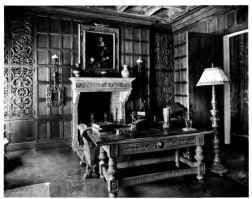
LIVING-ROOM, ILLUSTRATING A PARTICULARLY FINE SENSE OF SCALE RELATIONS IN DECORATIVE MOTIFS. COMPARE THE SCALE OF WALL CARVING WITH CHIMNEY PIECE, PICTURE FRAME, TABLE, LAMP, HANGINGS AND RUGS. THIS CHOICE PRODUCES A HARMONY OF SEQUENCE, IMPOSSIBLE WHEN DISREGARDED. ALSO NOTICE SIMPLICITY IN TREATMENT OF CEILING AND PANELS, THEREBY MAKING OTHER DECORATIVE FEA.
To be sure, the wax flowers of fifty years ago were nearer like nature than the hair ones of seventy-five years ago or the shell ones of one hundred years ago, but, for my part, of the three I believe the shell ones to be the most decorative, for they, at least, had the distinction of not looking like that which they were not. As sincerity is the first principle of art, I see in them some possibility of decorative effect.
Nature, then, is the first source from which decorative ornament has been drawn, and such ornament is called naturalistic ornament. Volumes could be written on what has happened in every field of art expression when nations have drawn their ideals from naturalism. Then idealism has given place to realism, symbolism to naturalism, while spirituality and aestheticism have given place to materialism and sensualized nature.
This is not the place to discuss the philosophy of the naturalistic ornament, but it readily will be seen what happens when a nation has reached a point where its natural life interests find their best expression in purely naturalistic ornamental forms. Perhaps one might cite the Roman Empire, the high period of the French Renaissance, the naturalistic Victorian period in England, and the black walnut and painted china periods in the United States.
The second source for ornament is found in the abstract idea. The Greeks, through centuries of evolution, produced ornament of pure form. Its beauty is in its proportion, in the exquisite relationships of abstract sizes, shapes and lines. It never was nature and never purported to be. Its charm, which is classic, lies in its impersonality or. abstraction and in its exquisite abstract relationships.
The Mohammedans evolved for religious reasons an Arabesque system of ornament in which no natural motif is found. Its surface charm, which is undeniable, is due to the intricate relationships of abstract motifs in which naturalism has played no part and nature has not been defamed. Other periods, following these two early ones, have also developed abstract ornament which never was and never purported to be natural in its origin.
These two sources, symbolically and decoratively, are the well springs out of which human ingenuity has created ornament shapes through all ages. Man's love for nature and nature's forms of expression, together with his religious ideals which connect natural objects with the divine idea, has introduced nearly always into the art of nations animal and plant forms as a part of their decorative plan.
The ancient Egyptians used the human figure, birds, animals, and trees, each representing an externalized divinity as a part of their hieroglyphic scheme. They treated these objects in flat single tones drawn without perspective and modified in form, size and shape in such a way that they fitted rather pleasingly together and assumed a somewhat decorative appearance.
The Assyrians were wont to use chariots, human beings and implements of war to illustrate their caste systems and various social forms in bas relief. In this manifestation of their art they used many of nature's symbols.
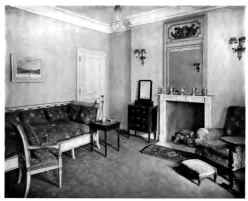
WOMAN'S SITTING-ROOM IN MODERN STYLE, EXPRESSING A PERSONALITY OF REFINEMENT, RESTRAINT, CONSISTENCY AND COMFORT. GOOD MIRROR AND PICTURE FRAMES. SHAPE AND SIZE OF PICT1RE GOOD. SCALE OF TEXTILE MOTIFS EXCELLENT.
Continue to:


My Books

