


Chapter XIII. Furniture
Description
This section is from the book "Principles Of Home Decoration With Practical Examples", by Candace Wheeler. Also available from Amazon: Principles of Home Decoration.
Chapter XIII. Furniture
ALTHOUGH the forms and varieties of furniture are infinite, they can easily be classified first into the two great divisions of good and bad, and after that into kinds and styles; but no matter how good the different specimens may be, or to what style they may belong, each one is subject again to the ruling of fitness. Detached things may be both thoroughly pleasing and thoroughly good in themselves, but unless they are appropriate to the place where, and purpose for which they are used, they will not be beautiful.
It is well to reiterate that the use to which a room is put must always govern its furnishing and in a measure its colour, and that whatever we put in it must be placed there because it is appropriate to that use, and because it is needed for completeness. It is misapplication which makes much of what is called "artistic furnishing" ridiculous. An old-fashioned brass preserving-kettle and a linen or wool spinning-wheel are in place and appropriate pieces of furnishing for a studio; the one for colour, and the other for form, and because also they may serve as models; but they are sadly out of place in a modern city house, or even in the parlour of a country cottage.
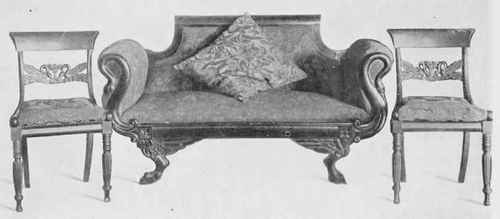
COLONIAL CHAIRS AND SOFA (BELONGING TO MRS. RUTH MC ENERY STUART).
We all recognise the fact that a room carefully furnished in one style makes a oneness of impression; whereas if things are brought together heterogeneously, even if each separate thing is selected for its own special virtue and beauty, the feeling of enjoyment will be far less complete.
There is a certain kinship in pieces of furniture made or originated at the same period and fashioned by a prevailing sentiment of beauty, which makes them harmonious when brought together; and if our minds are in sympathy with that period and style of expression, it becomes a great pleasure to use it as a means of expression for ourselves. Whatever appeals to us as the best or most beautiful thought in manufacture we have a right to adopt, but we should study to understand the circumstances of its production, in order to do justice to it and ourselves, since style is evolved from surrounding influences. It would seem also that its periods and origin should not be too far removed from the interests and ways of our own time, and incongruous with it, because it would be impossible to carry an utterly foreign period or method of thought into all the intimacies of domestic life. The fad of furnishing different rooms in different periods of art, and in the fashion of nations and peoples whose lives are totally dissimilar, may easily be carried too far, and the spirit of home, and even of beauty, be lost. Of course this applies to small, and not to grand houses, which are always exceptions to the purely domestic idea.
There are many reasons why one should be in sympathy with what is called the "colonial craze"; not only because colonial days are a part of our history, but because colonial furniture and decorations were derived directly from the best period of English art. Its original designers were masters who made standards in architectural and pictorial as well as household art. The Adams brothers, to whom many of the best forms of the period are referable, were great architects as well as great designers. Even so distinguished a painter as Hogarth delighted in composing symmetrical forms for furniture, and preached persistently the beauty of curved instead of rectangular lines. It was, in fact, a period in which superior minds expressed themselves in material forms, when Flaxman, Wedgwood, Chippendale and many others of their day, true artists in form, wrote their thoughts in wood, stone, and pottery, and bequeathed them to future ages. Certainly the work of such minds in such company must outlast mere mechanical efforts. It is interesting to note, that many of the Chippendale chairs keep in their under construction the square and simple forms of a much earlier period, while the upper part, the back, and seats are carved into curves and floriated designs. One cannot help wondering: whether this square solidity was simply a reminiscence or persistence of earlier forms, or a conscious return to the most direct principles of weight-bearing constructions.
All furniture made under primitive conditions naturally depends upon perpendicular and horizontal forms, because uninfluenced construction considers first of all the principle of strength; but under the varied influences of the Georgian period one hardly expects fidelity to first principles. New England carpenters and cabinet-makers who had wrought under the masters of carpentry and cabinet-work in England brought with them not only skill to fashion, but the very patterns and drawings from which Chippendale and Sheraton furniture had been made in England. Our English forefathers were very fond of the St, Domingo mahogany, brought back in the ship-bottoms of English traders, but the English workmen who made furniture in the new world, while they adopted this foreign wood, were not slow to appreciate the wild cherry, and the different maples and oak and nut woods which they found in America. They were woods easy to work, and apt to take on polish and shining surface. The cabinetmakers liked also the abnormal specimens of maple where the fibre grew in close waves, called curled maple, as well as the great roots flecked and spotted with minute knots, known as dotted maple.
All these things went into colonial furniture, so beautifully cut, so carefully dowelled and put together, so well made, that many of the things have become heirlooms in the families for which they were constructed. I remember admiring a fine old cherry book-case in Mr. Lowell's library at Cambridge, and being told by the poet that it had belonged to his grandfather. When I spoke of the comparative rarity of such possessions he answered: "Oh, anyone can have his grandfather's furniture if he will wait a hundred years!"
Continue to:


My Books

