


A Word Before Beginning
Description
This section is from the book "Box Furniture", by Louise Brigham. Also available from Amazon: Box Furniture.
A Word Before Beginning
To avoid repetition in the descriptions, directions applying in common to all the various articles are here given, together with a few brief hints to help make the way smooth.
Selection Of The Box
The appearance of the completed articles made from the various boxes called for in this book will depend very much upon one's ability to obtain boxes that are in good condition. Therefore, select the best, discarding those that are out of shape and have serious blemishes, such as brands burned on their surface, knotholes, or other serious defects which will be difficult to obliterate. Many boxes are now made having "dovetailed" corners. If a side or an end is to be removed, this kind of box must be rejected.
Size Of The Box
The size given in the requirements is the actual outside dimensions of the box named. A box of equal size under another name (and there are many, as boxes of every imaginable size and shape are made) will generally do quite as well, and in many instances boxes not the exact size specified, but nearly so, can be used. The size called for, however, is about the size necessary to obtain the proper proportion of the article to be made.
Disjointing The Box
When the box is to be partially or entirely taken apart, first remove the cover, then loosen the joints slightly by gently tapping on the inside close to the joint to be severed until the nails are "started." Then tap the side or bottom (as the case may be), and from the outside withdraw the nail with the hammer claw. The box will readily come apart if both the cover and the bottom are removed.
It is sometimes necessary to take the box entirely apart, and plane its sections in order to remove serious blemishes and enhance its appearance, and put it together again. If the box is to be used with the side or end removed, it is better to withdraw too many rather than too few nails. Then close up and re-nail the joints and fasten the cover on again.
Corner Trim And Legs
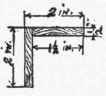
The method of making the corner trim and legs is the same for all the articles. They are always made of a narrow and a wider strip nailed together to form a right angle (regardless of their length, although size of material called for varies), each side of the angle measuring alike. In joining them together, use small nails or large brads 11/2 inches long, driven about 4 inches apart.
Nailing
When nailing together the various parts, it is well to drive the nails so that their points will remain hidden. In joining boxes, the nails are driven from the inside of one box through its side, end, or bottom (as the case may be), into and through the abutting portion of the adjoining box. Use nails of the right length to project 1/8 of an inch or more inside of the latter box, where the points should be bent over at a right angle, which is termed "clinching the nail.' The size of the nails for the various pieces and the distance apart they should be spaced must be a matter of individual judgment of the worker; generally speaking, however, a nail having a length equal to the combined thickness of the parts to be joined is sufficient, unless allowance is to be made for clinching. Use brads when possible, or wire nails with small heads, and with a nail-set and hammer drive their heads slightly below the surface in order that they may show very little or be entirely hidden.
Finishing Touches
Select good covers for the doors or lids, and smooth the edges and surfaces of each article by planing, scraping, and sandpapering. All objectionable nail-holes near the edges and any similar defects may be filled with a mixture of putty and sawdust or pegs of wood driven in and trimmed off even with the surface. Pure putty will not absorb stain, therefore add as much sawdust as the putty will hold.
Spools sawed in half and screwed on make very good home-made knobs. Serviceable buttons for the doors can be easily made of wood if desired. The prepared paints and varnishes sold in most of the paint-stores make an excellent finish. Flat stains of the dark hues are also very good, but the light ones are too transparent and will not cover well.
Decoration
The simple motifs shown in the several interiors are an adaptation of the "Hoffmann method" of utilizing the square as the basic principle in decoration. They are shown in combinations of two or more squares, or parts of the same, as in the Nursery Interior. This method makes it possible to have attractive rooms decorated in a simple manner without any especial art training. It may be so applied that nail-heads and other imperfections will be less conspicuous, as shown in the Kitchen Interior. It may also be effectively woven into rugs, appliqued or stenciled on the table-covers and hangings, and stenciled on the side walls.

The Rough Material Arrives.
Tools
The hammer is the most useful of all the tools required, therefore get a good one, a carpenter's claw-hammer, selecting one with a claw that will draw nails that project but slightly above the surface. The tools necessary to make the simple articles are named first, and others may be added from time to time, as the opportunity offers:
1 Three-foot Folding Rule
1 Adz-eye Claw-hammer, 16 oz.
(Hammond's No. 3) 1 Cross-cut Saw, 20 in. 1 Rip-saw, 20 in. 1 Stanley Iron Block Plane,
No. 91/2 1 Brad-hammer, 4 oz. 1 Drawing-knife, 8 in. blade
1 Hardened-blade Try-square,
10 in.
2 Firmer-chisels, 3/8 in. and 3/4 in.
(Buck Bros.'No. 2) 2 Firmer gouges, 1/4 in. and 1/2 in. 1 Sloyd Knife, No. 7
1 Brace, 8 in. (Barber's No. 223) 3 Auger-bits, 1/2 in., 3/4 in., and 1 in. (Russell Jennings') 1 Iron Pad Keyhole-saw, No. 2 1 Pair Winged Dividers, 6 in. 1 Handled Brad-awl, 11/2 in. 1 Round Knurled Nail-set, 1/16 in. cap 1 Stanley Iron Smooth Plane,
No. 3 1 Round Hickory Mallet, No. 4
1 India Oil-stone, No. 29, in Iron Box
2 Screw-drivers, 3 in. and 8 in. 1 Beech Miter-box, 18 in. long
Note. As boxes of the same make and kind vary slightly in size, and as boxes other than those specified, but of nearly the same size, may be selected, it is deemed wiser to make no attempt to state in figures absolute dimensions for the material (other than the boxes called for) under the head of requirements for each illustration.

The Tool-chest, given to the Author by One Hundred Friends.
Continue to:


My Books

